
Rest Well, Young Patriot: Archeological Discoveries From the Battle of Camden

War is cruel. The Battle of Camden illustrates this, and recent discoveries on that battlefield shed light on the events of Aug. 16, 1780.
Fought in the summer heat of South Carolina’s Midlands, Camden stands as one of the most consequential battles of the American Revolution. Though a disastrous loss for the Patriots, it became a turning point in the Southern Campaign, leading to strategic changes and linked events that resulted in American victory.
Maj. Gen. Horatio Gates, Maj. Gen. Baron Johann de Kalb, and Lt. Gen. Charles, Earl Cornwallis, tower over Camden’s roster of 4,000 patriots and 2,100 British soldiers. One thousand Americans were captured, and 68 died.
After the Americans fled Camden or were captured, the bodies of their dead brothers were left to rot in the extreme elements. Wild animals took care of most of the remains. It is likely that the British forced American prisoners of war to eventually bury what was left of the fallen. The graves were shallow; farmers in Camden were finding human bones well into the 20th century.
In 2020, the South Carolina Battleground Preservation Trust spearheaded recovery efforts at Camden. Archaeologists conducted a metal detector survey of the site. Among the musket balls, buttons, and other battlefield artifacts, they discovered human bones protruding from the ground.
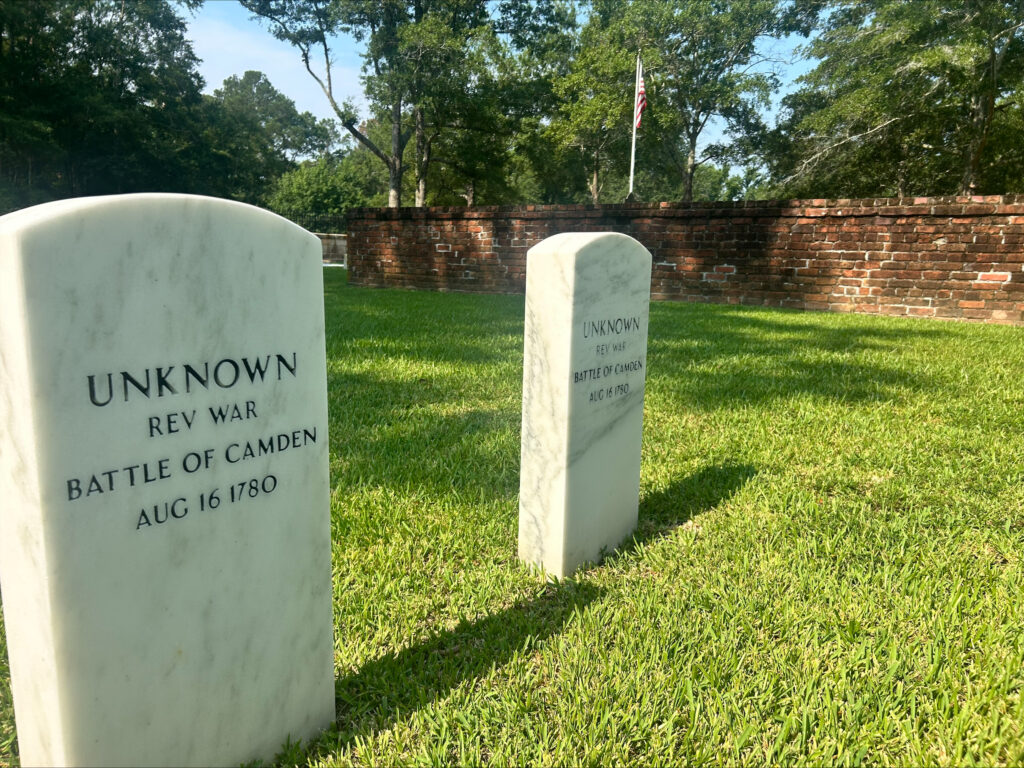
Further excavation revealed the shallow graves of 14 soldiers who fought in the American Revolution. 12 were American, two were British.
TRENDING ARTICLES



Anthropologists arranged for Astrea Forensics, a lab in California that specializes in ancient DNA, to extract and sequence DNA from two of the soldiers. The lab then created the oldest genealogy profiles in their lab’s history, uploading the profiles to GEDmatch and FamilyTreeDNA, databases of genetic profiles of users who have opted into forensic comparisons.
One of the soldiers was referred to at the lab as Camden 9B. The lab was able to extract DNA from a petrous portion of his temporal bone, the hardest, densest bone of the human body found behind the ear at the base of the skull. This revealed his three types of DNA: X chromosome from his mother, Y chromosome from his father, and autosomal from his mother and father.
When his profile was uploaded to GEDmatch and FamilyTreeDNA, 20,000 living relatives were found. These 20,000 represent the descendants of the soldier’s ancestors.
Researchers began to build a genealogical profile, but they were not positive that this experiment would work since so much time had passed; they supposed that the genetic distance would be too great between Camden 9B and his 20,000 living relatives.
To their surprise, the databases showed that the soldier was linked to prominent families in Anne Arundel County, Maryland. Further, they used his three types of DNA to discover the identity of the patriot: teenager John Pumphrey.
Forensic analysts, archivists, and genealogists built a profile of the young soldier and discovered that when John Pumphrey enlisted in the 7th Maryland Regiment in Baltimore in 1777, he was 13 to 15 years old. He was orphaned and could not read or write; he signed his enlistment papers with an X. Records in Maryland indicate that after the deaths of his parents, an older cousin took advantage of young John through the legal system.
The orphan faced financial hardship. Looking to find his way in the world, John became a Continental soldier at Valley Forge with Gen. George Washington. The stories of the winter of 1777-1778 are well known; hunger, cold, nakedness, and disease plagued the camp. John and his fellow Continentals would have experienced it all.
They were trained at Valley Forge by Major General Friedrich Wilhelm von Steuben, a Prussian military officer who transformed the Continental Army. John and the Maryland 7th went on to fight in some of the major battles, including Brandywine, Germantown, Monmouth, and Springfield. Between these battles, John reenlisted and was paid a $100 bonus. Eventually he found himself marching south.
At Camden, one thing after another went wrong for the Americans. Gates marched the soldiers through the hot August night without proper provisions or rest. John’s final moments included chaos and fear as Cornwallis repeatedly outmaneuvered Gates.
After Gates famously fled on horseback, Baron de Kalb heroically led the Maryland and Delaware Continentals on foot, after his horse was shot from under him. De Kalb and John both received mortal wounds.
The British bayoneted many Americans that day, but John’s cause of death cannot be determined as analysis of his remains did not point to a specific injury. What we do know is that John’s bones reveal that he was so young that at his death, the growth plates around his knees had not fully closed.
After the battle, John Pumphrey was listed as missing.
From 6:00 p.m. on April 20, 2023, until the stroke of midnight on April 22, the remains of the Camden 14 lay in repose in the beautiful rooms of the historic Kershaw House near the Camden Revolutionary War Battlefield. Twelve coffins were draped in American flags and two coffins lay under the Union Jack.
At 9:30 a.m. on April 22, horse-drawn caissons carried the coffins to Bethesda Presbyterian Church for a funeral. The remains were brought to the Old Presbyterian Burying Ground, adjacent to the Camden battlefield.
There, the U.S. Army rendered full military honors, including an Apache helicopter flyover. Bagpipes played before American and British military leaders joined South Carolina Gov. Henry McMaster, Rep. Joe Wilson, Rep. Ralph Norman, Camden residents, members of the Sons of the American Revolution, and members of the Daughters of the American Revolution.
Over a dozen of John’s living relatives, representing the 20,000 DNA matches found in the lab, attended. Historian Rick Wise delivered the burial tribute, titled “The Fate That Brings Us Here.”
I recently walked the Camden battlefield and found the new, white granite headstones of the Camden 14. Enveloped in sun and humidity and surrounded by the tall pines of central South Carolina, my own teenage sons came to mind as I reflected on John Pumphrey. John was just 15 to 17 years old when he died fighting for his new nation.
I hope my boys understand the cost of their freedom.
This article is part of a series on the American Revolution in South Carolina, North Carolina, and Georgia.
We publish a variety of perspectives. Nothing written here is to be construed as representing the views of the Daily Signal.

Read the first chapter of The Woketopus right now for FREE
Today, even with President Trump’s victory, leftist elites have their tentacles in every aspect of our government.
The Daily Signal’s own Tyler O’Neil exposes this leftist cabal in his new book, The Woketopus: The Dark Money Cabal Manipulating the Federal Government.
In this book, O’Neil reveals how the Left’s NGO apparatus pursues its woke agenda, maneuvering like an octopus by circumventing Congress and entrenching its interests in the federal government.
You can read the first chapter of this new book for FREE in this eBook, The Woketopus: Chapter One using the secure link below.


The Daily Signal depends on the support of readers like you.
RELATED ARTICLES



Don’t miss the

Don’t miss the signal