
As the United States approaches its 250th anniversary, Charleston, South Carolina, marks the 250th anniversary of Carolina Day on June 28, 2026. This day commemorates the American victory at the Battle of Sullivan’s Island, the first major Revolutionary War success in South Carolina. The triumph boosted patriot morale, rallied support for independence, and helped pave the way toward ultimate victory.
For me, the occasion carries deep personal meaning: My fifth-great-grandfather, James Baggett, helped defend Sullivan’s Island against overwhelming British forces.
In January 1776, American patriots forced British troops out of Charleston (then Charlestown). Determined to restore control, King George III approved a Southern campaign led by Maj. Gen. Henry Clinton, supported by Lord Charles Cornwallis and Commodore Sir Peter Parker.
Charleston was a vital prize. With about 12,000 residents, it was the wealthiest city in the Southern colonies and a major hub for trade in rice, indigo, and enslaved labor. Its economic importance and strong ties to Britain made it strategically essential. British leaders also counted on strong Loyalist support throughout the region.
Patriot leaders understood that losing Charleston would be disastrous. In spring 1776, Col. William Moultrie began constructing a fort on Sullivan’s Island to guard the city’s harbor entrance. Capt. Francis Marion (later called the Swamp Fox) assisted him, while Lt. Col. William “Danger” Thomson defended the island’s opposite end. Among Thomson’s men was my ancestor, James Baggett.
Baggett, a 20-year-old farmer from North Carolina, enlisted in a South Carolina ranger regiment led by Capt. Samuel Wise. The descendant of London-born colonists, he joined an eclectic unit of men from multiple colonies and about 80 Catawba warriors. Largely inexperienced, they quickly found themselves marching to Charleston and preparing for battle.
TRENDING ARTICLES



Their youth and lack of training initially concerned senior officers like Maj. Gen. Charles Lee, but he was impressed by their determination. Soon after their arrival, a British fleet of 10 ships appeared, landing troops on nearby islands. Both sides endured harsh coastal conditions—heat, mosquitoes, rattlesnakes, alligators, and unforgiving terrain—while skirmishes erupted in the days leading up to the battle.
At the same time, enslaved men joined Moultrie’s troops to construct the fort. Built from palmetto logs with sand and clay packed between double walls rising about 16 feet, the structure appeared crude but would prove remarkably effective.
Despite heated disagreements between Lee and Moultrie—Lee favored abandoning the unfinished fort—South Carolina President John Rutledge ordered Moultrie to hold his ground. A deep blue flag with a white crescent, modeled after militia uniforms, flew over the fort.
The British planned a swift seizure of Sullivan’s Island rather than an immediate attack on Charleston. Confident in their naval superiority, they believed the fort would fall quickly. Reconnaissance revealed vulnerabilities, including the soft logs and an incomplete rear wall.
Meanwhile, Lee assumed Charleston itself was the primary target and ordered extensive preparations. Militia and Continental troops gathered, while citizens built barricades and melted lead into bullets.
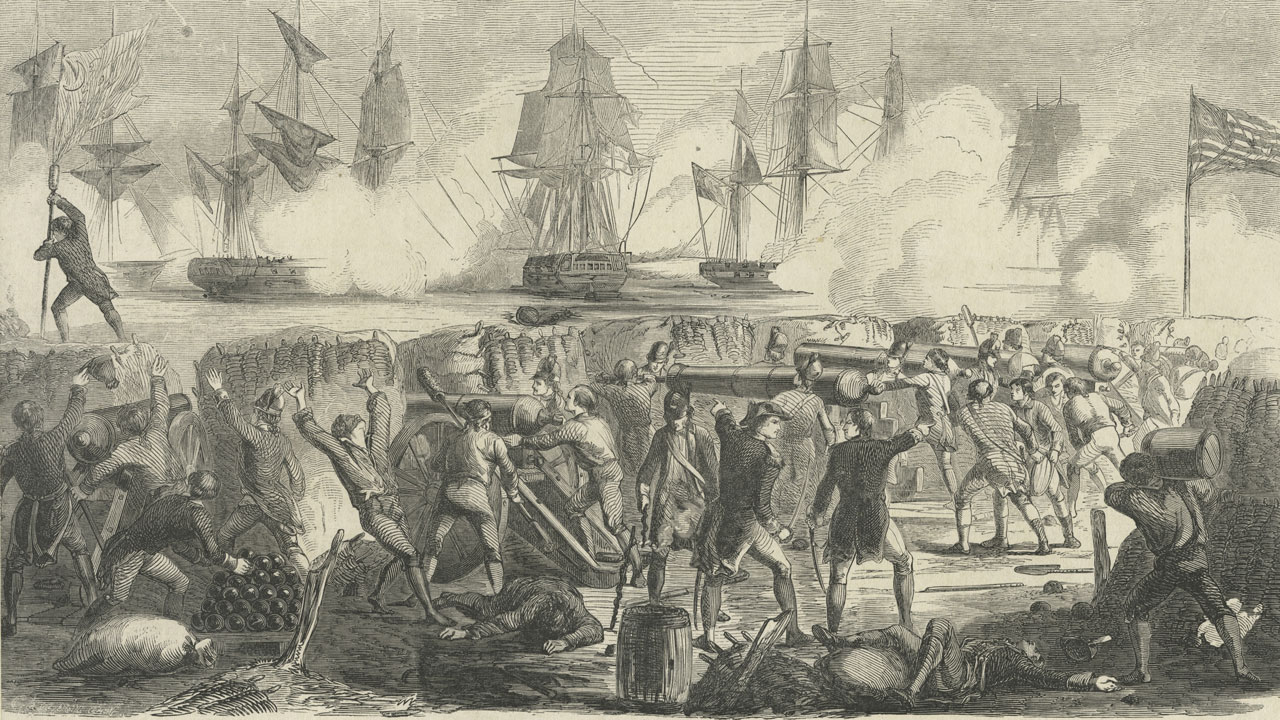
On June 28, 1776, approximately 435 men under Moultrie defended the fort, while Thomson commanded about 780 men on the island’s other end. At around 10 a.m., nine British warships advanced and began bombardment.
The battle lasted about nine grueling hours. Despite the power of the Royal Navy, the Americans held firm. Several factors contributed to their success: poor British communication, difficult tides that stranded ships on sandbars, and disciplined American cannon fire.
Most importantly, the palmetto logs absorbed British cannon fire instead of splintering. Cannonballs that might have shattered traditional wooden walls instead bounced off and landed in the sand. While Moultrie’s men carefully rationed ammunition, Thomson’s forces successfully blocked any land advance.
British losses mounted. What had been expected to be an easy victory became a frustrating and costly engagement. Sir Parker was wounded in his thigh and knee, and his torn britches exposed his backside. What a blow to the British ego!
During the battle, a cannonball knocked down the fort’s flag. Sgt. William Jasper climbed the bastion under fire, retrieved it, and held it high until it could be resecured. His bravery rallied the defenders and reassured observers in Charleston that the fort had not fallen.
Moultrie praised Jasper, and President Rutledge presented him with a sword and offered him an officer’s commission. Jasper declined the commission due to his illiteracy but accepted the sword. He died three years later while similarly rescuing a flag during battle in Savannah.
The flag he saved became known as the Moultrie, or Liberty, Flag and evolved into the South Carolina state flag. The palmetto tree, central to the fort’s defense, later became South Carolina’s state symbol. These remain enduring symbols of resilience and independence.
By nightfall, British forces withdrew, abandoning their attempt to take Sullivan’s Island. American casualties were relatively light—12 killed and 25 wounded—while British losses included 90 killed and 120 wounded.
The victory electrified Charleston. Just days later, on July 4, 1776, the Declaration of Independence was adopted in Philadelphia. When news of Sullivan’s Island victory reached the Continental Congress on July 19, it reinforced confidence in the fight for independence.
Moultrie was honored with a promotion, and the fort was named after him. In 1777, Charlestonians marked the first anniversary with a parade, beginning the long-standing tradition of Carolina Day.
Although the British captured Charleston in 1780, they were eventually forced out in 1782, restoring American control.
Today, Fort Moultrie is preserved as a National Historical Park. The 250th Carolina Day celebration includes reenactments, educational programs, concerts, and commemorative events, including a once-in-a-generation harbor procession. Volunteers have placed 1,000 flags in honor of those who fought and died.
A prayer service will be held at St. Michael’s Church, followed by a parade to White Point Garden at the tip of The Battery. Young men and women will carry American, Moultrie, and Gadsden flags while speakers memorialize Moultrie, Marion, and Jasper. Cannon fire will honor those who gave all.
Carolina Day leads directly into the nation’s Semiquincentennial on July 4, 2026. Across the country, Americans will celebrate with cookouts, music, and fireworks that blend joy with remembrance. From historic cities like Charleston and Philadelphia to communities nationwide, the anniversary offers a moment of unity.
It also invites reflection. We aren’t celebrating 250 years of perfection; we must always work to live up to our founding ideals of liberty, self-governance, and rule of law. The Declaration of Independence articulated unalienable rights that continue to define the nation’s identity. No other nation has this level of freedom and this amount of opportunity.
Simply put, we live in the best country in the history of the world! May we teach our history and our founding values to our children, so that they can celebrate America 300.
As we celebrate and enjoy the fireworks, remember the sacrifices behind these freedoms. The defenders of Sullivan’s Island—farmers, tradesmen, and young men like James Baggett—risked everything for their freedom and for ours. As President Ronald Reagan warned us, freedom is never guaranteed; it must be preserved by each generation.
As America marks 250 years, may we thank God for what He has given us. May we honor those who came before us and commit ourselves to preserving the ideals they championed. Like the patriots of 1776, may we stand together in gratitude and determination.
Happy 250, USA!
We publish a variety of perspectives. Nothing written here is to be construed as representing the views of the Daily Signal.

Read the first chapter of The Woketopus right now for FREE
Today, even with President Trump’s victory, leftist elites have their tentacles in every aspect of our government.
The Daily Signal’s own Tyler O’Neil exposes this leftist cabal in his new book, The Woketopus: The Dark Money Cabal Manipulating the Federal Government.
In this book, O’Neil reveals how the Left’s NGO apparatus pursues its woke agenda, maneuvering like an octopus by circumventing Congress and entrenching its interests in the federal government.
You can read the first chapter of this new book for FREE in this eBook, The Woketopus: Chapter One using the secure link below.
TRENDING ARTICLES


The Daily Signal depends on the support of readers like you.
RELATED ARTICLES




Don’t miss the

Don’t miss the signal
