
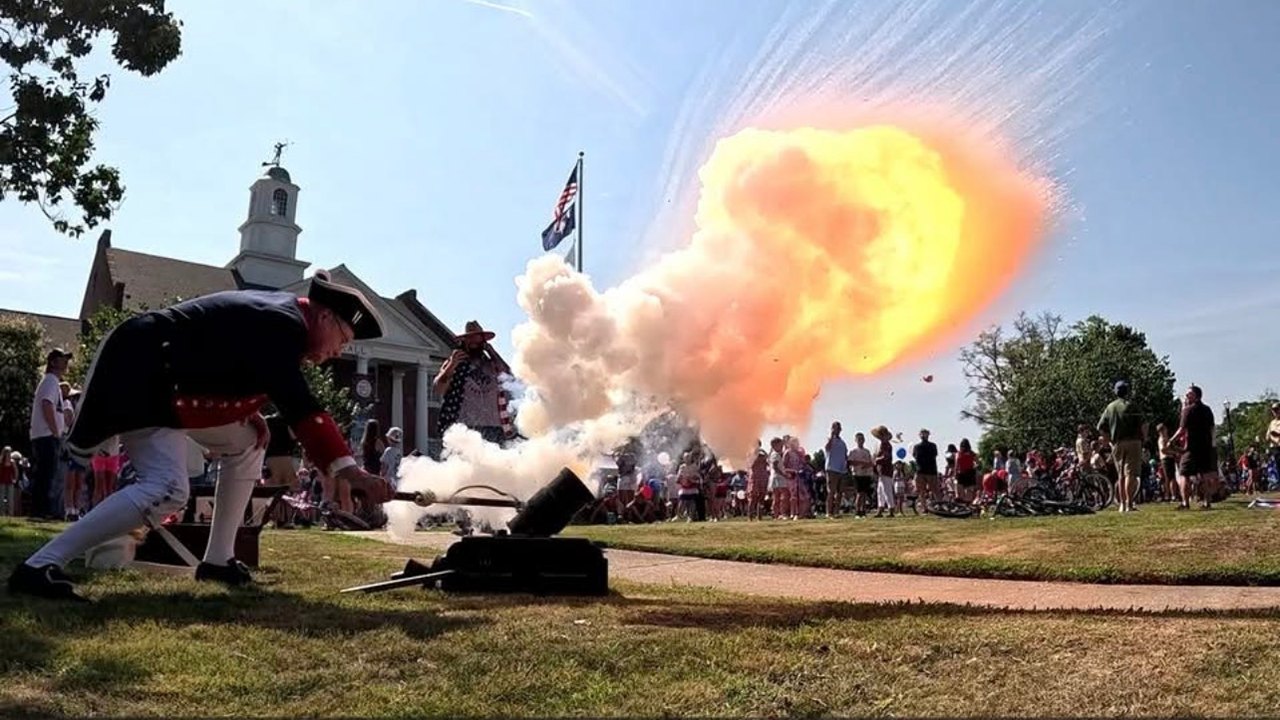
The American Revolution was won in South Carolina. Over 200 battles were fought in the Palmetto State between 1775 and 1782—more than in any other state. South Carolinians understand this, but these facts are often lost in other places. Many of us are working to rectify this as we celebrate the nation’s Semiquincentennial.
After the American victory at the Battle of Sullivan’s Island on June 28, 1776, it was relatively quiet for a year or so in South Carolina. Focus shifted to Brooklyn, Saratoga, Trenton, and Valley Forge. These battles and stories are known by Americans with even a moderate interest in our early history.
But there were crucial events going on at the same time in the South; strategies, suffering, defeats, and victories that led to Yorktown. In 1778, the British launched their “Southern Strategy” by capturing Savannah, Georgia. Despite American patriots fighting heroically, the British became stronger and rallied Loyalist support in the region. American and French forces failed to retake Savannah in 1779.
In the spring of 1780, the British laid siege to Charleston, South Carolina, taking over 5,000 prisoners in the jewel of the American South. This largest defeat of American forces in our Revolution devastated patriots. Out of desperate need for survival, many of them defected to the British due to threats to their families and property. Others held firm but were forced into an underground, covert strategy.
Just three months later, in August 1780, the Battle of Camden dealt our ancestors another bitter blow. Gen. Horatio Gates, the Hero of Saratoga, failed to live up to his reputation that summer in central South Carolina. Without enough provisions on hand, he marched his men through unforgiving terrain and extreme heat.
Accounts exist of the hungry, depleted men being given unripe peaches and green corn for sustenance. Additionally, while many Americans in other regions are used to summer nights bringing the relief of cooler temperatures, August darkness in South Carolina does not bring comfort. Hungry, tired soldiers were ordered to march through the hot night, causing confusion and increasing exhaustion.
TRENDING ARTICLES



Gates misjudged British aggression. When Gates and his men unexpectedly encountered Lord Cornwallis’ army on August 16, they engaged in a brief skirmish. Gates regrouped and then made fatal errors.
Following 18th-century convention, Gates placed his experienced Maryland and Delaware Continentals on the right but failed to anticipate that the British would do the same. This left his inexperienced Virginia militia under Brig. Gen. Edward Stevens on the American left. These men had little training and combat experience, were not accustomed to fighting with bayonets, and had poor discipline.
Cornwallis countered by placing his veteran redcoats opposite the Virginia militia. When the British advanced with bayonets, the Virginians broke and fled, triggering the collapse of the American line.
It is here that Maj. Gen. Johann de Kalb bursts into the story with valor and glory. A German army officer who had married a French heiress, Baron de Kalb joined the American cause with his protégé, the Marquis de Lafayatte. At Valley Forge with George Washington, de Kalb earned the commander in chief’s trust and was given command of the Maryland and Delaware Continentals.
Under Gates’ orders, de Kalb and his men fought stubbornly even as Gates himself fled the field (he rode 200 miles north, something South Carolinians still bitterly discuss). Psychological collapse ensued as many soldiers dropped their weapons and ran in chaos. Maj. Gen. de Kalb’s horse was shot from under him, throwing him to the ground. He continued the fight on foot as he rallied and ordered his brave, disciplined continentals.
Eventually overwhelmed, the patriots were forced to retreat. De Kalb was mortally wounded and died several days later in Camden at age 59, an ocean away from his wife and children.
This revered hero, a foreign friend to the patriot cause, has had cities, counties, streets, parks, schools, military buildings, and warships named in his honor. In 2021, a fine statue of de Kalb was dedicated at Camden’s Revolutionary War Visitor Center.
The defeat at Camden crushed organized Patriot resistance in South Carolina. About 900 Americans were killed or wounded, about 1,000 others were taken prisoner, and British control seemed assured. Additionally, the catastrophe cleared the way for Cornwallis’ invasion of North Carolina.
Camden marked the beginning of the Southern Campaign’s most intense phase in the Carolinas. Amid dangerously low morale, Maj. Gen. Nathanael Greene replaced Gates and deployed new strategies. Francis Marion and Daniel Morgan tantalized the British, setting in motion the chain of events that led to Patriot resurgence and, ultimately, victory at Yorktown. More on that to come.
I lived in South Carolina for several years before visiting Camden. As my son ran a cross-country race around the historic battlefield, I regretted not getting there sooner. South Carolina’s oldest inland city is a charming community that has built a culture around horses, the arts, and its Revolutionary War history.
On July 4, 2026, Camden celebrated the nation’s 250th birthday by inviting children to show their patriotism. Kids and parents braved the heat for a morning parade down Broad Street. Dressed in red, white, and blue and waving American flags, their decorated bicycles and wagons were led by a rendition of William Billings’ 1770s tune “Chester” on fife and drum. A touching 250th anthem celebrating Camden was composed by Ike Pitts, director of music at Grace Episcopal Church, and performed by students.
White, black, male, female, old, and young Americans united for a celebration that will live in memories for decades.
The American spirit is alive in South Carolina.
This article is part of a series on the American Revolution in South Carolina, North Carolina, and Georgia.
We publish a variety of perspectives. Nothing written here is to be construed as representing the views of the Daily Signal.

Read the first chapter of The Woketopus right now for FREE
Today, even with President Trump’s victory, leftist elites have their tentacles in every aspect of our government.
The Daily Signal’s own Tyler O’Neil exposes this leftist cabal in his new book, The Woketopus: The Dark Money Cabal Manipulating the Federal Government.
In this book, O’Neil reveals how the Left’s NGO apparatus pursues its woke agenda, maneuvering like an octopus by circumventing Congress and entrenching its interests in the federal government.
You can read the first chapter of this new book for FREE in this eBook, The Woketopus: Chapter One using the secure link below.




The Daily Signal depends on the support of readers like you.
RELATED ARTICLES



Don’t miss the

Don’t miss the signal