
The U.S. Supreme Court has been asked to decide an issue that could be one of the most watched of the coming court term.
In February, the U.S. Court of Appeals for the 5th Circuit lifted the injunction against a Louisiana law requiring a Ten Commandments display in public school classrooms. In April, the same court upheld a similar Ten Commandments law in Texas, holding that lower courts are no longer bound by the Supreme Court’s 1980 decision in Stone v. Graham.
Opponents of placing the Ten Commandments in classrooms often invoke Stone as if it represents the end of the discussion. But it shouldn’t be. Stone was bad precedent the day it was decided, and the doctrine it rests on no longer exists.
Stone was what is called a summary reversal. The result was a short, unsigned opinion joined by five justices, with four objecting. Justice William Rehnquist noted that what the majority brushed past in rejecting the state’s secular purpose for posting the Ten Commandments in Kentucky schools was that they have had “a significant impact on the development of secular legal codes of the Western World.”
Rehnquist recognized that the Ten Commandments are a foundational moral, literary, and historical text. Their influence on Western legal traditions is widely acknowledged. The Commandments form the basis of much of our modern legal system.
Displaying the Ten Commandments in classrooms is nothing more than a recognition of their historical and cultural importance. Documents and history are not banned in this country because they are religious or have religious content. No school would ban the Rev. Martin Luther King Jr.’s “Letter From a Birmingham Jail” because it is religious.
TRENDING ARTICLES



In fact, a complete education must include instruction on the religious and historical foundations of our country. Without that, students cannot understand the founding of our nation or its system of laws.
When the court decided Stone, it relied primarily on a legal test developed in a 1970s-era case, Lemon v. Kurtzman. But today Lemonis gone. In Kennedy v. Bremerton School District, the court said plainly that it “long ago abandoned Lemon and its endorsement test offshoot.” Instead, citing Town of Greece v. Galloway, the Court reminded us that the Establishment Clause must be interpreted with “reference to historical practices and understandings.”
Consequently, any interpretation of the establishment clause must consider Kennedy’s reliance on historical practices and understandings, which clearly supports the role of the Ten Commandments in the American education system.
“The New England Primer,” a catechetical reader saturated with Scripture (including the Ten Commandments), was the basic schoolbook of the founding generation and stayed in print into the 19th century. No serious person could believe that early Americans thought the establishment clause obliged public schools to strike “The New England Primer” from curricula.
Some argue that the 14th Amendment changed the paradigm by applying the establishment clause to the states. Despite that, religious instruction in public schools remained prominent even following the 14th Amendment’s ratification.
At the close of the Civil War, Pennsylvania built a system of soldiers’ orphan schools—state-funded institutions educating the children of men killed in the Union Army, which included “[d]aily religio[u]s exercises,” regular church attendance, Bible classes, and Sunday school. To that end, the prescribed course of study kept the “moral and religious training” of the orphans “constantly in view.”
If the generation that wrote and ratified the 14th Amendment understood it to drive Scripture out of government schools, no one told the Commonwealth of Pennsylvania.
The strongest argument offered by those who seek to censor the Ten Commandments is that such censorship keeps the government from telling kids the Ten Commandments are important enough for display. That argument ignores the fact that active censorship sends a hostile message, not a neutral one. School groups touring Washington, D.C., see the same commandments inscribed in the very building in which the Supreme Court meets.
If the Supreme Court takes one of this year’s Ten Commandments cases, the honest course is to tell the truth—Stone did not survive its foundation’s destruction—and decide the question based on the history and tradition that America’s schools never prohibited religious lessons or imagery.
Choosing the path of censorship defies legal reasoning and denies history.
We publish a variety of perspectives. Nothing written here is to be construed as representing the views of the Daily Signal.
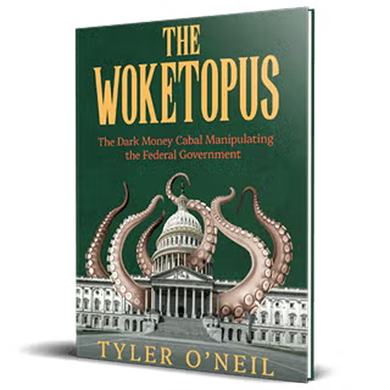
Read the first chapter of The Woketopus right now for FREE
Today, even with President Trump’s victory, leftist elites have their tentacles in every aspect of our government.
The Daily Signal’s own Tyler O’Neil exposes this leftist cabal in his new book, The Woketopus: The Dark Money Cabal Manipulating the Federal Government.
In this book, O’Neil reveals how the Left’s NGO apparatus pursues its woke agenda, maneuvering like an octopus by circumventing Congress and entrenching its interests in the federal government.
You can read the first chapter of this new book for FREE in this eBook, The Woketopus: Chapter One using the secure link below.


The Daily Signal depends on the support of readers like you.
RELATED ARTICLES




Don’t miss the

Don’t miss the signal