
Editor’s note: This is a lightly edited transcript of today’s video from Daily Signal senior contributor Victor Davis Hanson. Subscribe to our YouTube channel to see more of his videos.
Hello, this is Victor Davis Hanson for the Daily Signal.
We’re approaching 140 days since we first attacked Iran on Feb. 28 of this year. And we only really had … people call this a war, but it’s basically 40 days of actual bombing, tit for tat, followed by 100 days of negotiations interspliced with some tit-for-tat exchanges of missiles and drones. But for the most part, we have negotiated.
Now, we know the strategy of both sides. The strategy of our president was he wanted to stay in power, meaning he wanted to have control of Congress. Otherwise, his initiatives and agenda will be ossified if the Democrats take over the House. They will impeach him if they take over the House, and he’s protected against conviction by running the Senate.
But if he should lose the House or Senate, in other words, if things would blow up, he would be in deep trouble. So, his point was always to make sure that Iran did not have the ability to produce a nuclear weapon and did not have the ability to launch missiles all over the Gulf and did not have the ability to close the Strait of Hormuz.
But the negotiations interrupted that cycle in which Iran also had a strategy, and their strategy was, “If we can drag this conflict out and punctuate it with missile launches and ride out the retaliations, which would be proportional or symmetric, we can run the clock out all the way to the midterms.
TRENDING ARTICLES



“If we do, the Democrats will take over the House of Representatives, and maybe they will not allot money to continue Trump’s war. And more importantly, maybe this will be the start of a new government in 2028, and we’ll be home free as we were with [Joe] Biden and [Barack] Obama.”
So, that was their strategy: Drag it out, drag it out.
Who won? Well, we’ll see about the denouement, but for now, Iran has been able to survive because we stopped full-scale fighting almost 100 days ago, and these tit-for-tats have been ineffectual in the sense they have not stopped the missile barrages to the Gulf states, and they have not given us control over the Strait of Hormuz, and we do not have control of the enriched uranium.
So, where are we now? We still have the same pressures on Donald Trump. We’ve got less than four months now until the midterms, but the economic news has been surprisingly good. Inflation, at a per-month rate, is at a historical low almost, and unemployment is about 4.2. GDP is strong at 2.3, 2.4.
The stock market is high. The full effect of tax cuts and greater energy production and deregulation are starting to be felt, along with foreign investment. So, Trump thinks that, along with the redistricting and the Supreme Court ruling on gerrymandering, he might have a chance to upset the historical reality that 39 of the last 41 midterms have gone to the out party.
So, he still thinks he has a chance, and he still wants to conclude operations and go home, and the Iranians know that.
So, where are we now? I think we can see what he’s doing. The last four days he’s had very, very strong strikes. Some of his critics have said on the right, “Well, you’re hitting all of these dock works and these small mosquito fleets and the fuel for missiles.
“Why didn’t we do that earlier?”
Well, we didn’t do it earlier because we were negotiating and we were measured and proportionate. And to deal with the Iranians now, you have to be unmeasured and disproportionate.
So, what we are seeing now is a full-scale effort to destroy all of their military abilities. And that would mean going to the factories, the industrial complex that makes these missiles, find where their launchers are, find their drone fields, clear the corridor near the strait of all of their anti-aircraft ability, their missiles, their drones, and their small fleet of vestigial boats that they use to mine the strait and attack tankers.
Clear it all out. Do this for a week or two weeks and then stop and see if they want to concede. If they do not want to concede, then I think you would have another week of dual-use targeting.
And that would mean they were going to bring in the B-2s and hit Pickaxe Mountain, seal the areas under suspicion of harboring enriched uranium, hit the bridges, hit some of the power grid, and then go home and say to our allies Iran is now mostly inert.
They have no air force. You in the Gulf, you have 600 combat frontline aircraft. You have missiles. You have missile defense. You can defend yourself from an inert Iran.
You Europeans, Japanese, South Koreans, Taiwanese, you all want to use the Strait. We don’t. But we’ve cleaned it out now, and all you have to do is send a couple of vessels each.
And under our leadership, we always have forces in the Persian Gulf. We have frigates. We have a carrier that rotates in and out. We will help you organize the ability and the willpower to keep the Strait open.
And it’s not going to be difficult because Iran has suffered enormous damage, and that would be in two or three weeks.
In other words, then he could pivot and say that Iran is now militarily and nuclearly inert, and we are back home, and our allies are taking part of the burden, and they’re keeping the Strait open.
There’s one final wild card. Notice something very unusual. Iran boasts almost every day that it is hitting Oman, the UAE, Qatar, Saudi Arabia, and Kuwait.
The Houthis have even sent missiles into Saudi Arabia. These are Muslim nations fighting a Muslim nation. Iran fighting fellow Muslim nations. A Persian Muslim country fighting Arab Muslim countries.
What is Iran not doing? It’s not attacking Israel. It’s not attacking Israel.
Why isn’t it attacking Israel?
Because they know, in addition to the American effort, if they were to attack Israel, Israel has rested for the last four and a half months. They’ve restocked their munitions. They’ve got superior intelligence. They’re infiltrated into the Iranian Revolutionary Islamic Guard Corps. They’re infiltrated into the military.
They know where these people live. They know where they work. They know how they travel. And they’ve been warned that if they hit Israel, they’re going to go after the fourth-, fifth-, and sixth-tier leadership, and they’re providing intelligence to the Americans.
So, for now, it seems unbelievable, but the Iranians would rather attack other Muslim countries across the Gulf than tangle with their supposed little Satan, their existential enemy, Israel.
Why?
Because Israel has obtained overwhelming deterrence. And they are afraid that if Israel gets in the fray along with the United States, that they will suffer inordinately and may not recover.
So just to recap, Donald Trump has a week, two weeks at the most, to hit all of the targets that are militarily left and then see if they want to concede. And if they don’t, then hit the dual-use targets.
And then I think he’s going to plan to go home and concentrate on the economy and outsource the problem of the strait, with one final caveat. If we find out that they still have a nuclear program in existence, we can do what we did last July 2025. You can send in B-2 bombers and hit these facilities below the earth.
And it’s been proven that the Iranian air defenses are pretty anemic when confronted with Western technology that both we and Israel possess.
We publish a variety of perspectives. Nothing written here is to be construed as representing the views of the Daily Signal.

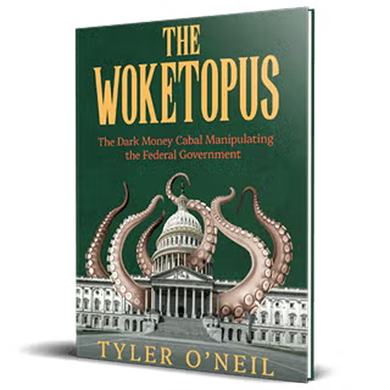
Read the first chapter of The Woketopus right now for FREE
Today, even with President Trump’s victory, leftist elites have their tentacles in every aspect of our government.
The Daily Signal’s own Tyler O’Neil exposes this leftist cabal in his new book, The Woketopus: The Dark Money Cabal Manipulating the Federal Government.
In this book, O’Neil reveals how the Left’s NGO apparatus pursues its woke agenda, maneuvering like an octopus by circumventing Congress and entrenching its interests in the federal government.
You can read the first chapter of this new book for FREE in this eBook, The Woketopus: Chapter One using the secure link below.


The Daily Signal depends on the support of readers like you.
RELATED ARTICLES





Don’t miss the

Don’t miss the signal