Editor’s note: This is a lightly edited transcript of today’s video from Daily Signal senior contributor Victor Davis Hanson. Subscribe to our YouTube channel to see more of his videos.
Hello, this is Victor Davis Hanson for the Daily Signal.
The so-called Iranian memorandum of understanding involving a 60-day period of negotiations that may or may not lead to an armistice was published just recently, and it’s gotten a lot of storm of criticism.
It’s kind of ironic. All last month and up until the memorandum was published, the Left said that Donald Trump was a warmonger. Now they’re calling him Neville Chamberlain and an abject appeaser.
Some on the right were saying he was the bravest of the last eight presidents, the first to take seriously the Iranian threat. In a sense, he didn’t just talk about it. He tried and did end it, I think. And now they are saying he was had. He’s a fool.
So, what’s going on with this memorandum of understanding?
TRENDING ARTICLES


I think everybody is confusing, first of all, military victory versus strategic victory. In a tactical sense, we have had an overwhelmingly historic victory over the Iranian military. There are no air defenses. The airspace is open to anybody who wants it. The Iranians cannot stop the Americans, the Gulf states, or Israel from entering its airspace. That’s new.
Second, they don’t really have a navy. They have some mosquito boats, but now we’ve learned they have very few of those left. We’ve been attriting them in the evening, and there are about 160 ships we sank.
Their missiles have been 90% destroyed, but we don’t know the denominator. We don’t know how many there were. But even then, we are still aware of where they’re stored, and if there is another war, we could pretty quickly dispense with them.
I could go on. Eighty percent of their leadership—80 of their key leaders—have been taken out, including the supreme leader. So that’s a military victory, but that is different from a strategic victory.
Strategic victory means an unconditional surrender, and you dictate terms unconditionally to the defeated. We did that in World War II. We did that in the Civil War. We sort of, kind of, maybe did it in World War I with the Versailles Treaty that followed the Armistice of 1918.
And we did it with Saddam Hussein, and we initially did it with the Taliban.
But here’s the catch: You usually need ground troops to enter the foreign country, and then you remove the regime that you were fighting and install a new one.
We did that with the Confederacy. We did that with Germany, Italy, and Japan. We did that with the Taliban. We did that with Saddam Hussein.
But the key is, you have to have ground troops. To do that required 7,000 American deaths, 53,000 wounded, $2 trillion, and a combined chronological frame of 30 years—10 in Iraq and 20 in Afghanistan.
And then the regimes we installed completely flipped or were replaced. The Taliban came back to power, and now there’s a consensual government in Iraq, but it’s heavily dominated by our enemies, radical Shia.
Do we really want to do that in Iran? It’s 93 million people. It’s one and a half times the size of Texas. If you want to go in there and remove the regime, then of course you can say, “You are not going to have missiles. You are not going to give subsidies to terrorists. You’re not going to send agents throughout Europe and the United States.” But that would require a strategic victory.
Right now, the American people poll overwhelmingly that they do not want any more ground troops in the Middle East. They feel like [Otto von] Bismarck did about the Balkans when he said it’s not worth the bones of one German grenadier, meaning the Middle East isn’t worth that type of expense.
So, we’re not a colonial power, and Iran is not a protectorate that we’re going to micromanage.
That said, our ability to go in at any time and severely damage it means that we can get the objectives that we talked about, specifically the Strait of Hormuz open and no more nuclear weapons. That would be a fantastic achievement.
So far, we’ve tragically lost 13 soldiers. That’s about the accident rate every two weeks in the military. So, it hasn’t cost a lot of blood and treasure yet.
So, what can we do if they violate the memorandum of understanding, if they send missiles into Kuwait or they try to shut down the strait? We can go to the next level of bombing.
You won’t believe it, but Donald Trump hasn’t bombed like [Barack] Obama did in Libya in 2011. He has not bombed like we did in Vietnam. He has not bombed like Bill Clinton did in Serbia.
All of these Democrats, whether they’re [Lyndon] Johnson, or Clinton, or Obama, hit dual-use targets: docks, TV stations in Libya, schools, hospitals.
Not that we’d ever do that, but we accidentally hit them, including the Chinese Embassy. But we did take out the bridges and the electrical grid in Serbia. In Vietnam, we tried to destroy everything that could be used by the military and civilians.
So, we can do that. If they violate the terms of the agreement, we can say, “OK, you violate it. We’re going to respond disproportionately and take out 10 bridges for every missile.” And I think that would have an enormous effect on them.
But why did Donald Trump and the administration even have a memorandum? Because polls said that the people wanted it over with, because the price of gas had gone up to over $5 a gallon from $3.12 on average, or $3, and because the world was pressuring him to avoid a global recession, and the midterms were coming up.
So, Donald Trump wanted a space in which he could get some of the objectives. He could get the enrichment—it’s under a buried mountain—and he’s got the strait opened, and then the others will be discussed.
In the meantime, the stock market has soared. The price of gas is falling precipitously. And in a generic poll, do you support or reject the negotiations with Iran, the majority support it.
Everybody says he can’t win the midterms. If he were to lose them, he will be impeached. His whole family and associates will be subject to lawfare investigations for two years. So, it’s paramount that he bulk up and break from historical precedent that says he’s going to lose.
Redistricting, whether it’s racial gerrymandering or blue-state gerrymandering, will result in a loss, due to red-state gerrymandering, of probably five to 10 seats.
The Democratic agenda is very unpopular when people hear about it, whether it’s the trans issue, or open borders, or Green New Deal, or DEI, etc.
And, of course, the economy, for all the bad news about the war—record Wall Street highs, good employment, enormous foreign investment, tax cuts, deregulation kicking in—we could have the inflation back to where it was well before the war by November.
People have also mischaracterized the deal itself. This is not the end of the negotiations or the war. This is the very beginning of the problems for Iran.
Once the kinetic part of the war stops, they have to face the people, and the people are angry. We have taken out much of their leadership. The next second- or third-tier are mostly incompetent, and the people are going to say not one dime of reconstruction goes to Arab terrorists—the Houthis, Hamas, Hezbollah.
Not one dime goes to these crazy nuclear programs. Not one dime to your missile fleet.
You lost them all. You were humiliated. You lost half a trillion dollars and a half century of investment. No more.
So they’re going to have a problem with internal dissension that is rising. We can always, at any time, encourage that. We can even arm it.
More important, time is on Trump’s side. Not only can he react with dual-use targeting any time during the memorandum if they break it, but he can also explain to our allies and our friends that the strait itself will be irrelevant in some sense in two years, maybe one year.
Right now as we speak, the Saudis, Oman, Qatar, the UAE, Kuwait—all of the Gulf Councils—are saying expand the pipeline to the Arabian Sea outside the Strait of Hormuz, and we can export oil without even getting near it. Expand the pipeline to the Red Sea without even getting near the Gulf.
Expand pipelines or build them, whether with Turkish plans or with the Israelis, to the Mediterranean.
The result of all that is that you may be able to export 10, 12 million barrels without ever going into the strait, which would flip the entire geostrategic reality.
Iran would be vulnerable. We could shut the strait any time we wanted and shut down all of their oil exports and imports. But if they tried to shut down the strait, it would not affect, within two years from now, the vast majority of oil exports to the West, to Asia, to Africa. And the same thing is true of imports.
Finally, geostrategic, I’ve talked about this before, Russia has lost its clients in the Middle East—Syria and Iran. China has lost its clients—Venezuela and Iran.
They both have enormous problems. Both have very low fertility. China has to import 10 to 11 million barrels. They’re big losers in this war.
They are not winners when Elizabeth Warren says everything was going well until the war, and now Iran is much stronger than it was before the war. She should ask 80 or so of their leaders who are now burning in an inferno if they would prefer the present to the past under Obama when they were ascendant.
She should ask the Air Force generals, the head of missile defense, the Iranian admirals: Would you prefer right now having no military, or would you like to go back to the hey days when you were calling the shots under Obama?
The strait, Senator Warren, was closed sometimes, sometimes it was open, because we decided for the first time to disarm them nuclearly. Every other president, all seven of them, said they cannot have a bomb, and then people said, but they might close the strait. OK, we don’t want to get near that.
They closed the Strait because we took away their nuclear option. When you don’t take their nuclear option away and you appease them, the strait is open. It’s that simple.
We publish a variety of perspectives. Nothing written here is to be construed as representing the views of the Daily Signal.

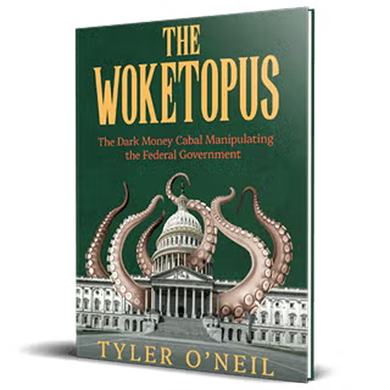
Read the first chapter of The Woketopus right now for FREE
Today, even with President Trump’s victory, leftist elites have their tentacles in every aspect of our government.
The Daily Signal’s own Tyler O’Neil exposes this leftist cabal in his new book, The Woketopus: The Dark Money Cabal Manipulating the Federal Government.
In this book, O’Neil reveals how the Left’s NGO apparatus pursues its woke agenda, maneuvering like an octopus by circumventing Congress and entrenching its interests in the federal government.
You can read the first chapter of this new book for FREE in this eBook, The Woketopus: Chapter One using the secure link below.

The Daily Signal depends on the support of readers like you.
RELATED ARTICLES




Don’t miss the

Don’t miss the signal