
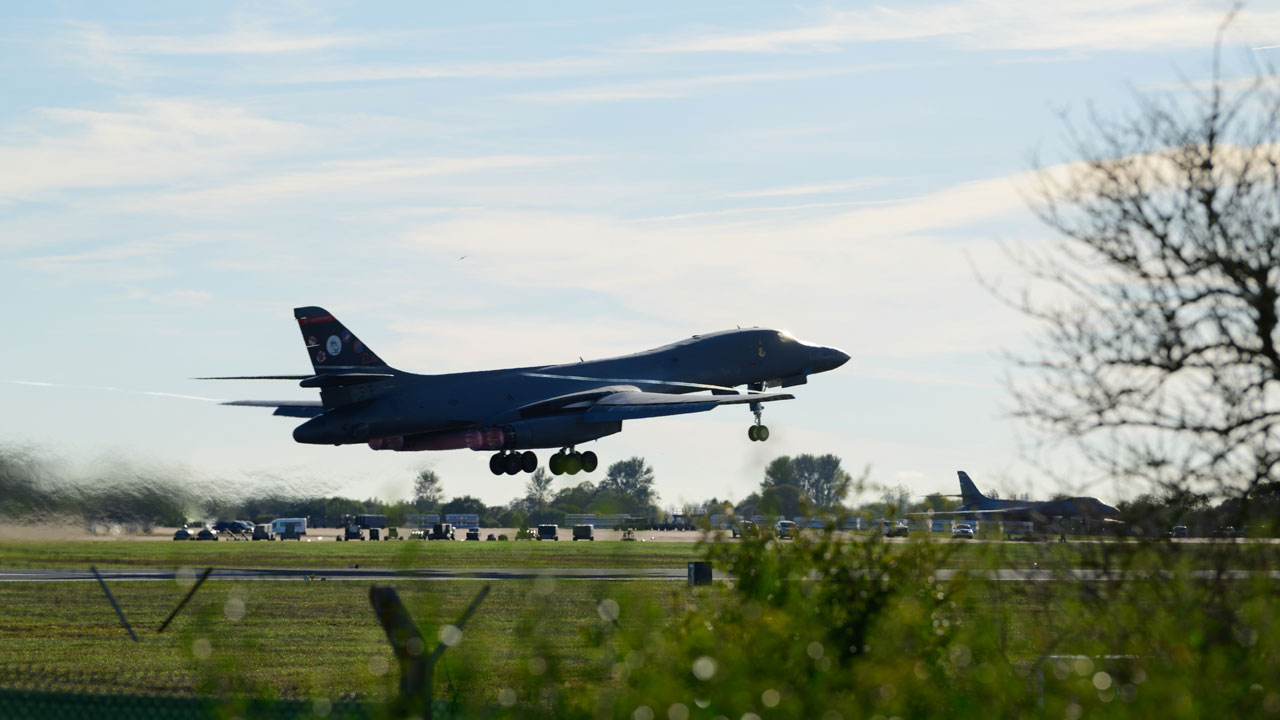
On Oct. 4, the United States removed all bombers stationed at Royal Air Force Fairford from active service and sent them back to their home bases in America.
The Pentagon and the U.S. European Command did not announce it until after the planes had left, and they provided no explanation. The number of aircraft that departed was stated to be 12 B-1B Lancers, the remainder of the force that had been using the base in Gloucestershire since early March as part of the Operation Epic Fury Iran campaign.
The fact that so many aircraft were deployed to the base shows how important it was.
In 2026, the U.S. Air Force had around 140 operational bomber aircraft, according to the Congressional Research Service, which in July 2026 recorded 76 B-52s, 44 B-1s, and 20 B-2s.
In March 2026, approximately 24 bombers were at Fairford Air Base, including about 18 B-1Bs and 6 B-52Hs.
Open-source tracking indicated that 29 individual bombers passed through the base during the conflict. Twenty-four of the aircraft amount to 17 percent of a fleet of 140 aircraft, or roughly one-sixth.
TRENDING ARTICLES



Although no bombers are permanently based at the base, the U.S. Air Forces in Europe regard RAF Fairford as its only forward operating location for bombers. The base has the runways, parking facilities, refueling facilities, and the support squadron required to carry out repeated heavy-bomber operations. The infrastructure available at the base therefore allowed one-sixth of the bomber force to operate from a single British airfield.
The timing of the October departures coincided with a counterterrorism investigation. Nevertheless, no official statement has said the investigation led to the aircraft being recalled.
On Sept. 27, police were called to three vehicles suspected of being suspicious near the base. Five British men in their mid-20s were arrested on suspicion of possessing explosives and preparing a terrorist act. They were later released on bail.
A sixth man, a 25-year-old dual British-Iranian national, was arrested in central London on suspicion of preparing terrorist acts under Section 5 of Britain’s Terrorism Act 2006. He also was released on bail.
It has been stated that petrol was found in the vehicles that were checked and that no explosives were reported to have been discovered. The counter-terrorism police said that they were looking at all possible angles, including the possibility of foreign state involvement.
Prime Minister Andy Burnham said there were “strong indications” that Iran had been involved, but he did not explain why.
Iran denied having taken any part in the matter and summoned the British ambassador. American officials, speaking anonymously to The New York Times, said the decision to leave was due to new information about threat warnings first mentioned three weeks earlier. The importance of this information and the level of urgency grew in the 24 hours before the aircraft’s departure.
These officials spoke of a scheme connected with Iran against the base. The European Command asserted that the bombers had been redeployed and that the crews of the B-1, B-2, and B-52 planes could still launch from the continental United States.
The fact that the aircraft have returned to the United States doesn’t rule out the possibility of them having used another European airfield.
In previous years, several European airfields have had temporary rotations of Bomber Task Forces, for example, Morón Air Base in Spain and Ørland Air Base in Norway.
Reports on the 2026 strikes on Iran said Fairford was the only European base from which B-1s and B-52s flew during that operation; the B-52s had already left earlier that year. After the fragile ceasefire in April, the remaining B-1s mainly carried out training missions. Does the sudden return of the bombers to the United States indicate that President Trump has no intention of attacking Iran again?
The bomber missions carried out by the United States as part of Operation Epic Fury lasted more than 30 hours, including the return trip, and each group of three bombers needed between six and nine tanker aircraft. Since the distance from RAF Fairford to Tehran is about 4,510 kilometers, this is less than half the length of the route used by the United States; the mission is shorter and thus requires fewer refuelings.
Public records contain no evidence that the withdrawal reflects a decision not to carry out a further attack on Iran.
The Pentagon has not made any statement connecting the bombers’ return with a change in war objectives. The base from which the bombers took off is one that is currently the subject of an investigation.
The administration has not announced a halt to the strikes. Iran has stated that any base used to carry out attacks on its own territory is a legitimate target. The actions of the U.S. Air Force to recall the bombers leaves significant questions unanswered.
We publish a variety of perspectives. Nothing written here is to be construed as representing the views of the Daily Signal.

Read the first chapter of The Woketopus right now for FREE
Today, even with President Trump’s victory, leftist elites have their tentacles in every aspect of our government.
The Daily Signal’s own Tyler O’Neil exposes this leftist cabal in his new book, The Woketopus: The Dark Money Cabal Manipulating the Federal Government.
In this book, O’Neil reveals how the Left’s NGO apparatus pursues its woke agenda, maneuvering like an octopus by circumventing Congress and entrenching its interests in the federal government.
You can read the first chapter of this new book for FREE in this eBook, The Woketopus: Chapter One using the secure link below.
TRENDING ARTICLES


The Daily Signal depends on the support of readers like you.
RELATED ARTICLES



Don’t miss the

Don’t miss the signal