Early in my career, I managed money for a federal judge. She couldn’t hold a single stock. No individual securities, no sector bets, no company-specific exposure of any kind. Any ruling touching a publicly traded company had to be beyond reproach. The appearance of a conflict was enough. She accepted that as a condition of public service.
They write laws governing entire industries, receive classified briefings about policy decisions before they’re public, and sit on committees with direct oversight authority over the sectors they’re trading. Most of them keep trading. This is a structural feature of an ethics framework designed by the people it was supposed to constrain.
Article I, Section 5 of the Constitution grants each chamber the power to “determine the Rules of its Proceedings, punish its Members for disorderly Behaviour, and, with the Concurrence of two thirds, expel a Member.” Congress has never lacked the authority to police itself; it has lacked the will.
The Stop Trading on Congressional Knowledge Act of 2012, known as the STOCK Act, applied insider trading prohibitions to members of Congress and required disclosure of trades over $1,000 within 30 days of the transaction. The civil penalty for a late filing is $200. No member has ever been prosecuted. A decade of violations, and the deterrent is indistinguishable from zero.
I’ve spent 30 years in institutional investment management and testified as an expert witness in securities and fiduciary litigation. The framework for evaluating an insider trade is clear: material nonpublic information, a fiduciary relationship, and a trade that benefits from the combination. Every CEO, board member, and portfolio manager who touches that combination faces SEC enforcement, potential criminal referral, and civil liability.
TRENDING ARTICLES



Congress gave itself a disclosure form with a $200 fine.
In January 2026, House Administration Committee Chairman Bryan Steil introduced the Stop Insider Trading Act, which would ban members, spouses, and dependent children from purchasing publicly traded stocks and require seven to 14 days of public notice before any sale. Violations carry a fine of $2,000 or 10% of the transaction value, whichever is greater, plus disgorgement of any gain.
Sen. Pete Ricketts, R-Neb., introduced a Senate companion in March. President Donald Trump called for passage in his State of the Union address, receiving a standing ovation that was, by some accounts, genuinely bipartisan.
The first quarter of 2026 came and went without a floor vote. Rep. Anna Paulina Luna, R-Fla., promised a vote, filed a discharge petition that gathered 82 signatures, and kept pressing. Rep. Chip Roy, R-Texas, noted that time was ticking. Speaker Mike Johnson, R-La., noted other priorities.
A December 2025 Common Cause study found members executed 13,324 trades totaling $635.6 million in 2025 alone. The institution being asked to ban stock trading is populated by people who are actively trading.
The case of Rep. Ilhan Omar, D-Minn., is worth tracing in detail. At the end of 2023, Omar’s household assets stood at roughly $51,000. Her 2024 disclosure reported that her husband Tim Mynett’s stake in his venture capital firm, Rose Lake Capital, had jumped from under $1,000 to between $5 million and $25 million. His California winery, eStCru, appeared at $1 million to $5 million. Total reported household assets: between $6 million and $30 million—a 3,500% increase in a single year.
In February 2025, before filing any amendment, Omar posted on X that claims of her millionaire status were “categorically false” and “ridiculous,” and challenged followers to check her public financial statements. Those same public statements still showed the $30 million range. She denied being a millionaire even as her active disclosure said otherwise.
In March 2025, she filed an amended disclosure cutting household assets to between $18,004 and $95,000 and attributing the original figures to “an accounting error.” But the amended filing still listed Mynett as having received between $100,000 and $1 million in income from Rose Lake Capital—the same firm whose ownership stake was simultaneously valued at zero.
Paul Kamenar of the National Legal and Policy Center, which filed a formal ethics complaint against Omar, put it plainly: “She can’t keep her story straight.”
The 2025 disclosure, filed in May, dropped further still—total assets between $20,000 and $125,000, net worth potentially negative. Meanwhile, Mynett’s own accountants, in a 2025 email reviewed by The Wall Street Journal, valued his businesses at a combined $9.4 million. The House Oversight Committee has opened a formal probe.
The broader point isn’t about Omar specifically. It’s about what happens when the penalty for a late disclosure is $200, no member has ever been criminally charged under the STOCK Act, and the Ethics Committee’s track record on self-policing is closer to a compliance formality than an enforcement mechanism.
The bipartisan standing ovation at the State of the Union was an accurate read of public sentiment. Eighty-six percent of Americans across party lines support prohibiting members from trading individual stocks. The bill is stalled not because the public doesn’t want it, but because the institution that would pass it has a financial stake in not passing it. That’s a structural conflict of interest—the same kind the bill is designed to eliminate.
The Constitution gives Congress the authority to fix this. Article V gives citizens the authority to fix Congress when it won’t. Twenty states have passed Convention of States resolutions. If the Stop Insider Trading Act doesn’t reach a floor vote this Congress, that failure becomes one more entry in the case for why citizens need a mechanism to bypass the legislature entirely.
The rules don’t apply when you write the rules. The Founders understood that. Article I, Section 5 gave each chamber the power to punish its own members rather than trusting the other branches to do it. They assumed Congress would use that power. The assumption has aged poorly.
We publish a variety of perspectives. Nothing written here is to be construed as representing the views of the Daily Signal.
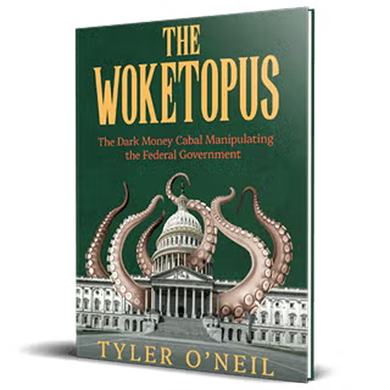
Read the first chapter of The Woketopus right now for FREE
Today, even with President Trump’s victory, leftist elites have their tentacles in every aspect of our government.
The Daily Signal’s own Tyler O’Neil exposes this leftist cabal in his new book, The Woketopus: The Dark Money Cabal Manipulating the Federal Government.
In this book, O’Neil reveals how the Left’s NGO apparatus pursues its woke agenda, maneuvering like an octopus by circumventing Congress and entrenching its interests in the federal government.
You can read the first chapter of this new book for FREE in this eBook, The Woketopus: Chapter One using the secure link below.



The Daily Signal depends on the support of readers like you.
RELATED ARTICLES




Don’t miss the

Don’t miss the signal