

Ever heard of the Agriculture Risk Coverage program? How about the Price Loss Coverage program? You’re paying for them.
Along with the Conservation Technical Assistance program, the Biological and Environmental Research program, and the USDA Catfish Inspection program.
The list goes on, but why have I highlighted these particular entries? Because of the millions we can save annually by eliminating their federal funding.
Not that these are the only programs worth targeting, of course. There are many other specific steps we can take to finally put the government on the diet it should have been put on years ago. I can think of 106 of them, to be exact.
You can find each one in a new publication called, “The Budget Book: 106 Ways to Reduce the Size and Scope of Government.” Fortunately, it’s not the lengthy tome that the title might suggest. Most entries take up no more than one page. This is a practical guidebook for busy policymakers who want to make a difference now.
Calls to cut federal spending are nothing new. But they’re nearly always couched in general terms, with huge numbers that do more to depress than inspire. “The Budget Book” is designed for action. After all, what good is it to sound the alarm, to point toward the iceberg, without showing how we can steer around it?
TRENDING ARTICLES



And there are steps that we can take throughout the budget. I randomly chose the programs cited above, but “The Budget Book” has them organized by topic, from energy and agriculture to national defense and foreign aid.
Some of them will sound familiar to anyone who follows the news. For example, “Eliminate the Export-Import Bank,” which would save taxpayers $2 billion over 10 years, according to a recent Congressional Budget Office study. Or “Reduce Fraud in the Earned Income Tax Credit,” which would save $8 billion annually. Others, however, are relatively small programs like the ones I mentioned at the outset of this column. But large or small, they all add up. Taken individually, they may not sound like much, but combine a large number of them, and you’re talking some real savings.
It’s remarkable how many programs survive long after they’ve proven ineffective. Why is the Office of Community Oriented Policing Services (COPS) still around? It was established in 1994 to put 100,000 new state and local law enforcement officers on the streets by 2000, but it didn’t come close to doing that. It’s time to cut it loose. Savings: $248 million in 2016 and $3 billion over 10 years.
Not all of the recommendations involve axing a particular program. Take No. 91, “Set a Work Requirement for Able-Bodied Adult Food Stamp Recipients.” We can save quite a bit by insisting that able-bodied adults must work, prepare for work or look for work for a minimum number of hours each month in order to receive benefits — approximately $5.4 billion annually, and $54 billion over 10 years, to be exact.
In other cases, the mission of the “Budget Book” (“to reduce the size and scope of government”) is best achieved by expanding a particular program. Greater access to the D.C. Opportunity Scholarship Program, for example, would offer the benefits of school choice to more families and do so in a way that doesn’t spend more taxpayer money.
The need to act couldn’t be greater. Over the past 20 years, spending has grown 63 percent faster than inflation. The federal government spent nearly $29,000 per household in 2014 — a figure projected to rise to more than $47,000 per household in 10 years.
Much of that is driven by entitlements. Runaway spending on Medicare, Medicaid and Social Security will drive federal debt to unsustainable levels over the next few decades.
We’re running out of money. And with the arrival of “The Budget Book,” politicians have run out of excuses. Let’s get to work.
Originally appeared in the Washington Times.
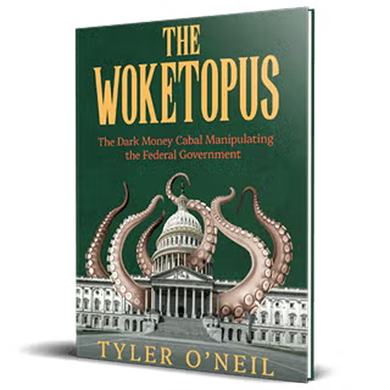
Read the first chapter of The Woketopus right now for FREE
Today, even with President Trump’s victory, leftist elites have their tentacles in every aspect of our government.
The Daily Signal’s own Tyler O’Neil exposes this leftist cabal in his new book, The Woketopus: The Dark Money Cabal Manipulating the Federal Government.
In this book, O’Neil reveals how the Left’s NGO apparatus pursues its woke agenda, maneuvering like an octopus by circumventing Congress and entrenching its interests in the federal government.
You can read the first chapter of this new book for FREE in this eBook, The Woketopus: Chapter One using the secure link below.

The Daily Signal depends on the support of readers like you.
RELATED ARTICLES





Don’t miss the

Don’t miss the signal