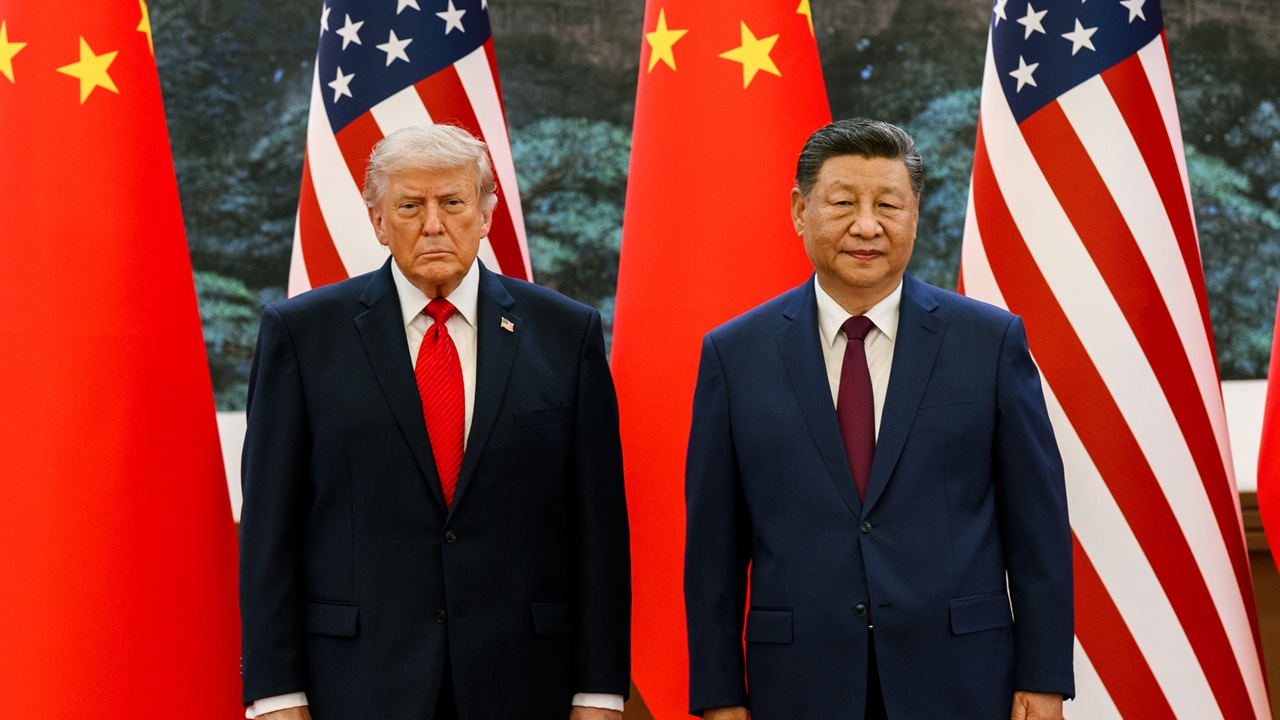
The recent Trump-Xi summit in Beijing featured grand ceremonies, red-carpet pomp, and diplomatic flair, but it produced no major breakthroughs. This has allowed some media and analysts to promote distorted narratives about U.S.-China relations, the Iran conflict, and global power dynamics.
Here is a clear-eyed debunking of the three most misleading myths.
Myth 1: The Iran War Weakened the US and Trump Sought China’s Help
Critics claim the conflict bogged down U.S. forces, depleted munitions needed for a Taiwan contingency, kept the Strait of Hormuz closed, and drove up American gas prices, while China’s strategic reserves and green energy push supposedly insulated it and even strengthened its geopolitical leverage. President Donald Trump’s conciliatory language toward Chinese leader Xi Jinping is cited as evidence of a weakened president seeking China’s help.
The U.S. has faced real costs, including higher energy prices fueling inflation. But it is misleading to ignore the war’s heavier impact on China. Despite its green energy investments, China remains the world’s largest oil importer, with consumption still rising. Most of its crude comes from the Middle East via the Strait of Hormuz.
Since the start of the year, the Trump administration’s actions, including the removal of Venezuela’s Nicolas Maduro and military operations with Israel against Iran, have limited Beijing’s access to discounted crude oil from key sources. Consequently, rising oil and gas prices have significantly impacted China’s manufacturing economy, slowing exports, triggering factory closures, and weakening consumer spending.
It is reasonable to conclude that the Iran conflict has harmed China more than the U.S. This explains why China pressed Iran to reopen the Straits of Hormuz “as soon as possible” before the Trump-Xi summit.
TRENDING ARTICLES
The war also showcased American military superiority while exposing failures in China-linked equipment. Just days before the summit, former defense Ministers Wei Fenghe and Li Shangfu received suspended death sentences for bribery and corruption—a stark sign of Xi’s lack of confidence in the People’s Liberation Army’s fighting ability and loyalty.
Trump’s flattering rhetoric toward Xi follows his first-term pattern: personal compliments paired with tough action. Back then, Trump praised Xi while launching trade wars against China and shutting down the Chinese consulate in Houston.
Last week, while Trump was making flattering remarks to Xi, the U.S. took significant steps against Chinese agents: Arcadia, California, Mayor Eileen Wang agreed to plead guilty to acting as an illegal agent for China, and Lu Jianwang was convicted in New York for running a covert Chinese “police station.”
Before leaving Beijing, the U.S. delegation discarded Chinese-issued items, including badges, credentials, souvenirs, gift bags, and especially burner phones, into a trash bin at the foot of Air Force One. The directive was clear: Nothing of Chinese origin was permitted on the plane. This precaution was necessary to guard against potential hacking or tracking by Chinese operatives, especially considering that China is ranked as the most active and daring state actor in cyber espionage.
These developments show that rhetoric is theater. President Trump and his team recognize China as a serious adversary and are prepared to meet this challenge head-on.
Myth 2: China Is a Rising Power, the US Is Declining
Xi referenced the “Thucydides Trap” (a concept popularized by Harvard professor Graham Allison) in remarks, evoking ancient Athens vs. Sparta to imply a declining America that is fearful of a rising China could potentially lead to conflict, especially over Taiwan.
This framing ignores China’s mounting internal crises under Xi: a collapsing property market, crushing local government debt, a self-inflicted demographic disaster from the one-child policy, high youth unemployment, and a surveillance state that stifles innovation. While China leads in electric vehicles, solar, and some AI hardware, these gains have not offset the drags from the rest of the economy. All of these suggest China is in a structural decline more than inexorable rise.
Xi’s historical analogy is also ironic: Athens was a democracy; China is an authoritarian one-party state.
The U.S. retains clear advantages in energy independence, dynamic innovation, free markets, and the rule of law. Trump arrived in Beijing with roughly 17 CEOs whose companies represented a combined market capitalization of approximately $16 trillion—larger than many countries’ entire GDP. That is a powerful demonstration of American economic strength.
Xi’s reception of Trump further undercuts his own “America is declining” narrative. Xi often treats leaders of perceived weaker powers as subordinates—see the recent diplomatic humiliation of British Prime Minister Keir Starmer. Trump, by contrast, received full state honors, including a rare personal tour of the secretive Zhongnanhai leadership compound.
One Chinese netizen commented on X: “In fact, Chinese people should be grateful to Trump. If it weren’t for his visit to China, ordinary Chinese people would never have known what the Zhongnanhai looks like in their lifetime! You can’t even get into Xinhua Gate.”
It seems that Xi’s flattering of Trump might have backfired.
Myth 3: The Summit Was a Failure Because There Were No Major Breakthroughs
Although Trump mentioned the potential Chinese purchases of Boeing aircraft and U.S. soybeans, the highly anticipated summit ended with no major breakthrough. Critics called the summit a failure due to the absence of sweeping deals on trade, Iran, Taiwan, or technology.
Furthermore, no major announcements meant no unwise concessions on core U.S. interests. During the summit, Xi warned Trump that mishandling Taiwan could create “an extremely dangerous situation.” Yet neither Xi’s flattery nor threats altered the U.S. official position on Taiwan. Xi’s emphasis on Taiwan may even have backfired. On the flight home, Trump said he would speak with Taiwan’s President Lai Ching-te before deciding on a major arms sale package. A direct presidential call between the U.S. and Taiwan has been unprecedented since 1979, and would itself anger Xi.
The recent summit between Trump and Xi illustrates how great-power diplomacy functions: surface-level flattery and spectacle masking underlying firmness and vigilance. Narratives of American decline and Chinese inevitability overlook concrete actions the Trump administration has taken, including energy leverage and enforcement against espionage, as well as Beijing’s serious domestic constraints.
Given China’s track record of signing agreements it later fails to honor (as with the Phase One trade deal), tempered expectations, consistent pressure, and realistic engagement remain the wisest approach for long-term U.S. strategic success.
Originally published by Confucius Never Said
We publish a variety of perspectives. Nothing written here is to be construed as representing the views of the Daily Signal.
Read the first chapter of The Woketopus right now for FREE
Today, even with President Trump’s victory, leftist elites have their tentacles in every aspect of our government.
The Daily Signal’s own Tyler O’Neil exposes this leftist cabal in his new book, The Woketopus: The Dark Money Cabal Manipulating the Federal Government.
In this book, O’Neil reveals how the Left’s NGO apparatus pursues its woke agenda, maneuvering like an octopus by circumventing Congress and entrenching its interests in the federal government.
You can read the first chapter of this new book for FREE in this eBook, The Woketopus: Chapter One using the secure link below.
TRENDING ARTICLES


The Daily Signal depends on the support of readers like you.
RELATED ARTICLES


Don’t miss the

Don’t miss the signal