‘Sexual Orientation and Gender Identity’ Agenda Suffers Setbacks at the UN
Summary
- Advocates of rights based on “sexual orientation and gender identity” or “SOGI” continue to present their agenda at the UN.
- However, a vast array of nations worldwide are resisting efforts to turn “gender identity” into a protected humanitarian category.
- The United Nations will retain legitimacy only if it respects the difference between protecting fundamental human rights and imposing contested ideologies.
At the United Nations, advocates of rights based on “sexual orientation and gender identity” or “SOGI” continue to present their agenda—and the terminology that acts as a vehicle for it—as the natural and inevitable development of international human rights law.
But recent debates tell a different story.
The General Assembly has demonstrated that contentious “SOGI” language can be removed from documents, while governments from the developing world continue to challenge progressives’ efforts to turn contested concepts into universal legal and humanitarian obligations.
Consider these recent events: First, the SOGI agenda suffered a big loss at the U.N. Human Rights Council in October. France and Albania proposed a resolution calling on all countries worldwide to decriminalize homosexual relations. It claimed that “criminalization of consensual same-sex conduct between adults is contrary to the principles of international human rights law.”
That claim requires the word “principles” to do some heavy lifting, as the text of the international human rights treaties is silent on the issue. None of them expressly identifies sexual orientation, homosexuality, same-sex sexual conduct or “gender identity” as a protected category in the treaty text.
TRENDING ARTICLES

In the years since these treaties were drafted, signed, and ratified, various U.N. treaty bodies have interpreted treaty terms, particularly “sex” and “other status,” to encompass “sexual orientation” under the principle of nondiscrimination.
More broadly, the U.N. Office of the High Commissioner on Human Rights’ own list of human rights references to these terms demonstrates that explicit SOGI language has appeared in a handful of Human Rights Council and General Assembly resolutions rather than originating in the core treaties themselves.
This is a prime example of how progressives use incremental steps to redefine terms to “evolve” with the times.
At the Human Rights Council’s October 2026 meeting, several delegations, led by Pakistan and the Organization of Islamic Cooperation, challenged the decriminalization resolution. In diplomatic negotiations, member states of the organization explained their fundamental objections to the resolution’s premise and objective and then boycotted all further negotiations.
Those subsequent negotiations revealed other objections from countries outside the Organization of Islamic Cooperation. Several European and Latin American countries sought to remove provisions from the draft text, narrow its scope, or qualify the legal formulations.
When Mexico and Chile expressed concern, their proposal received support from a geographically and ideologically diverse group of countries: Brazil, Canada, Colombia, the Dominican Republic, Finland, Iceland, Malta, Sweden, Switzerland, Liechtenstein, and the United Kingdom.
Ultimately, the French and Albanian supporters of the resolution withdrew it rather than see it voted down by the Human Rights Council members.
The memory of a historic vote in December 2025 in which the General Assembly voted to remove “sexual orientation and gender identity” from another resolution was likely top of mind for the diplomats. The amendment to remove the objectionable term in that resolution was also supported by the Organization of Islamic Cooperation.
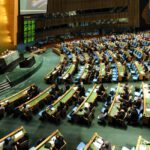
The second recent challenge to the SOGI agenda transpired in October at U.N. headquarters in New York. Graeme Reid, the U.N. Independent Expert on protection against violence and discrimination based on sexual orientation and gender identity, presented his report to the U.N. General Assembly’s Third Committee. The report’s subject was the treatment of “LGBT persons” in humanitarian emergencies.
Reid argued that exclusion from society may leave LGBT persons with fewer financial resources and weaker support networks when war, displacement, or natural disaster occurs. According to his report, humanitarian assistance systems may fail to accommodate nontraditional family arrangements, transgender identification documents, or people unwilling to disclose their status to aid providers.
Reid argued that “identity-blind” assistance is insufficient, and that agencies must identify LGBT persons as a population with vulnerabilities and barriers to assistance.
Reid’s report illustrates the expansion of the SOGI agenda from protection against violence into institutional restructuring and demands on governments. The report did not merely condemn violence or denial of emergency aid. It went much further, treating political, religious, and legal objections to the SOGI framework as factors that humanitarian agencies should identify and counteract.
During Reid’s dialogue with diplomats, delegations from Africa and the Middle East noted the absence of agreed definitions of “sexual orientation” and “gender identity” in universal human-rights treaties and voiced concern that a contested social and legal framework was being presented as if it were settled international law. They objected to Reid’s overreach and the mandate’s intrusion into matters of national law, religion, culture, and family policy.
Most significantly, Reid claimed that government opposition to the LGBT agenda is itself dangerous. In his remarks, he said that political actors sometimes manufacture “moral emergencies” by portraying LGBT persons as threats to religion, the family, or national security. He asserted that this “political hostility” should be recognized as a humanitarian risk factor.
His statement is politically consequential. If advocacy for traditional family law or religious teaching is treated as a “humanitarian risk factor,” the line between preventing violence and delegitimizing political disagreement becomes blurred.
A mandate ostensibly created to address violence and discrimination is increasingly positioned to judge the legitimacy of national laws, religious beliefs, and political speech. This feeds into the “anti-rights” discourse that has flourished at the U.N. in recent years, wherein any country, organization, or individual that opposes the establishment of new rights based on sexual orientation and gender identity, or the fabrication of a right to abortion, is labeled an “anti-rights actor.”
While the SOGI agenda remains deeply embedded in parts of the United Nations, its advocates are finding it increasingly difficult to portray their preferred terminology and policy prescriptions as universal, uncontested human rights norms. The resistance to the SOGI agenda is broad and becoming more coordinated.
The emerging resistance is not in favor of violence or mistreatment. Every person possesses human dignity and should receive humanitarian assistance based on need. But dignity does not require governments to accept every new legal category devised by U.N. experts.
The United Nations will retain legitimacy only if it respects the difference between protecting fundamental human rights and imposing contested ideologies.


Read the first chapter of The Woketopus right now for FREE
Today, even with President Trump’s victory, leftist elites have their tentacles in every aspect of our government.
The Daily Signal’s own Tyler O’Neil exposes this leftist cabal in his new book, The Woketopus: The Dark Money Cabal Manipulating the Federal Government.
In this book, O’Neil reveals how the Left’s NGO apparatus pursues its woke agenda, maneuvering like an octopus by circumventing Congress and entrenching its interests in the federal government.
You can read the first chapter of this new book for FREE in this eBook, The Woketopus: Chapter One using the secure link below.

The Daily Signal depends on the support of readers like you.
RELATED ARTICLES


Don’t miss the

Don’t miss the signal