Georgia Election Committee Holds Meeting Weighing Risks and Recommendations
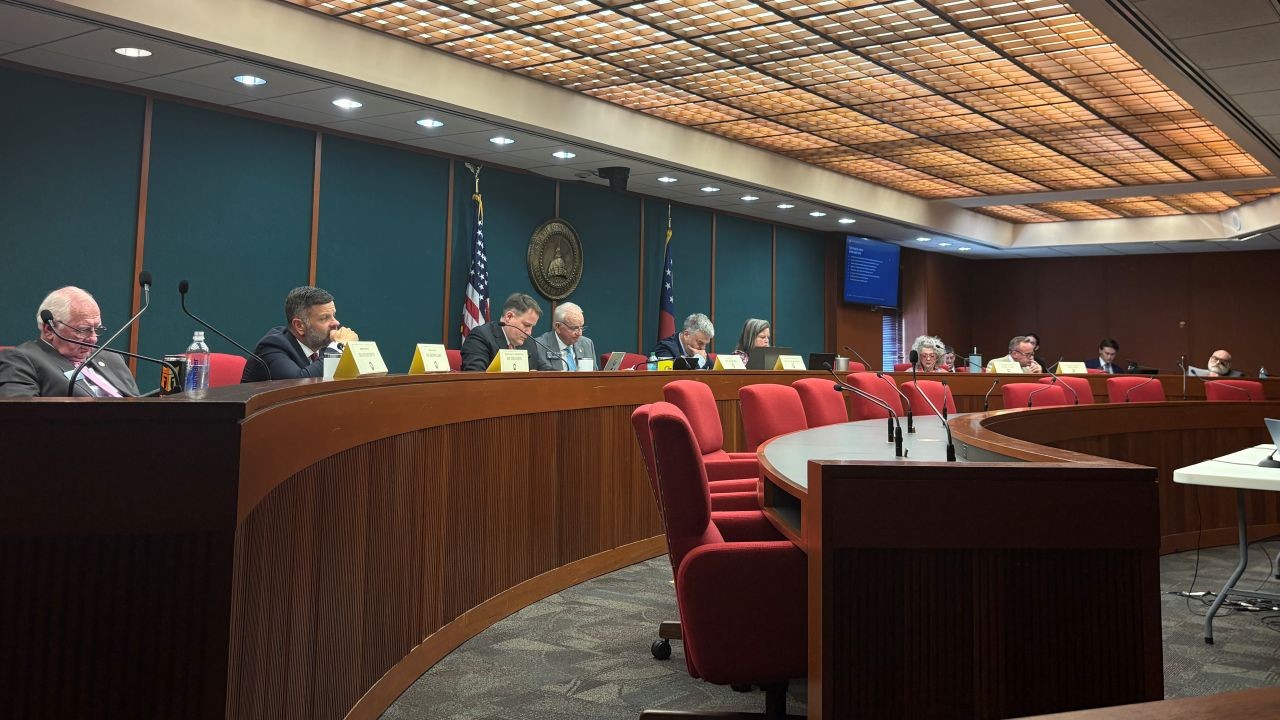
ATLANTA—The Joint Election Equipment Specifications and Standards Committee recently held its third meeting at Georgia’s General Assembly to discuss recommendations for the state’s next voting system.
The committee was created through Senate Resolution 3 EX during this year’s special legislative session and has been “tasked with evaluating specifications and requirements for election equipment utilizing hand-marked paper ballots produced through ballot-on-demand printing,” the Senate Press Office reports.
The committee is chaired by state Sen. Max Burns, R-Sylvania, and state Rep. Victor Anderson, R-Cornelia.
A History of the State’s Voting System
Following state Sen. Rick Williams’ invocation, Anderson welcomed Blake Evans, elections director for the secretary of state’s office, and Michael Barnes, deputy director of information technology for voting systems for Secretary of State Brad Raffensperger.
Barnes described the history of the state’s voting system, noting “the impetus of Georgia transitioning to a uniform system of voting happened after the 2000 election.”
He said that there was an “update process” that took place in 2005, specifically to institute another “touchscreen component”. A year later, in 2006, the “first electronic poll book” was “introduced … for use in Georgia elections,” he said.
TRENDING ARTICLES



The Threat of Foreign Interference
Geoff Hale, visiting fellow for election security at the Center for Democracy and Technology, testified about the vulnerability of the country’s elections. He said, “Our elections face real cyber risks. They’ve been a target of foreign adversaries and other threat actors whose operations seek to shape and undermine the United States.”
After stating that there have been no confirmed instances where foreign nations have interfered with elections in ways that have affected or changed a vote tally, he added, “Nearly every other part of election infrastructure has faced adversarial cyber operations.”
When it comes to foreign interference, Deidre Holden, Paulding County elections and voter registration director, told reporters, “We have to have a system that is absolutely untouchable.”
Hale said, “Election security is a process and not a purchase.” He then explained the two different components that uphold that process—namely, the system’s security, and the “security program around that system,” he said.
Recommendations for the Next Voting System
Jason Wareham, chief executive officer of Mojave Research, emphasized the importance of communication and disclosure in the industry. “It’s [the voting machine has] got to check itself every time it turns on,” he said, adding that if there is a discrepancy or variation, “it’s got to fail loudly.”
Michael Specter, assistant professor at the School of Cybersecurity and Privacy at Georgia Tech, started off his presentation on a positive note, saying that “Georgia’s elections community is incredibly strong.”
He detailed six points of advice, including “requir[ing] access to independent researchers, enabl[ing] researchers to report flaws, requir[ing] vendors to provide patches on a time limit, mandat[ing] interoperability, provid[ing] support to elections officials for operational changes, [and] increas[ing] support and protection for elections officials.”
But as Mark Lindeman, policy and strategy director for Verified Voting, warned, “There’s no such thing as a voting system that’s perfectly secure and reliable.”
He discussed the importance of “voter-verified paper ballots”, which help ensure accountability when it comes to technology and corrects mistakes. He continued to explain that his organization supports “hand-marked paper ballots … because it tends to reduce reliance on electronic technology.”
He then discussed how ballot-marking devices are necessary as well and that this access is “an issue of basic fairness.”
Mark Davis, president of Data Productions Inc., agreed with Lindeman and other presenters that hand-marked paper ballots are a good avenue to move forward with, except for those with disabilities and with an appropriate amount of “backups.”
Davis explained the residency analysis he has been working on for several years, saying, “It [the analysis] shows tens of thousands of voters in each general election who may have cast ballots in a county they no longer lived in.”
An Ideal System
Holden told reporters that when it comes to an ideal voting system, she would like to see “the voter be able to go in there from beginning to end, cast their vote, and have no issues.” She also added that technology can raise concerns, saying, “With technology comes those security issues.”
Burns also told reporters that his ideal for the state’s voting system is for it to be aligned with “Gov. [Brian] Kemp’s position—easy to vote, but hard to cheat.”
Evans commented on the timeline of the process for informing the state’s next voting system, telling reporters, “I think it [the current timeline] is an aggressive timeline. What I ask is this: that they move quickly, and if there is a new system, that we get it in the hands of county election officials quickly, so that they can learn it and then be prepared by training their poll workers.”
At the end of the day, as Anderson said, “We’re not in here trying to score political points. We’re here to try to determine the facts, try to look at the options, and decide … what is best for Georgia.”


Read the first chapter of The Woketopus right now for FREE
Today, even with President Trump’s victory, leftist elites have their tentacles in every aspect of our government.
The Daily Signal’s own Tyler O’Neil exposes this leftist cabal in his new book, The Woketopus: The Dark Money Cabal Manipulating the Federal Government.
In this book, O’Neil reveals how the Left’s NGO apparatus pursues its woke agenda, maneuvering like an octopus by circumventing Congress and entrenching its interests in the federal government.
You can read the first chapter of this new book for FREE in this eBook, The Woketopus: Chapter One using the secure link below.


The Daily Signal depends on the support of readers like you.
RELATED ARTICLES





Don’t miss the

Don’t miss the signal