
Georgia Election Committee Discusses Ballot-on-Demand, Needs of Latinos and Disabled
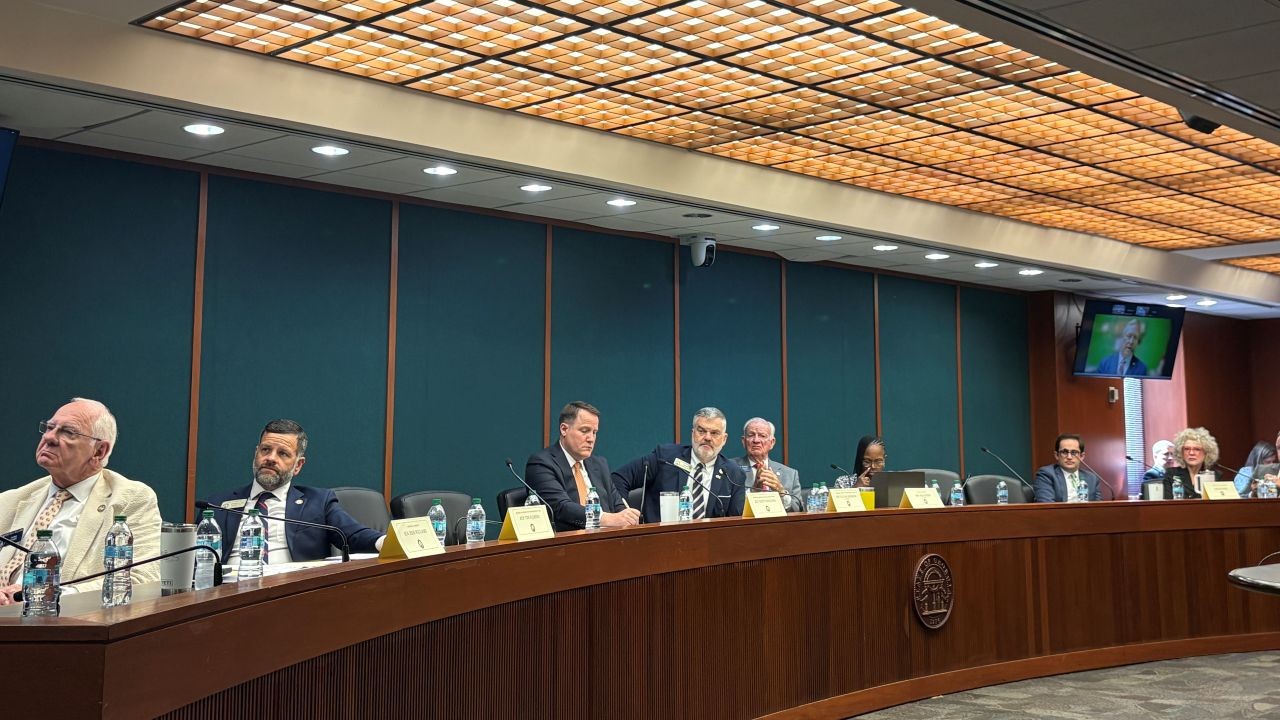
ATLANTA—The Joint Election Equipment Specifications and Standards Committee on Thursday held its second meeting at the Georgia Statehouse, and lawmakers heard testimony about ballot-on-demand technology, cybersecurity, and ensuring that the state’s new voting system considers the needs of Latinos and individuals with disabilities.
The meeting featured state Sens. Max Burns, Rick Williams, and Bo Hatchett and state Reps. Victor Anderson, Tim Fleming, and Scott Holcomb.
After going through the agenda of the meeting, Anderson said, “I want everybody who is signing up [to offer public comment] to remember this committee’s task is to determine a recommendation for specifications and standards for the next uniform voting system in the state of Georgia.”
Three state election officials were on hand to testify before the committee: Rebecca Anglin, elections director for the Greene County Board of Elections and Registration; Chris Channell, director of the Glynn County Board of Elections and Voter Registration; and Kelvin Williams, acting elections supervisor for the Gwinnett County Board of Registrations and Elections.
Anglin spoke first, saying that “A successful election system is not simply about the equipment itself; it’s about the entire process, from voter check-in, to ballot production, to casting your ballot, tabulation, reconciliation, reporting, maintenance, training, and ultimately, the ability of 159 counties to successfully administer our system.”
“Based on the feedback we received, it is our belief that a ballot-on-demand system, and or a full-faced ballot-marking device, are a viable path forward for consideration,” she added.
TRENDING ARTICLES


Williams, who spoke next, discussed whether current systems can be upgraded, as opposed to switching to an entirely new voting system. “Understanding recommendations must fully meet the legislative requirements for a change in our current voting system, we recommend careful evaluation of whether existing hardware and components can be upgraded and retained rather than discarded for a complete replacement,” he said.
Channell, the last of the local election officials to speak, stated that cybersecurity should remain a focus. “Cybersecurity was ranked as the top concern for members of the association that responded to our survey,” he said.
He also emphasized the importance of “physical security and protections,” saying, “The Halderman Report proved, given unlimited time, unrestricted access, and keys and passwords to a voting system, potential weaknesses can be identified.”
Recommendations by Elections Experts
Paul Lux, supervisor of elections in Okaloosa County, Florida, spoke next, highlighting the efficiency of ballot-on-demand voting.
“We were already using what we call direct print, directly from the poll book to a laser printer. In other words, when they [voters] check in, they just pause briefly. It takes the ballot about 30 seconds to print out, and then you hand them their ballot.”
Next up was John Cronin, elections services manager for the Virginia Department of Elections, who said that his state uses paper ballots as well as counting machines “to determine the results of the scanned paper ballots.”
He noted that the “vast majority of these ballots are hand marked,” and that, in 2022, “the law changed the definition of a voting system to include ballot-on-demand devices.”
Accessibility Considered
In the afternoon session, the focus of the meeting shifted to disability advocacy and ensuring that everyone has access to voting, regardless of disability.
Various organizations and individuals testified, including Lanona Jones of the Rev Up Georgia Coalition leadership team. The coalition also included Jessica Mathis, who spoke on the prevalence of voters with disabilities, and how “Georgia’s electronic ballot-marking devices work well for voters with disabilities.”
Dr. Anar Parikh, policy manager for Asian Americans Advancing Justice-Atlanta, urged lawmakers to consider expanding “language access,” which “has been a cornerstone of our voting rights.”
AJ Link, a disability justice advocate, and Shun Tucker-Allen, director of community engagement for New Disabled South, also weighed in on the new voting system, calling for curbside voting.
Latino Justice
Nicolas Bernal, election protection consultant for the Latino Justice PRLDEF, a New York-based civil rights organization, urged lawmakers to expand language access for Hispanic and Latino voters, stating that “any new election equipment specifications should require the complete voter-facing ballot interface to be available in multiple languages.”
Speaking to reporters outside of the hearing, Burns said that, when it comes to accessibility for voters with disabilities, lawmakers will want to “make sure it’s an integral part of the specification requirements.”
Anderson, also speaking about the voting system’s accessibility, added, “We have a system that was, for the most part, considered to be fairly successful at addressing a lot of the needs now.”
“As we develop plans for whatever this next system looks like, we’ll just have to make sure that those same principles are brought forward to it, and that we continue to provide services,” he said.


Read the first chapter of The Woketopus right now for FREE
Today, even with President Trump’s victory, leftist elites have their tentacles in every aspect of our government.
The Daily Signal’s own Tyler O’Neil exposes this leftist cabal in his new book, The Woketopus: The Dark Money Cabal Manipulating the Federal Government.
In this book, O’Neil reveals how the Left’s NGO apparatus pursues its woke agenda, maneuvering like an octopus by circumventing Congress and entrenching its interests in the federal government.
You can read the first chapter of this new book for FREE in this eBook, The Woketopus: Chapter One using the secure link below.



The Daily Signal depends on the support of readers like you.
RELATED ARTICLES




Don’t miss the

Don’t miss the signal