
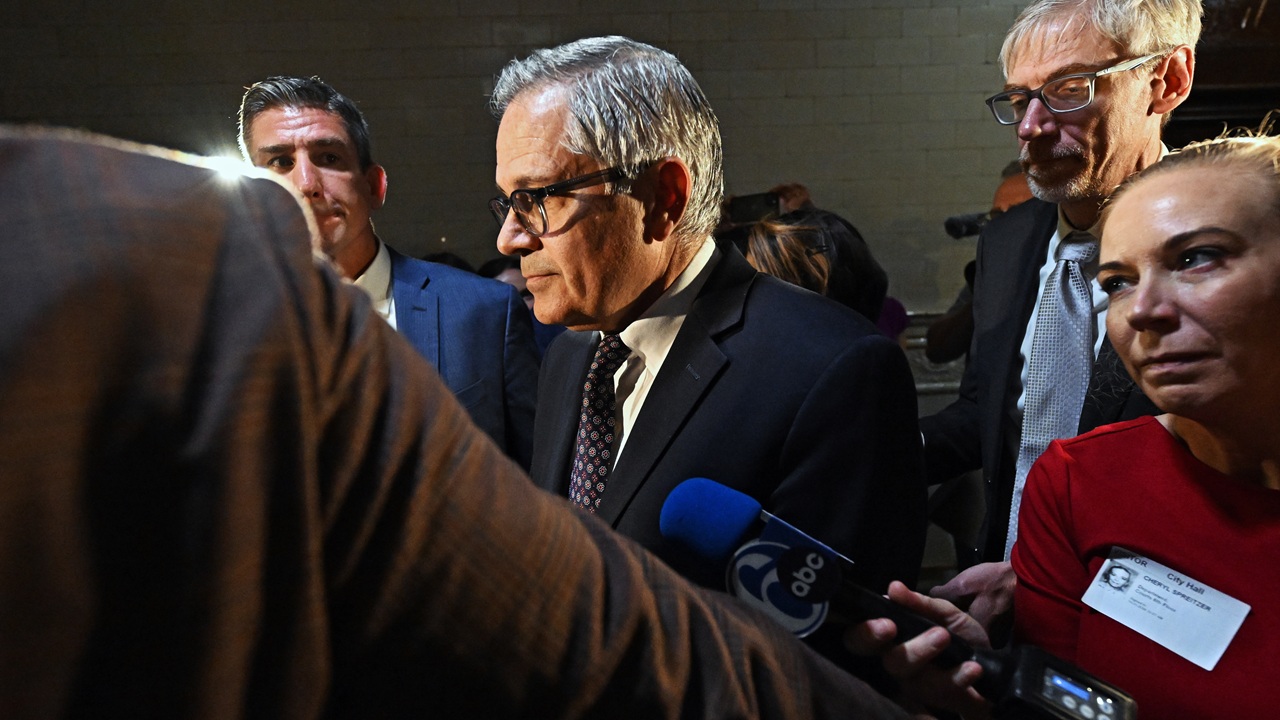
Larry Krasner won the Philadelphia district attorney’s race in 2017, thanks in no small part to a $1.7 million infusion of cash from George Soros-funded groups. On the night of his victory party, he told the assembled crowd that he felt like a “public defender with power,” and he has governed as such ever since. In 2021, he won reelection—thanks to an additional $1.259 million from Soros-funded groups.
Until now, the Soros rogue prosecutor has been able to slither along without being forced from office. This has been true, despite the fact that his pro-criminal, cop- and victim-hating policies have coincided with the largest spike in crime in the City of Brotherly Love in decades. Because of those policies and his mafioso tactics, he was impeached by the Pennsylvania House of Representatives by a vote of 107-85.
Pennsylvania lawmakers passed and Democrat Gov. Josh Shapiro signed Act 40 in 2023, establishing a “special prosecutor” to handle crimes on SEPTA transit. Krasner sued to stop the law and lost. In June, the Pennsylvania Supreme Court rebuked Krasner, saying that his office misled the court in the way it handled post-conviction relief act cases.
But this week, a federal district court judge issued a scathing opinion that recused Krasner and his top deputy from a homicide case and referred them to the U.S. Justice Department for possible criminal prosecution for false statements, false declaration, perjury, and obstruction of justice.
Judge Diamond’s Scathing Opinion
Yesterday, U.S. District Court Judge Paul S. Diamond issued a blistering 40-page opinion excoriating the actions of Krasner and his top henchman, Matthew Stiegler, chief of the ironically named “Conviction Integrity Unit.” The facts and findings of the judge are simply remarkable and will likely pique the interest of federal investigators given the granularity of the judge’s factual findings.
In 2009, a Philadelphia jury convicted Dennis Johnson of second-degree murder, robbery, and a firearms offense for the killing of Kenyatta Smith. Two witnesses who had known Johnson for years identified him as the gunman who robbed and shot Smith, and a detective testified—without objection—that a third witness had also identified Johnson.
TRENDING ARTICLES



Years later, after Johnson returned to federal court with recantations and new affidavits, Krasner’s Philadelphia District Attorney’s Office reversed its longstanding position and conceded habeas relief, claiming trial counsel had been ineffective for failing to object to the hearsay identification.
Diamond concluded that this concession was not the product of sober, adversarial review. He found that supervising Stiegler, an assistant district attorney, had already decided to concede relief before assigning the case to Jacqueline Mason, a new prosecutor with no criminal litigation experience and no relevant training.
Mason became, in her own words, merely the “conduit for drafting this,” while Stiegler’s governing maxim was: “If it’s good enough for the Innocence Project, it’s good enough for me.” Stiegler had met with the Innocence Project numerous times in this case and took it at its word.
Since he took office, Krasner has hired former public defenders and criminal defense attorneys, who have met members of the defense bar, the Innocence Project, and other pro-defendant groups, not as a matter of professional courtesy, but to take their cue on cases.
In this case, the judge found that no meaningful independent investigation followed; instead, prosecution and defense lawyers met repeatedly to decide “which claim would be the best claim to concede on.”
When experienced Law Division supervisors finally examined the record in 2026, they found “very significant errors” in the concession and moved to withdraw it. What followed, in Diamond’s factual findings, was not an institutional rush toward candor but an effort to find a scapegoat. Stiegler proposed combing through Mason’s other cases to portray her as “one rogue ADA” and make the Johnson filing appear “one hundred percent her fault, zero percent his fault.”
Diamond credited the supervisors who rejected that account and found that “it was Stiegler and Mr. Krasner who would seek to sacrifice Mason to protect Stiegler.”
The opinion’s gravamen is Krasner’s response. At a June 5 meeting, Krasner told senior assistants that Stiegler had given him a “really good idea”: review Mason’s cases, find other mistakes, call them a pattern, and report that narrative to the court.
Diamond did not mince words: “Like Stiegler, Mr. Krasner wanted the DAO to submit a false narrative to the Court.” The supervisors “roundly rejected” the proposal, one calling it “tremendously inappropriate.” Krasner nevertheless resisted referring the matter to the Pennsylvania attorney general, insisting that “we have to have somebody in the room, in the courtroom to protect the office.”
That phrase—“protect the office”—became the tell. The supervisors warned Krasner that a prosecutor’s duty was to the Commonwealth and the merits, not institutional self-preservation. Yet Diamond found that Krasner “was not interested in talking about the merits of the case,” disparaged the attorney general’s lawyers as “Nazis,” and suggested that the assigned prosecutor conduct no investigation while merely objecting to anything the OAG did that the DAO disliked.
When the supervisors said their duty of candor required disclosure of the conflict, Krasner warned there would be “consequences.” Two witnesses understood that as a threat to their jobs; Krasner’s chief of staff later said their “jobs may be salvageable.”
Judge Diamond held that Krasner’s conduct collided directly with the prosecutor’s constitutional and ethical office: “The prosecutor’s duty is to vindicate the interest of the Commonwealth not the interest of any particular individual.” Because there was a “significant risk” that Krasner’s public duties were “materially limited by … a personal interest”—shielding himself, Stiegler, and the DAO from scrutiny—the court found multiple, concrete conflicts arising from Krasner’s “own words and actions.”
Diamond therefore disqualified Krasner and Stiegler from any participation in Johnson, barred Krasner from choosing substitute counsel, denied the admission of the outside lawyer Krasner had selected, and struck her filing.
Diamond declined, however, to disqualify the entire nearly 700-person DAO. The record showed that the conflicts belonged to identifiable individuals and that senior assistants, “at the risk of their jobs,” had refused Krasner’s directions, alerted the court, and withdrawn.
But the judge found the evidence went beyond an ethics problem: it was “tantamount to a prima facie showing” of possible false statements, perjury, obstruction of justice, and conspiracy.
His closing judgment was stark: “Philadelphia’s highest law enforcement official and one of his top assistants may have violated the law.” He accordingly referred the DAO, Krasner, and Stiegler to the United States Attorney’s Office for investigation—an extraordinary terminus to a case in which those charged with vindicating justice appeared, in the court’s findings, bent on protecting themselves.
It will now be up to the United States attorney for the Eastern District of Pennsylvania to decide whether to conduct an investigation. Given Krasner’s track record and the judge’s findings of fact and conclusions of law, it should be an easy call.


Read the first chapter of The Woketopus right now for FREE
Today, even with President Trump’s victory, leftist elites have their tentacles in every aspect of our government.
The Daily Signal’s own Tyler O’Neil exposes this leftist cabal in his new book, The Woketopus: The Dark Money Cabal Manipulating the Federal Government.
In this book, O’Neil reveals how the Left’s NGO apparatus pursues its woke agenda, maneuvering like an octopus by circumventing Congress and entrenching its interests in the federal government.
You can read the first chapter of this new book for FREE in this eBook, The Woketopus: Chapter One using the secure link below.
TRENDING ARTICLES


The Daily Signal depends on the support of readers like you.
RELATED ARTICLES





Don’t miss the

Don’t miss the signal