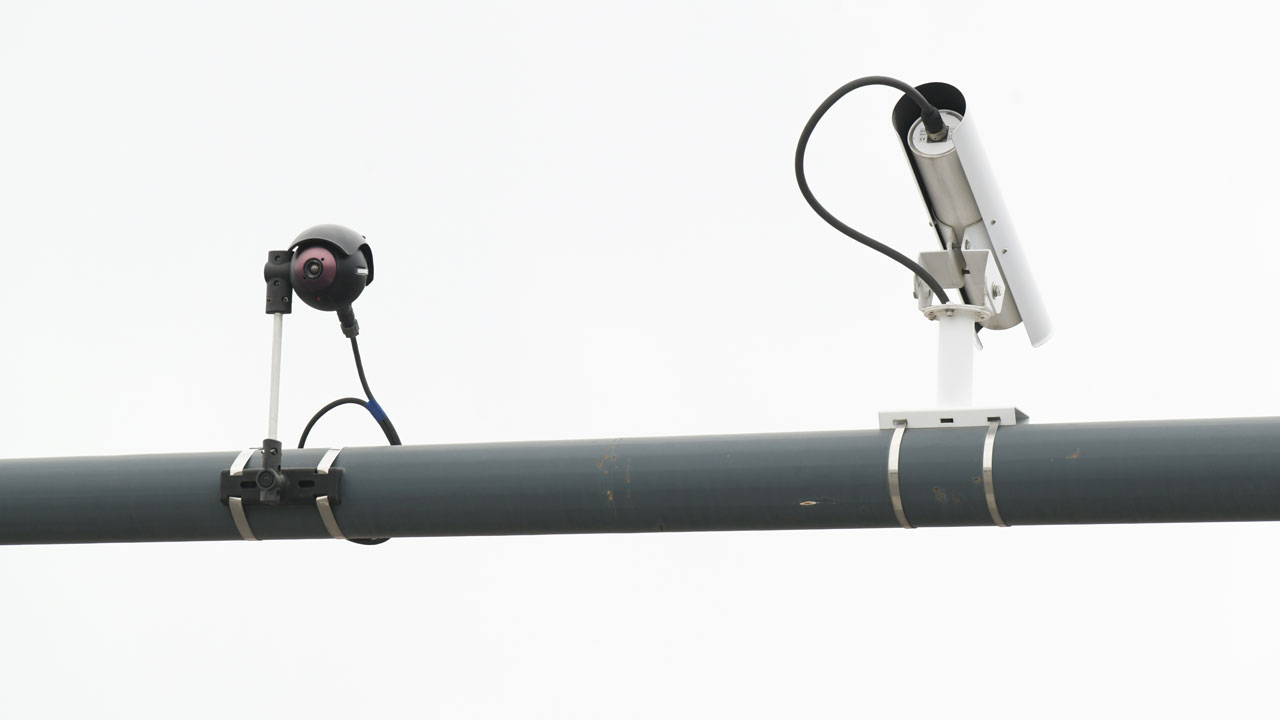
The Harrisonburg City Council voted unanimously this week to end the city’s contract with Flock Safety. It will bag the company’s surveillance cameras with trash bags until they are removed and will consider an ordinance that prohibits other similar mass-surveillance entities from entering into contracts with any entities in the city.
Earlier this year, the Charlottesville City Council discontinued its one-year pilot program with Flock Safety after concerns about data protection, potential misuse, and limits on local control. The city had 10 cameras installed in late 2024, including one near the University of Virginia grounds.
In Staunton, some of the city’s Flock Safety ALPR cameras were removed, though not all were taken offline.
The Virginia Department of Transportation operates speed-zone cameras in areas near roadwork and uses vehicle sensors to photograph or videotape vehicles at intersections during red-light violations. They are also used for unmanned speed monitoring in certain areas where speeding is a known problem.
Norfolk’s ALPR network remains operational after a 2026 federal court ruling upheld its constitutionality. Given the campaign against Flock cameras, let’s examine that case, Schmidt v. City of Norfolk.
Judge Mark S. Davis found that Norfolk’s Flock ALPR system does not constitute a “search” under the Fourth Amendment because the cameras take discrete, noncontinuous images at different locations, the system has gaps in coverage, and the data is limited to information visible on public roads.
TRENDING ARTICLES



That’s the important part I want to delve into: privacy vs. “public-see.”
Before we get into what has both sides of “the aisle” against such cameras, let’s start with the “source code” of American privacy.
The Third and Fourth Amendments in the Bill of Rights do not say that you cannot be surveilled or have your home searched. They maintain a strict toolkit by which you may be. They lean heavily on the premise that the burden of proof is on law enforcement to make the case as to why. They also don’t say that law enforcement cannot watch you or even follow you in public. Probable cause is the cornerstone and, again, the burden of proof is supposed to be with the government.
It’s supposed to be innocent until proven guilty, nothing more. But in this time where reputation is no longer abstract, but rather how you earn a living, the modern version is “innocent until alleged to be guilty by association or being nearby the guilty parties and failing to do anything about it!”
This is how this has become an issue that unites both sides of the aisle.
Conservatives want strong law enforcement but also privacy.
Progressives are still (quietly) in the “defund the police” mode and see any law enforcement as increasingly “fascist.”
There is also a strong anti-surveillance position in our cities among conservatives who reside there because the cities are “run by liberals,” and they are afraid of being targeted for their noncompliant political beliefs. While the no-borders crowd on the left believes the cameras are being used by ICE to round up their new servant underclass. As Minneapolis Mayor Jacob Frey said, “They are coming after our abuela’s and bus boys.”
John Whitehead, the founder of the Rutherford Institute and the man who took on Bill and Hillary Clinton as Paula Jones’ lawyer, said regarding Flock cameras: “A camera can photograph a car. Flock’s AI-powered platform can identify and categorize a vehicle, compare an observation with stored records, generate alerts, identify connections and help police reconstruct where that vehicle has been. AI is what transforms a photograph into the building blocks for a suspect society.”
This is what happens when lawlessness is not only allowed but promoted.
It’s an extrapolation of the exercise of prosecutorial discretion, which has long been a part of the canons of American justice. However, it’s been conveniently forgotten that its practice was individualized and based on exigent factors each time.
That changed when President Barack Obama instructed U.S. attorneys not to enforce federal marijuana possession prohibitions in states with strong regulatory systems for legal marijuana in a document called the Cole Memorandum dated Aug. 29, 2013.
Up until then, if a political leader didn’t like a law (see Jim Crow, for example), he or she would propose changes legislatively or battle to have it declared unconstitutional in court.
Not anymore. Now it seems that law enforcement can make this stuff up as they go along, and that is how we arrive where we are societally today.
Whether it’s “J6-ers” or “Black Lives Matter,” a significant portion of “We the People” think that if we are under the scrutiny of law enforcement, it’s because of who we are and not what law we may have broken.
That’s the issue that must be resolved. Not whether cameras exist. Too late. Not whether AI exists. Too late.
We must get back to being a society with clear laws that protect each other’s rights. What those are needs to be a whole other column. And we must ensure that they are enforced equally on the poorest and the wealthiest, the outsiders and those in positions of influence. Not just in a society that uses the law to “get its way.”
The existential danger here is that the people who want this lawlessness to continue are the ones who will come to us and use this soft-core anarchy as the premise to take away most of our civil rights in exchange for “restoring order.” We know this because it’s how KGB boss Vladimir Putin won the presidency in Russia a quarter century ago.
As they say in the game-designing community, “it’s not a bug, it’s a feature.”
We publish a variety of perspectives. Nothing written here is to be construed as representing the views of the Daily Signal.

Read the first chapter of The Woketopus right now for FREE
Today, even with President Trump’s victory, leftist elites have their tentacles in every aspect of our government.
The Daily Signal’s own Tyler O’Neil exposes this leftist cabal in his new book, The Woketopus: The Dark Money Cabal Manipulating the Federal Government.
In this book, O’Neil reveals how the Left’s NGO apparatus pursues its woke agenda, maneuvering like an octopus by circumventing Congress and entrenching its interests in the federal government.
You can read the first chapter of this new book for FREE in this eBook, The Woketopus: Chapter One using the secure link below.



The Daily Signal depends on the support of readers like you.
RELATED ARTICLES




Don’t miss the

Don’t miss the signal