
As we celebrate America’s 250th birthday, the skies will be filled with not only fireworks but song. Those great patriotic tunes we all know by heart, even when we can’t hit all the notes.
Though the songs may be as familiar as the red, white, and blue, the stories behind them often are not. In Part 1, we dove into the duel between “God Bless America” and “This Land Is Your Land.”
Part 2, we looked at three patriotic classics we swiped from Britain.
In Part 3, we close where America began: on its knees, acknowledging the source of its strength.
‘God Bless America’ Revisited
We’ve already talked about how “God Bless America” came about. But we didn’t talk about the star of the song. The One central to the American story and so many of our favorite patriotic classics. That is, as the declaration describes Him, “our Creator,” whose “Divine Providence” guides our nation’s fortunes.
The chorus of “God Bless America” is a prayer, a call out to God to bless this land, to “stand beside her and guide her through the night with a light from above.”
George Washington was no Irving Berlin—then again, Irving Berlin didn’t put a whippin’ on the world’s most powerful army—but hear General Washington express the same prayer for America in his Circular Letter to the States in June 1783:
TRENDING ARTICLES



I now make it my earnest prayer, that God would have the United States in his holy protection, that he would incline the hearts of the citizens to cultivate a spirit of subordination and obedience to Government, to entertain a brotherly affection and love for one another, for their fellow citizens of the United States at large, and particularly for their brethren who have served in the Field, and finally, that he would most graciously be pleased to dispose us all, to do Justice, to love Mercy, and to demean ourselves with that Charity, Humility and pacific temper of mind, which were the Characteristics of the Divine Author of our blessed Religion, and without an humble imitation of whose example in these things, we can never hope to be a happy Nation. Amen.
‘Battle Hymn of the Republic’
While Washington called to God for justice and mercy, come the Civil War, an abolitionist named Julia Ward Howe was calling out to the Lord for vengeance.
On the night of Nov. 18, 1861, just months after the outbreak of the War Between the States, Howe took a soldiers song called “John Brown’s Body” and wrote out a new set of lyrics, bringing God into the war firmly on the side of the Union.
Mine eyes have seen the glory of the coming of the Lord;
He is trampling out the vintage where the grapes of wrath are stored;
He hath loosed the fateful lightning of His terrible swift sword:
His truth is marching on.
For Howe, the Lord walks among the soldiers in their camps:
I have seen Him in the watch-fires of a hundred circling camps,
They have builded Him an altar in the evening dews and damps;
I have read His righteous sentence by the dim and flaring lamps:
His day is marching on.
He leads the troops into battle:
He has sounded forth the trumpet that shall never call retreat;
He is sifting out the hearts of men before His judgment-seat;
Oh, be swift, my soul, to answer Him! Be jubilant, my feet!
Our God is marching on.
His own sacrifice is to be matched by our own in the cause of ending slavery.
As He died to make men holy, let us die to make men free.
In total, over 360,000 Union soldiers would die to end the scourge of slavery.
Oh, but Howe’s rousing chorus!
Glory, glory, hallelujah!
Glory, glory, hallelujah!
Glory, glory, hallelujah!
His truth is marching on.
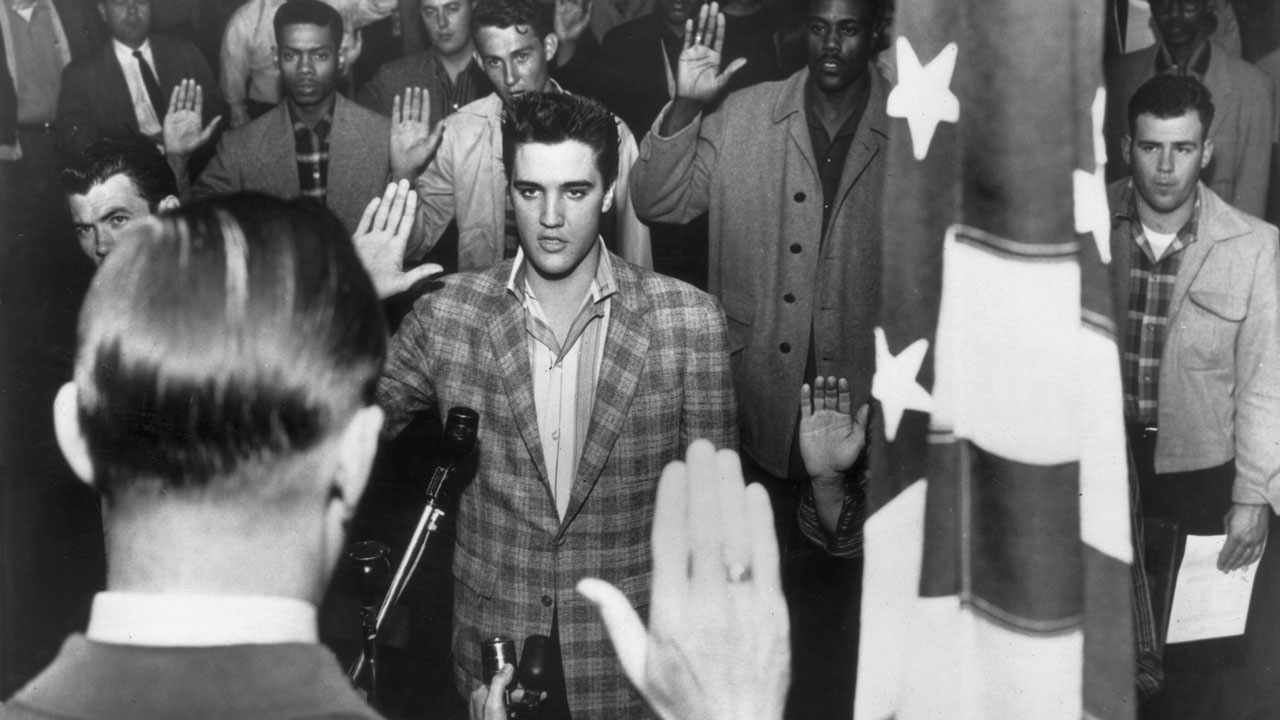
Perhaps fittingly, it would take a former U.S. Army soldier born in the Confederate state of Mississippi to reunite the South and the North in song, powerfully pairing Howe’s battle hymn with a rebel favorite.
Here’s Elvis Presley, performing his “American Trilogy,” featuring “Dixie,” “All My Trials,” and, unforgettably, “The Battle Hymn of the Republic.”
No Kings, America? Well, maybe one.
‘America, the Beautiful’
Like “The Star-Spangled Banner,” “America, the Beautiful” started as a poem. Katharine Lee Bates, inspired by a trip out West, penned a poem called “Pike’s Peak,” which she soon changed to “America.” It was published in the July 4, 1895, edition of the church periodical The Congregationalist.
The poem caught on, and many attempts were made to put a melody to it. In fact, roughly 75 melodies were attached to the words. That is, until a church organist in Newark, New Jersey, named Samuel A. Ward took a shot at it. In 1910, Bates’ lyrics and Ward’s melody were published together as “America the Beautiful.” Our unofficial national anthem was born.
Here’s what it sounded like in 1923:
But that’s not the version that captures the American story. In 1972, on “The Dick Cavett Show,” Ray Charles sat down at his piano.
Ray Charles, blind, born black in a time of ruthless segregation and discrimination, a heroin addict. Yet through his God-given ability and this imperfect land of opportunity, where we seek a “more perfect Union,” where God can “mend thine ev’ry flaw,” Ray Charles rose to become one of the seminal figures in American cultural history.
Think of what he overcame—think of what America has overcome—as Brother Ray takes us to church, and he brings us home for our 250th birthday.
America! America!
God done shed His grace on thee,
And crown thy good with brotherhood
From sea to shining sea!
We publish a variety of perspectives. Nothing written here is to be construed as representing the views of the Daily Signal.


Read the first chapter of The Woketopus right now for FREE
Today, even with President Trump’s victory, leftist elites have their tentacles in every aspect of our government.
The Daily Signal’s own Tyler O’Neil exposes this leftist cabal in his new book, The Woketopus: The Dark Money Cabal Manipulating the Federal Government.
In this book, O’Neil reveals how the Left’s NGO apparatus pursues its woke agenda, maneuvering like an octopus by circumventing Congress and entrenching its interests in the federal government.
You can read the first chapter of this new book for FREE in this eBook, The Woketopus: Chapter One using the secure link below.




The Daily Signal depends on the support of readers like you.
RELATED ARTICLES




Don’t miss the

Don’t miss the signal
