
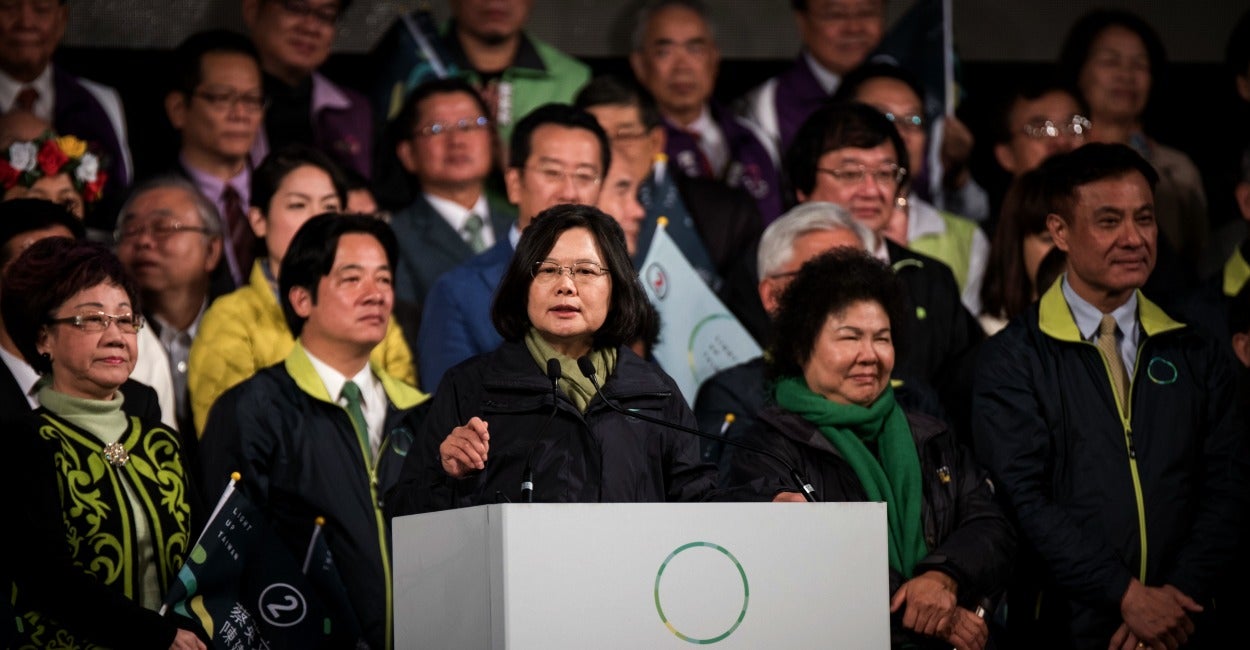
Tsai Ing-wen of the Democratic Progressive Party (DPP) has become the fourth popularly elected president of the Republic of China since the return of presidential elections in 1996—joining Lee Teng-hui, Chen Shui-bian, and Ma Ying-jeou.
Early reports indicate that she has taken a solid majority of the popular vote, outpolling Eric Chu of the Kuomintang (KMT) party 57-30.
The DPP is identified as being in favor of independence for Taiwan from the People’s Republic of China (PRC), while the KMT opposes independence. Tsai, however, has followed a more reassuring line in interviews over the course of the election campaign. She followed the same tack in her victory speech, stating her support for the status quo in relations with China. At the same time, she also noted that Beijing must respect the outcome of Taiwan’s democratic elections and called for both sides to avoid provocations.
Tsai’s victory is rooted in a number of factors, including a slowing economy and unhappiness with President Ma’s policy of pursuing closer cross-straits relations with the PRC.
Tsai lost in the 2012 presidential elections but then built a strong regional support base for the party, which appears to have benefited the DPP in the legislative races as well.
While results are not yet complete, it appears that the DPP may have secured a majority in the 113-seat Legislative Yuan (the equivalent of the U.S. Congress) as well.
TRENDING ARTICLES
If this is the case, Tsai would enjoy a very different political landscape from that of her DPP predecessor, Chen Shui-bian (2000-2008).
During Chen’s terms, the DPP never controlled the legislature, leading to political gridlock, as the KMT often opposed various Chen initiatives. A DPP legislature would afford Tsai substantially more leeway to pursue various policies ranging from energy to business and taxes to defense spending.
Beijing has generally pursued a low profile in the course of this election. The leadership of the People’s Republic of China seems to have recognized that saber-rattling and overt efforts to influence Taiwan elections have tended to backfire.
Most notably, Chinese missile tests in 1995 and 1996, during the “Third Taiwan Straits Crisis,” did not prevent Lee Teng-hui from winning the election, but they did precipitate the deployment of two U.S. carrier battlegroups to the area.

Read the first chapter of The Woketopus right now for FREE
Today, even with President Trump’s victory, leftist elites have their tentacles in every aspect of our government.
The Daily Signal’s own Tyler O’Neil exposes this leftist cabal in his new book, The Woketopus: The Dark Money Cabal Manipulating the Federal Government.
In this book, O’Neil reveals how the Left’s NGO apparatus pursues its woke agenda, maneuvering like an octopus by circumventing Congress and entrenching its interests in the federal government.
You can read the first chapter of this new book for FREE in this eBook, The Woketopus: Chapter One using the secure link below.
TRENDING ARTICLES


The Daily Signal depends on the support of readers like you.
RELATED ARTICLES



Don’t miss the

Don’t miss the signal