

We are living in the midst of an ongoing and accelerating artificial intelligence revolution. That revolution leads to many possible futures, some beautiful and some terrifying. One possible future is a world of mass surveillance in which everything you say and do is meticulously recorded and analyzed, and even the content of your thoughts can be predicted or “inferred.”
China has led the way, constructing an AI-powered network of online and physical surveillance technology to monitor citizens, manipulate narratives, and crush dissent. Even some Western nations have fallen prey to the temptations of mass surveillance. Edward Snowden called the United Kingdom’s online data retention law, also known as the “Snooper’s Charter,” the “most extreme surveillance in the history of Western democracy.”
Here in the United States, concerns about government surveillance are rising, as evidenced by the recent uproar over automated license plate readers, such as Flock Safety’s roadside cameras.
Privacy advocates have mapped over 137,000 automated license plate readers across the country. While readers have been used to solve a number of serious crimes, including kidnappings, reports have surfaced about mistaken arrests and police officers abusing the technology to stalk former romantic partners.
The recent uproar over Flock cameras is a symptom of Americans’ growing unease with AI’s power to track, analyze, and even anticipate their behavior, both online and in the physical world.
Americans, however, have always been uneasy with intrusive government. The Fourth Amendment, which protects against “unreasonable searches and seizures” of citizens’ “houses, papers, and effects,” arose from the Founding Fathers’ opposition to “general warrants” that empowered royal officials with sweeping power to search anywhere or seize anyone without probable cause.
These warrants, which were often used to persecute the crown’s political enemies, were declared by James Otis, a patriot and lawyer, to be the “worst instrument of arbitrary power, the most destructive of English liberty and the fundamental principles of law, that ever was found in an English law-book.”
Today, we are challenged to renew our commitment to privacy in an AI age where data gathered through mass digital surveillance can be analyzed rapidly at scale, and our behaviors, likes, and even beliefs can be predicted and manipulated. That challenge is not hypothetical—it’s coming toward us in real time like a bot swarm.
Start in Europe.
In 2022, the European Union enacted the Digital Services Act. The law applies to large platforms and search engines, including U.S. companies such as X, Google, Meta, and OpenAI, that provide services to European users.
One of the Digital Services Act’s core requirements is that these platforms and search engines monitor, assess, and remove illegal content. In addition, large platforms and search engines must take proactive steps to mitigate “societal risks” posed by “disinformation.” If they fail, they face the prospect of regulatory enforcement and substantial fines.
This entire scheme turns, of course, on how government enforcers define “illegal content” and “disinformation.” Thus far, those enforcers—at both the member-state and the EU levels—have used the Digital Services Act to crush political and religious dissent.
Start with the case of ADF’s client, Paivi Rasanen, a member of the Finnish Parliament who was prosecuted under a Finnish hate speech law for authoring a pamphlet for her church titled “As Man and Woman He Created Them” and for a social media post criticizing, on biblical grounds, her church’s decision to sponsor an LGBT event. Paivi was tried three times for these supposed crimes. She was acquitted twice but found guilty the third time for publishing the pamphlet.
Because of the Digital Services Act, this decision will reverberate throughout Europe, as decisions in one member state can directly influence what online speech is allowed across the entire union. In this case, simply calling out the lie of gender ideology and speaking the truth about God’s creation, as Paivi did, is a type of hate speech to be banished from the digital world.
The problem is compounded by the European Commission’s recent announcement that OpenAI’s chatbot, ChatGPT, is a search engine covered by the Digital Services Act. Even more so than traditional platforms like Facebook and X, AI-powered chatbots like ChatGPT and Claude increasingly mediate how people discover, process, and understand information. If European regulators can use the Digital Services Act to prevent content from ever surfacing in response to a prompt, they can control how their nation’s citizens think.
The Euro-censors are already handing out eye-watering fines for Digital Services Act violations. Elon Musk closed his purchase of Twitter, now X, in October 2022. One year later, the European Commission began investigating X for violations of the Digital Services Act’s rules concerning illegal content and disinformation. In December of 2025, the European Commission fined X 120 million euros for violating the Digital Services Act. Alliance Defending Freedom attorneys are currently working with X to challenge that fine in court.
Why should events in Europe matter to us here in the United States? Because what happens in Europe doesn’t stay on that side of the Atlantic.
In the past year, ADF has challenged three laws in three different states that sought to limit satire websites like The Babylon Bee and platforms like Rumble from using AI to parody politicians. These laws echo laws like Germany’s ban on insulting politicians, which are fully enforceable under the Digital Services Act. Similarly, X recently challenged Colorado’s AI Act, which barred algorithmic discrimination—unless the discrimination was to “increase diversity or redress historical discrimination.” Again, echoes of the Digital Services Act here in America.
In his piece “The China Convergence,” N.S. Lyons warned that China and the West, far from drifting apart, could converge on technocratic forms of autocratic, AI-powered surveillance and censorship states—one enforced through violence, and one through subtle coercion. Privacy is antithetical to this all-encompassing government power because it recognizes that there are some spaces where the state’s power does not, and cannot, reach.
As lovers of freedom and people of faith, we should care about privacy because we care about truth. Because, as George Orwell understood, in a world where Big Brother knows all and censors all, “thought cannot be free.”
We publish a variety of perspectives. Nothing written here is to be construed as representing the views of the Daily Signal.



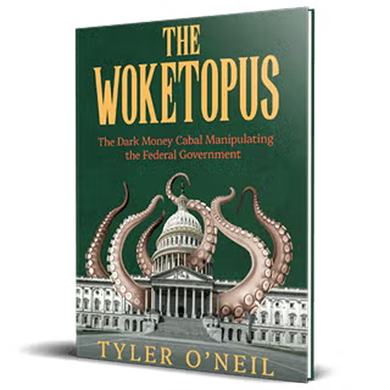
Read the first chapter of The Woketopus right now for FREE
Today, even with President Trump’s victory, leftist elites have their tentacles in every aspect of our government.
The Daily Signal’s own Tyler O’Neil exposes this leftist cabal in his new book, The Woketopus: The Dark Money Cabal Manipulating the Federal Government.
In this book, O’Neil reveals how the Left’s NGO apparatus pursues its woke agenda, maneuvering like an octopus by circumventing Congress and entrenching its interests in the federal government.
You can read the first chapter of this new book for FREE in this eBook, The Woketopus: Chapter One using the secure link below.
TRENDING ARTICLES


The Daily Signal depends on the support of readers like you.
RELATED ARTICLES




Don’t miss the

Don’t miss the signal