
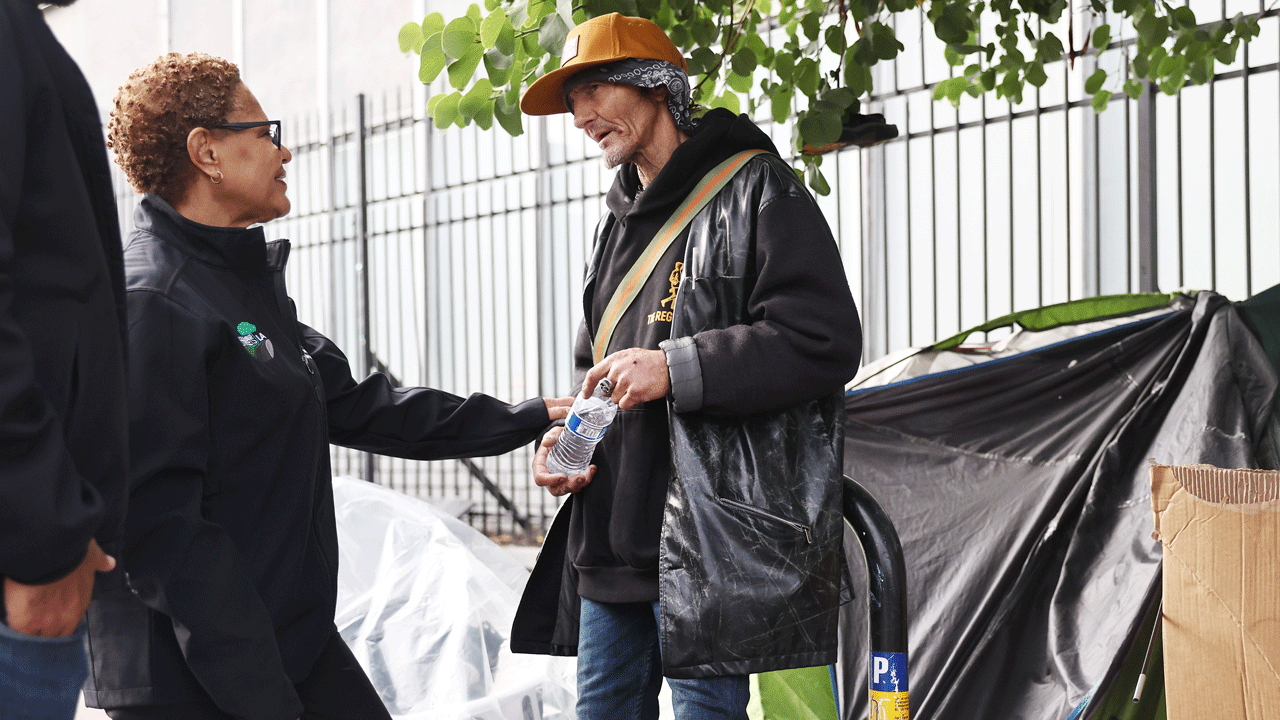
Many Angelenos say they have been left with broken promises after Los Angeles Mayor Karen Bass has yet to deliver on her signature campaign pledge to tackle the city’s homelessness crisis.
New data released by the Los Angeles Homeless Services Authority (LAHSA)—the agency responsible for coordinating homeless services across Los Angeles—found homelessness increased 3.3% in LA County and 7.9% in the city.
The increase reverses last year’s reported decline, which Bass previously pointed to as evidence that the city’s homelessness strategy was beginning to work.
In a statement following this year’s report, Bass defended the latest numbers, arguing they were influenced by the Trump administration’s decision to suspend funding to LAHSA after federal officials cited alleged waste and record-keeping deficiencies.
But Wayne Winegarden, a senior fellow at the Pacific Research Institute, rejected Bass’ argument that federal funding cuts were primarily responsible for the increase, saying the latest figures instead reflect deeper policy failures.
TRENDING ARTICLES



“The mayor is talking about how this is the Trump administration’s fault because they’re cutting funding—never talking about, well, how much do we actually spend per homeless person in LA, an exorbitant amount? So, it’s not the administration’s fault.”
Winegarden said that without addressing the causal factors, almost half of the people put in temporary housing will end up back on the street.
“Forty percent of people who get into this affordable housing end up back on the street because we haven’t given them the ability to kind of overcome those causal factors,” he said. “That’s the problem with our approach. We spend too much on programs that really aren’t addressing root causes.”
Edward Ring, director of water and energy policy at the California Policy Center, similarly argued Los Angeles has prioritized housing over treatment for addiction and mental illness.
“The only way you can solve the homeless crisis is if you treat the underlying conditions—mental illness and substance abuse. You can do that in congregate shelters where you segregate people according to what kind of treatment they need,” he said.
Ring said the city has spent billions of dollars on programs that, in his view, enable homelessness rather than encourage people to seek treatment.
“You also can’t make it so attractive to live in a tent on Venice Beach year-round because the weather’s so forgiving and they bring food out to them and they give them free needles and they look the other way when they sell and consume drugs. That’s how the city of Los Angeles has squandered billions of dollars to make the problem worse, and it’s grossly corrupt and completely ineffective.”
Beyond the debate over why homelessness continues to rise, experts also have raised concerns about how the city’s homeless population is measured.
Those figures come from LAHSA’s annual Point-in-Time Count, a federally required survey conducted over several nights each year in which volunteers and outreach workers estimate the number of people experiencing homelessness. The count helps determine how billions of dollars in homelessness funding are distributed.
Because the annual count plays such a significant role in shaping policy and funding decisions, researchers say its accuracy is critical.
Sarah Hunter, a senior behavioral scientist at RAND, told the Daily Signal that recent research found the Point-in-Time Count undercounted unsheltered homelessness by 25% to 60%, particularly among people living in vehicles or sleeping outside traditional encampments.
“Changes in volunteer participation, methodology, and field conditions can significantly affect PIT count results. LA LEADS found that the 2024 PIT undercounted unsheltered people by up to one-third compared to professional enumerations,” she said.
Hunter said incorporating more trained professionals, improving methods for counting vehicle dwellers, conducting more frequent counts in key areas, and expanding individualized tracking systems could make future counts more accurate.
The Daily Signal reached out to Mayor Karen Bass, Councilmember Nithya Raman, and Los Angeles Homeless Services Authority for comment but did not receive responses by the time of publication.


Read the first chapter of The Woketopus right now for FREE
Today, even with President Trump’s victory, leftist elites have their tentacles in every aspect of our government.
The Daily Signal’s own Tyler O’Neil exposes this leftist cabal in his new book, The Woketopus: The Dark Money Cabal Manipulating the Federal Government.
In this book, O’Neil reveals how the Left’s NGO apparatus pursues its woke agenda, maneuvering like an octopus by circumventing Congress and entrenching its interests in the federal government.
You can read the first chapter of this new book for FREE in this eBook, The Woketopus: Chapter One using the secure link below.
TRENDING ARTICLES


The Daily Signal depends on the support of readers like you.
RELATED ARTICLES





Don’t miss the

Don’t miss the signal