
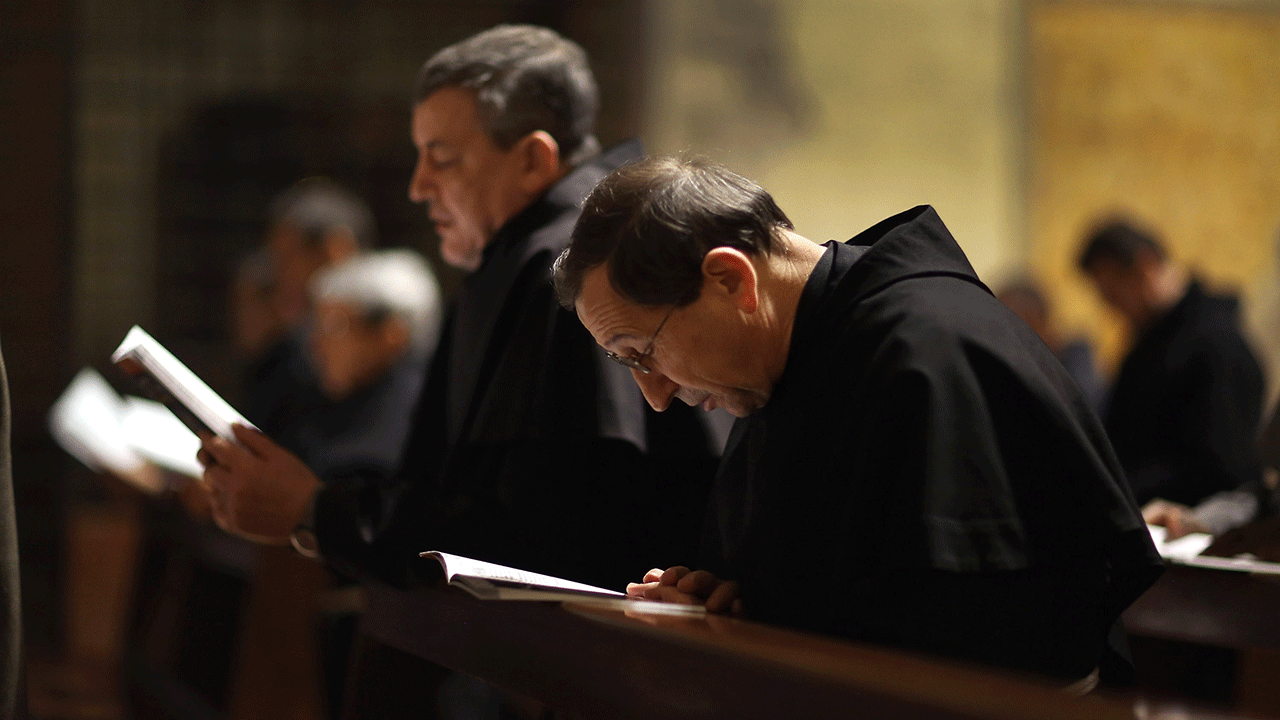
St. Francis of Assisi changed my life.
This holy man and bold follower of Jesus Christ is often reduced to nothing more than a lover of animals who spoke of peace, but he was so much more than this.
First and foremost, St. Francis was captivated by Jesus and devoted his life to knowing him and making him known. He did so through living radically for God.
Francis of Assisi was born to a wealthy family in 1186 and was named Francesco because of his father’s love of France. In his youth, Francis was known to host large parties and was enamored with his life of comfort, fame, and wealth. However, something changed when he became severely ill as a young man. This led Francis to a powerful moment of prayer, and he began reorienting his life around God.
His poverty, commitment to prayer, and relentless pursuit of purifying his life made his witness so attractive that by the time he died in 1282 there were 5,000 men who called themselves Franciscans. The appeal of his life has only grown since his death.
My own fascination with St. Francis began with the recognition of my own brokenness. One day soon after I got married, I was very rude, inconsiderate, and insensitive in a conversation with my wife, Joanna. The next day, I knew what I had done and that I should have handled myself better. I was ashamed.
TRENDING ARTICLES



It was difficult for me to even look at Joanna. As I entered the kitchen to get some coffee, she looked at me and gave me a hug. Then she looked me straight in the eyes and said: “I love you. I forgive you.”
Although she had forgiven me, and I had gone to the Sacrament of Confession, I still felt shame weeks later. One day, I found myself in prayer and staring at a crucifix. It was in this moment, staring at Jesus crucified, that I thought of St. Francis.
I was moved by St. Francis’ poverty, sacrifice, and suffering. I became convicted that God was not scared of my brokenness and sin. In a sense, God was attracted to me precisely because of my failings. Just as a magnet is attracted to its opposite, so God moves toward our brokenness to restore it.
This sent me on a year-and-a-half journey researching all that I could about the life and writings of St. Francis. At the end of it, I was fortunate enough to publish a book drawn from my study, “Let Us Begin: St. Francis’s Way of Becoming Like Christ and Renewing the World”.
The lesson I take from St. Francis is simple. If you wish to restore the world, you must begin with your own brokenness. Renewal of the culture starts with the personal commitment to ongoing conversion.
Like St. Francis, we must live our faith radically and intentionally. We must admit our weakness and move toward rooting it out with the help of God and others.
Christ called him in a moment of prayer in a broken-down chapel. He heard the voice of Jesus say, “Francis, go rebuild My house; as you see, it is all being destroyed.” He began by physically rebuilding the decrepit chapel he was sitting in: brick by brick, stone by stone, plank by plank. Then he soon realized that God was inviting him to restore the entire Catholic Church, not the building.
To that end, he lived a life of intense prayer, sacrifice, and intentional poverty. Others saw a man who was fully alive and completely fulfilled, and many began to follow him, leading countless souls away from sin and toward God.
The recipe for holiness and fulfillment is the same as it was when St. Francis began to follow Jesus—indeed, it is the same as it was when Jesus Himself preached. Prayer, communion with the heart of God, was the foundation of St. Francis’ holiness, as it can be for us today.
St. Francis was always praying. This meant that he was united to God, no matter what he was doing. He became deeply entrenched in Scripture, devoted to the Blessed Mother, and enthralled by the Real Presence of Jesus Christ in the Eucharist.
From this stance of prayer and union with Jesus, he was committed to becoming poor because Christ Himself became poor in order to save us (Philippians 2:6-11). Everything St. Francis did was out of imitation of Christ. His prayer allowed him to know Jesus deeply, and his poverty was the organic conduit of his prayer. The result was a deep conversion of life.
Personal poverty is a reality, no matter how affluent we may be. We are all broken and in need of saving. Left to our own devices, we can be selfish, prideful, and lazy. Forming a consistent and powerful prayer life, along with a commitment to eradicate sinful tendencies through sacrifice, forms us to become like Christ, into “other Christs.”
The questions raised by the life of St. Francis are clear. How much time do we give to God in prayer each day? Can we give Him more? From there, how can we move to tear out the roots of sin in our lives? How can we make small sacrifices that remind us of our dependence on God in order to become who we know we should be?
If prayer and sacrifice become the foundation of our lives, we, like St. Francis, become imitators of Christ. From there, bit by bit, the world will be restored as well.
We publish a variety of perspectives. Nothing written here is to be construed as representing the views of the Daily Signal.


Read the first chapter of The Woketopus right now for FREE
Today, even with President Trump’s victory, leftist elites have their tentacles in every aspect of our government.
The Daily Signal’s own Tyler O’Neil exposes this leftist cabal in his new book, The Woketopus: The Dark Money Cabal Manipulating the Federal Government.
In this book, O’Neil reveals how the Left’s NGO apparatus pursues its woke agenda, maneuvering like an octopus by circumventing Congress and entrenching its interests in the federal government.
You can read the first chapter of this new book for FREE in this eBook, The Woketopus: Chapter One using the secure link below.


The Daily Signal depends on the support of readers like you.
RELATED ARTICLES


Don’t miss the

Don’t miss the signal