
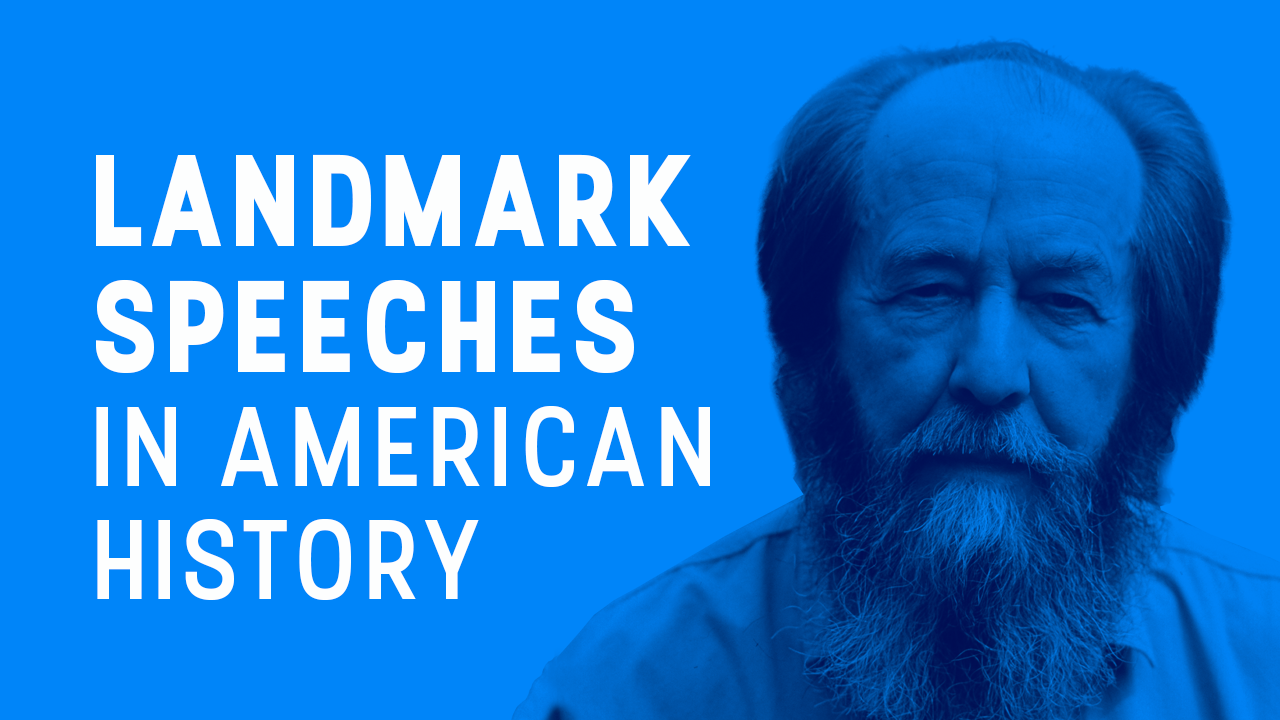
Welcome to the ninth in our series “Landmark Speeches in American History.” We are celebrating America’s 250th anniversary with articles by prominent authors about how some of the greatest speeches in our history—by celebrated orators like Ronald Reagan, Abraham Lincoln, and Martin Luther King Jr.—honored the vision of our founding document, the Declaration of Independence.
Aleksandr Solzhenitsyn’s June 8, 1978, commencement address at Harvard University, provocative and controversial at the time, is still an important point of reference for those attempting to come to terms with what the most perspicacious political thinkers of the 20th century called “the crisis of the West” or “the moral crisis of our time.”
To be sure, many in the then-contemporary intellectual clerisy responded with dismay and even indignation to Solzhenitsyn’s deeply thoughtful and challenging remarks. Like Alexis de Tocqueville before him, Solzhenitsyn spoke as a self-described “friend,” not as an “adversary,” of American democracy. But that did not seem to matter to his “cultured despisers” and to many of his erstwhile admirers who preferred he speak negatively only about communism and not the West or America.
To read the full speech, click here.
His more heated academic and journalistic critics could only hear in his calm and reflective remarks a bitter “Jeremiad,” a screed by a “fanatic” who was incorrigibly “Orthodox,” and who wished to replace liberty and the rule of law of the American type with an alien authoritarianism tinged with “theocratic” reaction. However, there was nothing in Solzhenitsyn’s carefully calibrated speech to give support to such unhinged judgments.
Writing three years later in the pages of Foreign Affairs magazine, Solzhenitsyn remarked that he had been under the mistaken impression that Americans welcomed criticism, but now he understood that our elites only welcomed it from the Left. “Total,” unrelenting, even nihilistic, criticism of Western civilization by leftist ideologues was welcome, but “partial,” yet sympathetic, criticism of the kind proffered by Solzhenitsyn was verboten.
TRENDING ARTICLES



Later, however, Solzhenitsyn would observe in his memoir “Between Two Millstones” that after the initial round of uncomprehending indictments of the “Harvard Address,” he began to hear from those who belonged to another, more solid, traditional America. This less elite-driven America “was small-town and robust, the heartland, the America I envisioned as I was writing my speech, and to which my speech was addressed.” The receptive welcome of these patriotic and religious-minded Americans gave the great Russian writer and Nobel laureate “a glimmer of hope” that he could connect with the part of the country that had not yet succumbed to the progressivist Zeitgeist.
In the “Harvard Address,” Solzhenitsyn defends liberty under God and the law while taking aim at soulless legalism and facile moral relativism. Instead of recommending authoritarian coercion of any kind, Solzhenitsyn endorsed “freely accepted and serene self-limitation” as the wisest and most prudent course of action for both individuals and societies.
Prudence and self-limitation were not the only moral qualities about which Solzhenitsyn reminded Americans.
In the address, he noted a marked “decline in courage” in Western societies and linked this decline to an inordinate concern for “material well-being” and “gorg(ing) on everyday life” that had come to characterize life in the late modern world. Materialism, however, could not satisfy the deepest needs of the human soul.
To live well, human beings need a salutary appreciation of moral limits, and the exercise of “voluntary self-limitation,” to rise to levels worthy of human beings created in the image and likeness of God. No free political community worth its salt should grant boundless space to “destructive and irresponsible freedom,” since moral nihilism as much as totalitarian despotism is the deadly enemy of ordered liberty and the integrity of the human soul.
Here one should state the obvious: There is nothing extreme or distinctively “Russian” about these tried-and-true insights (which were once shared by conservatives and classical liberals alike).
Solzhenitsyn in no way repudiated “human rights”—far from it. But in his view they must always be accompanied by a robust sense of our obligations to society and our fellow human beings. Similarly, he made clear that his criticism of excessive legalism in no way entailed a denial of the indispensable role that the rule of law must play in any civilized polity.
As Solzhenitsyn stated in the “Harvard Address” itself, “Having spent all my life under a Communist regime, I will say that a society without any objective legal scale is a terrible one indeed.” Still, a “society grounded in law but never reaching any higher takes but poor advantage of the full range of human potential.”
Is that not indeed the case? Solzhenitsyn’s more fevered critics, however, addicted to “modernity without restraint,” as the political philosopher Eric Voegelin so suggestively called it, could see in classical and Christian wisdom of this sort only an invitation to repression and authoritarianism.
Solzhenitsyn’s “partial” yet benevolent “critique of the Western system” in no way recommended “socialism as an alternative,” much to the chagrin of his port side critics. Indeed, he saw in socialism “of any style and hue” a recipe for the “comprehensive destruction of the spiritual essence of man” and “the leveling of mankind unto death.”
Nor would his criticisms of the antiwar movement for its blindness about the massive tyranny and bloodshed that would descend upon the Vietnamese and Cambodian people after 1975 win him any admirers among those blind to the lethal character of communism. Criticism of this sort, rooted in deep-seated familiarity with the criminal character of communism, was unwelcome to those with ideological blinders.
Not surprisingly, the deepest philosophical levels of the “Harvard Address” were ignored by most critics.
Solzhenitsyn makes clear in the “Harvard Address” that he is indeed a humanist, but not of the modern atheistic variant. He writes quite discreetly about religion in the 1978 address, referring to God as a “Superior Spirit” and as something “Supreme” and “Whole,” no doubt to avoid sectarianism or any appearance of special religious pleading. But Solzhenitsyn took pointed aim at the Enlightenment’s tendency to culminate in “rationalistic humanism or humanistic autonomy: the proclaimed and practiced autonomy of man from any higher force above him.”
Here is where the fundamental issue is joined. Human beings lose their ballast, their moral and spiritual core, when they succumb to “anthropocentricity,” to the illusion that Man is “the center of existence.” The necessary balance between spiritual and material goods is rapidly lost, and the existence of “intrinsic evil” in human beings is denied, with the devastating consequences that Solzhenitsyn chronicled in “The Gulag Archipelago.”
Freedom is debased when it is shorn of the noble, elevating, and altogether true recognition that “all individual rights were” initially granted “under the assumption that man is God’s creature.” At Harvard, Solzhenitsyn praises the American Founders for still appreciating this profound truth.
In contrast, the ideologues who reduce liberty to “pure autonomy” have promoted a “final emancipation” from “the moral heritage of Christian centuries, with their great reserves of mercy and sacrifice.” As a result, state systems have thus become “ever more consummately materialistic,” and the assertion of the “rights of man” has grown beyond measure as “man’s sense of accountability to God and society has grown utterly faint.” Thus, “[a]ll the celebrated technological achievements of our fabled Progress” “cannot redeem the 20th century’s moral poverty, which no one could have imagined as recently as the nineteenth century.”
This is the wisdom of Edmund Burke, Tocqueville, and Fyodor Dostoevsky, and of the most profound anti-totalitarian thought of the 20th century. Why should we perceive this wisdom as “un-American” when it is in line with the most profound insights of our larger Western inheritance?
Nearly 50 years after Solzhenitsyn’s remarkably prescient and prophetic address, it is past time to take heed of his firm—but friendly—warnings.
This is even more important as we witness the rise in public sympathy for seemingly discredited forms of radical socialism, and even communism, with the obligatory admixture of “post-colonialism” and anti-Zionism thrown into the mix.
In the concluding sections of the “Harvard Address,” Solzhenitsyn showed just how vulnerable liberal humanism shorn of classical and Christian content was to cooptation by more consistent and radical currents of modern thought.
Modern progressives habitually see no enemies to the left. In the address, Solzhenitsyn traces how moderate liberalism soon gave way to radicalism, radicalism to socialism, and socialism found itself powerless before communism’s more radical and insistent appeals to atheism, materialism, and the call for the revolutionary transformation of human nature and society. As a result, progressive intellectuals almost always “feel the kinship” with radical and revolutionary movements well to their left, however tyrannical and unsavory. Solzhenitsyn’s analysis of this phenomenon remains as compelling as when he first advanced it in 1978.
In the peroration of his address, Solzhenitsyn did not call for a return to a past which had problems all its own. Instead, he called for a new “spiritual blaze” “where our physical nature will not be cursed, as in the Middle Ages, but even more importantly, our spiritual being will not be trampled upon, as in the Modern Era.”
“No one on earth,” he concluded, “has any other way left but-upward.”
Thus Solzhenitsyn closes his remarkably consequential address with words of wisdom that are at once sobering and hope-filled—and that remain as relevant as the day he first spoke them.

Read the first chapter of The Woketopus right now for FREE
Today, even with President Trump’s victory, leftist elites have their tentacles in every aspect of our government.
The Daily Signal’s own Tyler O’Neil exposes this leftist cabal in his new book, The Woketopus: The Dark Money Cabal Manipulating the Federal Government.
In this book, O’Neil reveals how the Left’s NGO apparatus pursues its woke agenda, maneuvering like an octopus by circumventing Congress and entrenching its interests in the federal government.
You can read the first chapter of this new book for FREE in this eBook, The Woketopus: Chapter One using the secure link below.



The Daily Signal depends on the support of readers like you.
RELATED ARTICLES





Don’t miss the

Don’t miss the signal
