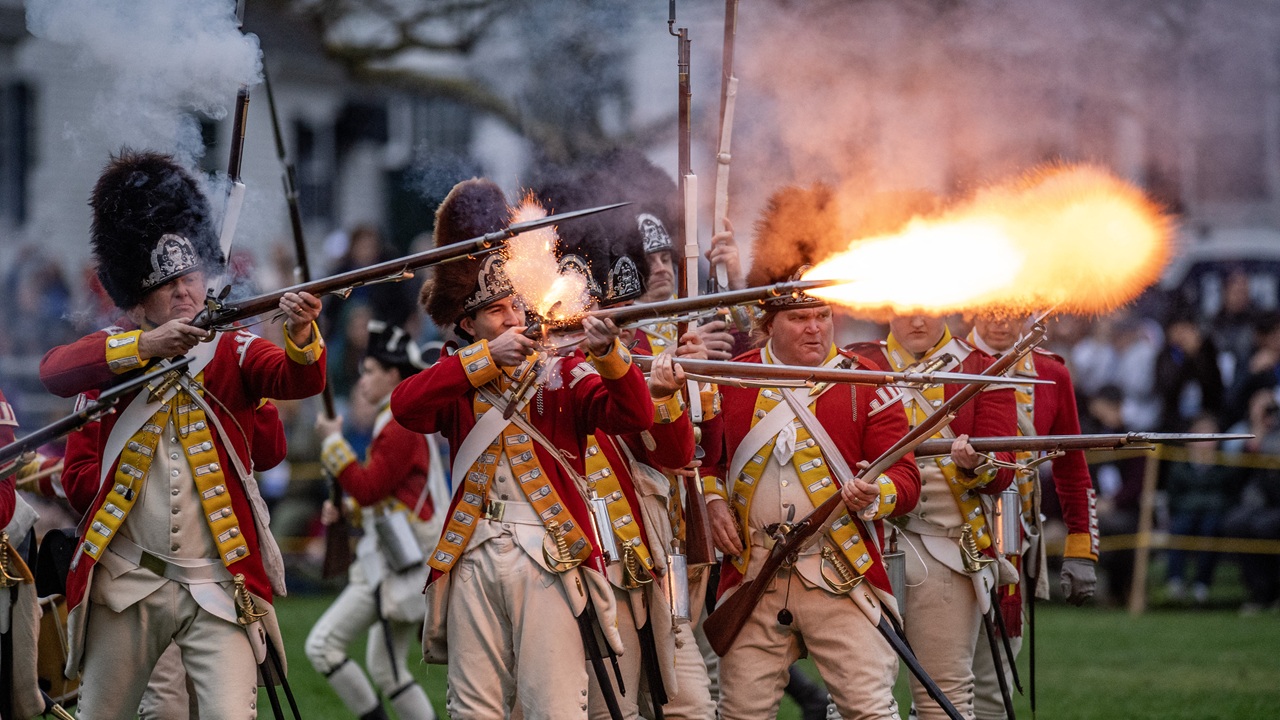
The following is a lightly edited transcript of a speech delivered on May 28, 2026, at the “Give Me Liberty or Give Me Death” Reenactment at The Heritage Foundation.
Britain’s seven year war with France came at a great cost. Its consequences would alter the world.
England accumulated a substantial amount of debt throughout the war. Parliament began to look to the American colonies, long used to governing themselves, as a solution to its problem. It imposed the Sugar and Stamp Acts of 1764 and 1765 to raise revenue from their “subjects.”
The Americans found the Stamp Act particularly grating. Not only was Parliament introducing taxation without representation, but colonial forms of communication—newspapers, almanacs, pamphlets, and other documents—would need stamps to circulate. While the stamps were of little financial cost, they impeded freedom of speech and deliberation, beliefs and practices central to the American character—a character fit for citizenship, not subjugation.
- Tensions grew following the Boston Massacre of 1770, when British troops fired on a group of protesters, wounding 11 and killing five.
- In the final month of 1773, the Sons of Liberty dumped tea into the frigid waters of the Boston Harbor.
- With the Intolerable Acts, Parliament closed the port of Boston, infested Boston’s streets with British troops and forced their quartering, and replaced elected officials with ones appointed by the royal governor.
American principles—freedom of speech, of representation, of consent—were being violated. And Paul Revere was at the ready.
TRENDING ARTICLES



The Boston native rode for five days from Massachusetts to Carpenters’ Hall in Philadelphia. In his hands was the response to the Intolerable Acts, the Suffolk Resolves. With him, he carried a question: Would the other colonies join Massachusetts against Great Britain? Was an attack on one part an attack on the whole?
Other localities had passed resolutions against Parliament, but perhaps none were as substantive as the Suffolk Resolves. The people of Massachusetts urged their fellow colonists to form local militias and boycott British goods.
But more than that, they contended that Parliament had committed “gross Infractions of those Rights to which we are justly entitled by the Laws of Nature, the British Constitution, and the Charter of the Province.” The ongoing dispute was not about mere manmade laws or the rights of Englishmen, but about natural law and the inalienable rights of mankind.
On Sept. 17, a day that now lives in our memory as Constitution Day, the first Continental Congress unanimously endorsed the Suffolk Resolves. In 1774, George Washington, Patrick Henry, John Adams, and Sam Adams were there, uniting Virginia and Massachusetts in Pennsylvania.
That brings us to Virginia. Many of the ideas of the Revolution spread through churches to the 70% to 80% of colonists who attended services on a regular basis. (The religious revival known as the Great Awakening had swept through America in the 1730s and 1740s, and the most referenced work of the Founding generation was the Bible.)
On March 20, 1775, a month before Lexington and Concord, the Second Virginia Convention gathered in St. John’s Church in Richmond. Its main objective was to elect delegates to the Second Continental Congress. The course of that weeklong convention would further solidify America’s principles.
Not to be out spirited by those Massachusetts Puritans, Anglican Patrick Henry introduced resolutions to form a Virginia militia.
But that was not the only point of commonality between the Suffolk Resolves and Henry’s endeavors. By 1775, the question of Revolution was upon America.
The Declaration of Independence describes the revolutionary act not simply as a right, but as a duty. A duty to whom? The Suffolk Resolves provides the answer:
“[I]t is an indispensable Duty which we owe to GOD, our Country, Ourselves and Posterity, by all lawful Ways and Means in our Power, to maintain, defend and preserve those civil and religious Rights and Liberties for which many of our Fathers fought—bled—and died; and to hand them down entire to future Generations.”
Knowing the same, Virginia’s orator spoke “freely and without reserve,” a “responsibility which we hold to God and our country. Should I keep back my opinions at such a time, through fear of giving offense, I should consider myself as guilty of treason towards my country, and of an act of disloyalty toward the Majesty of Heaven, which I revere above all earthly kings.”
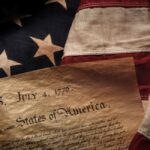
The Declaration of Independence was indeed an expression of the American mind, threading itself through Suffolk County, Massachusetts; Philadelphia, Pennsylvania; and Richmond, Virginia. It carries itself forward on the hearts of today’s citizens:
“And for the support of this Declaration, with a firm reliance on the protection of divine Providence, we mutually pledge to each other our Lives, our Fortunes and our sacred Honor.”

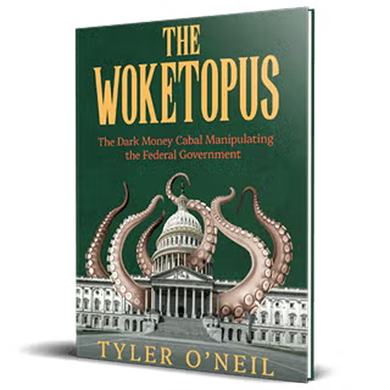
Read the first chapter of The Woketopus right now for FREE
Today, even with President Trump’s victory, leftist elites have their tentacles in every aspect of our government.
The Daily Signal’s own Tyler O’Neil exposes this leftist cabal in his new book, The Woketopus: The Dark Money Cabal Manipulating the Federal Government.
In this book, O’Neil reveals how the Left’s NGO apparatus pursues its woke agenda, maneuvering like an octopus by circumventing Congress and entrenching its interests in the federal government.
You can read the first chapter of this new book for FREE in this eBook, The Woketopus: Chapter One using the secure link below.
TRENDING ARTICLES

The Daily Signal depends on the support of readers like you.
RELATED ARTICLES


Don’t miss the

Don’t miss the signal