
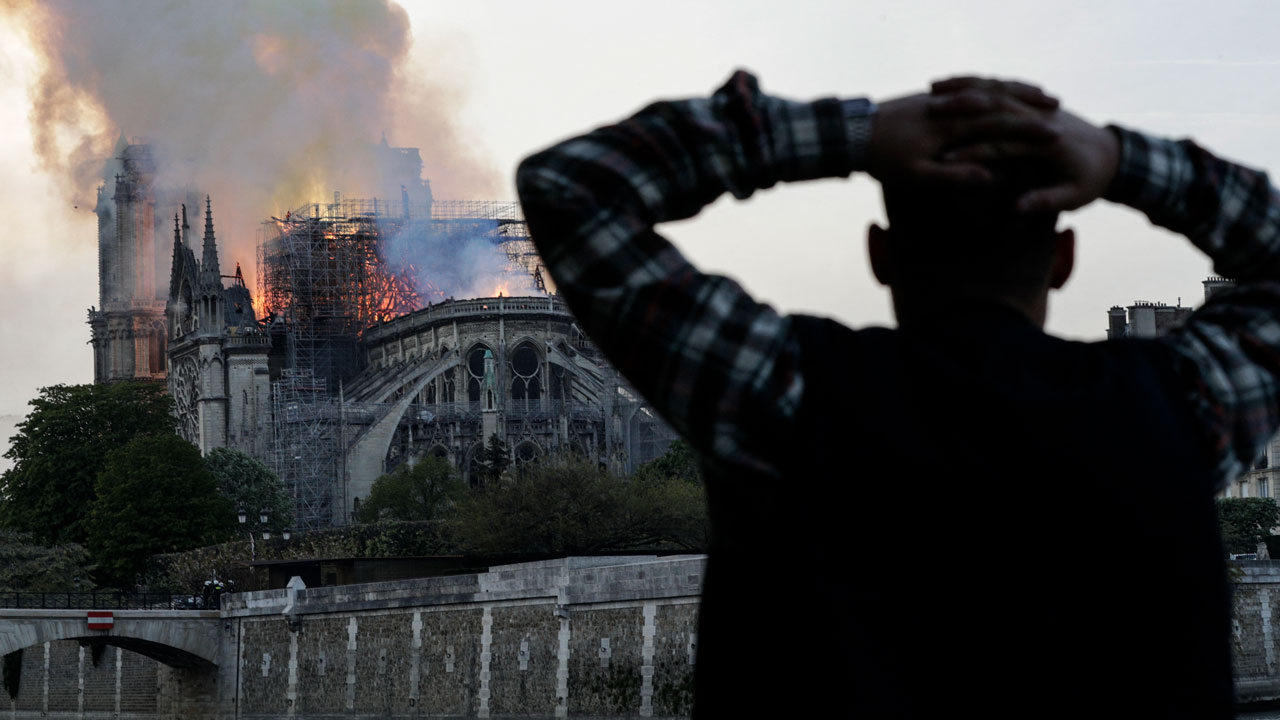
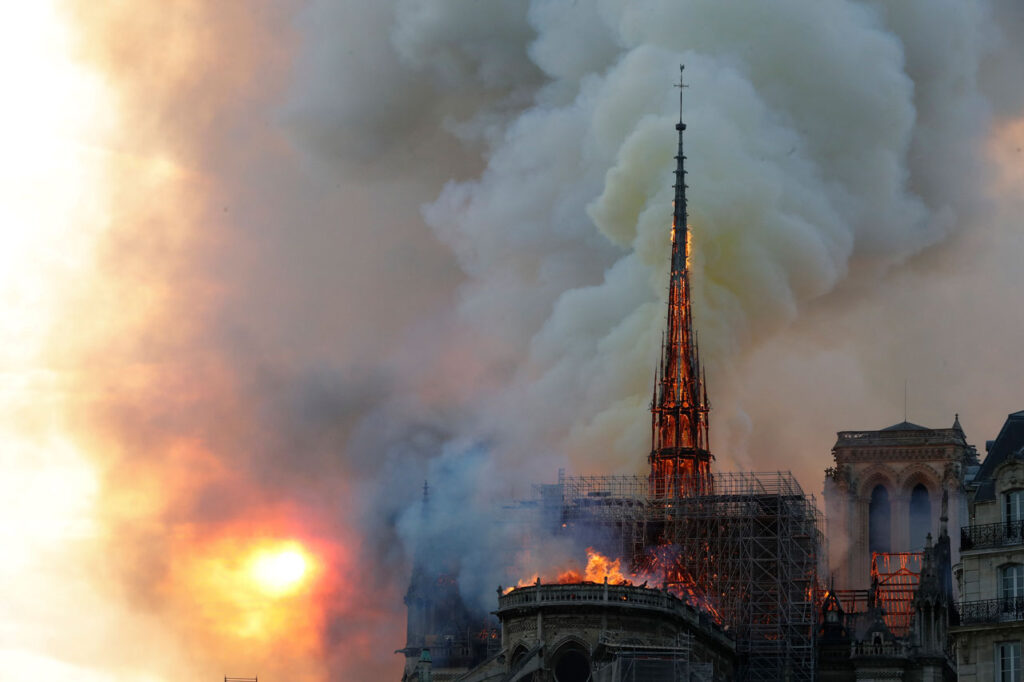
Bishop Robert Barron‘s new feature-length film, “Heaven in Stone and Glass,” begins with a scene of Notre-Dame cathedral in flames. I visited Paris three times before the devastating 2019 fire, and the cathedral was the one place I returned to on every trip. Watching the building burn was no easier on a movie screen than it was seven years ago.
The moment isn’t meant to make you mourn, however, but rather to cherish and appreciate the beauty of the great Gothic cathedral constructed during the Middle Ages.
Today, Notre-Dame is once again restored and open daily for Mass, welcoming the Catholic faithful and tourists from around the world.
The fire that captivated and shocked many like me inspired Barron to create Word on Fire’s first cinematic production.
“Heaven in Stone and Glass” premiered Saturday night at the Museum of the Bible ahead of a two-night theatrical release on Sept. 20 and 23. Tickets went on sale Friday.
The film spends 90 minutes exploring five Gothic cathedrals: Notre-Dame, Chartres, Reims, Amiens, and Saint-Denis. Barron and the filmmaking team from Spirit Juice Studios made something that serves not just as a history lesson but also a call to action.
TRENDING ARTICLES



Why the Fire Shook the World
Barron began work on the film shortly after the Notre-Dame fire in 2019. He was serving as auxiliary bishop for the Archdiocese of Los Angeles at the time. He wrote the script but filming was delayed by the COVID-19 pandemic and his 2022 appointment as bishop of the Diocese of Winona-Rochester in Minnesota.
The panel discussion that followed Saturday’s screening returned to what the world’s reaction to the fire revealed.
“A lot of buildings come and go. A lot of buildings burn down,” said the Rev. Steve Grunow, CEO of Word on Fire Catholic Ministries. “But this one—when it was burning, everyone was trembling. And then we didn’t just knock it down and put something in its place. People from all over the world contributed to the restoration of that building. And I think it’s because most of us knew intuitively, if that goes, we are all diminished in some way.”
For Barron, that instinct is an argument against the relativism he says has hollowed out the culture.
“If you take something seriously, you stop being a relativist,” he said. “All this appeal to relativism and ‘my truth, your truth.’ We say those things as long as we don’t really care. Once we care about something, we get very interested in the objectivity of it.”
That, he said, is why he thinks young people are turning to the faith in larger numbers today: “That drab materialism and relativism, it produces no energy in the soul.”
Centered on the Bible
Barron was joined on stage by Grunow; Rob Kaczmark and Branden Stanley of Spirit Juice Studios; and moderator Matthew Petrusek of the Word on Fire Institute.
Asked what role Scripture plays in the cathedrals, Barron recounted his years as a doctoral student in Paris.
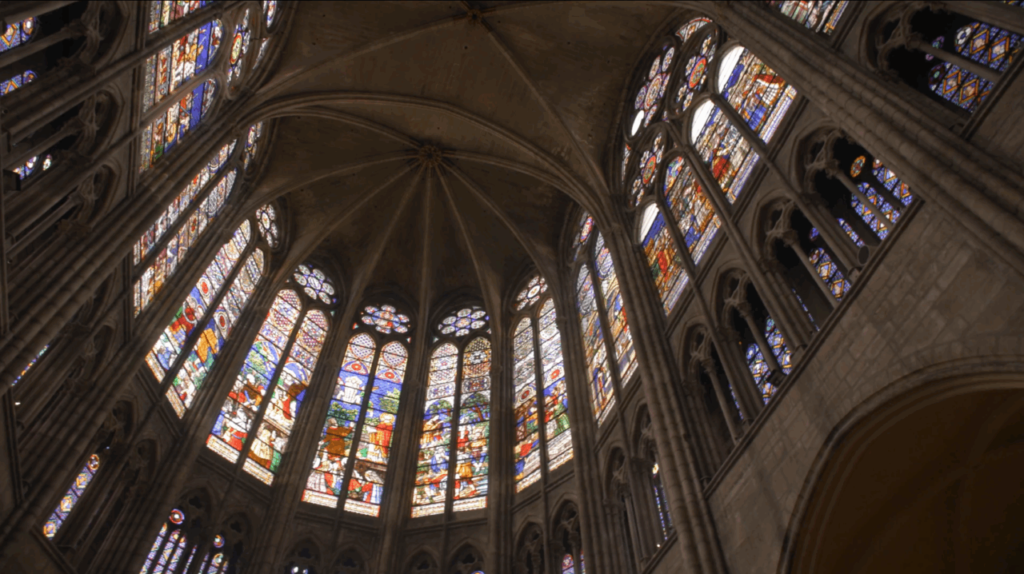
“I got on the train and I went down to Chartres by myself,” he recalled. “I left on a Friday, checked into a hotel, and I spent the entire weekend with a really good guidebook—not a tourist thing, but a really good book on Chartres—and looked at everything. I went to every window, every sculpture. I climbed the towers.”
What stayed with him wasn’t only the architecture.
“My enduring memory of that was how it stirred my biblical imagination,” Barron said.
He credited that weekend with eventually producing the Word on Fire Bible and a two-volume Old Testament commentary.
“A lot of that started with Chartres Cathedral,” he said. “So the Bible is everything.”
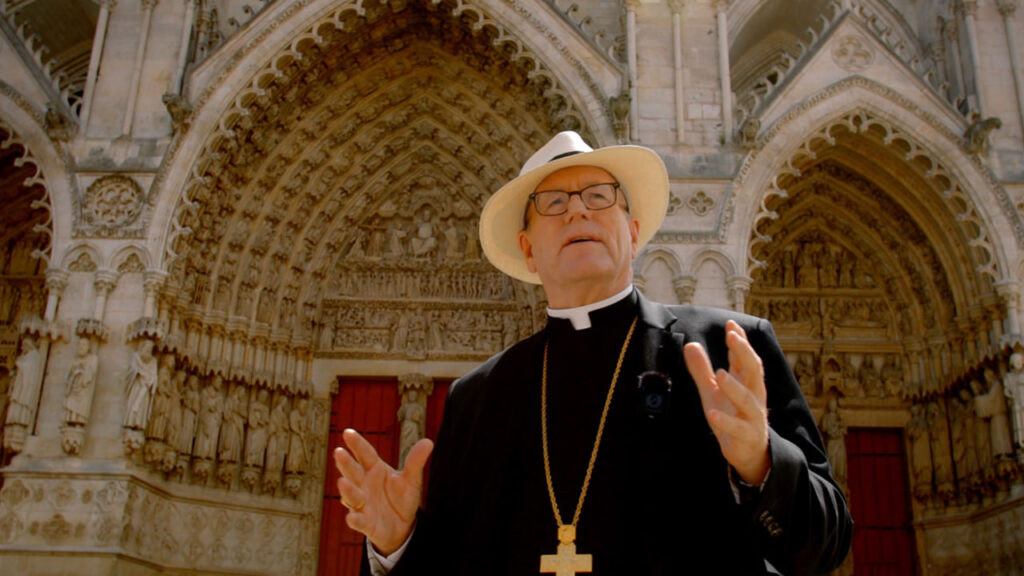
Grunow argued that most treatments of the cathedrals miss the role of the Bible.
“When you read a book about the history of the cathedrals or you see some other documentaries about them, they’ll stress the architecture, the mathematics of it and things like that, but not that which is the condition for its possibility, which is biblical revelation,” he said. “You take the scriptures, you take the revelation of God in the scriptures away from Western civilization—it’ll fall apart, but it also won’t make any sense.”
Bishop Barron: ‘I Want to Play’
Petrusek pressed the panel on Word on Fire’s own warning against religious nostalgia—the temptation to look at a film like “Heaven in Stone and Glass” and simply wish for the past.
Barron answered with a story about being 6 or 7 years old and going to his first Detroit Tigers baseball game with his father.
“I was caught up in the beauty of the place and the feel of the colors and the sounds and the play of these Detroit Tigers,” he said. “But what it led me to was: I want to play. I knew perfectly well I couldn’t play with the Detroit Tigers, but I started Little League the following summer.”
“When you see a great work of art like Chartres—well, I want to play. I want to make something beautiful. I want to contribute,” Barron said.
He traced his own work at Word on Fire back to a jet-lagged first day as a doctoral student in Paris when he dropped his bags and walked to Notre-Dame.
“I stood there for a half hour at the rose window,” he said. “Those are the deepest roots of Word on Fire. I saw all this great stuff, and, well, all right—I want to play.”
Grunow was blunter about the alternative: “Nostalgia is dangerous business when it gets its hold of religion, because if we’re living in the past, we’re living with this kind of idealized unreality. And it usually comes from a lack of confidence that meaning and purpose can be found in the present.”
Then he turned the point around.
“The evangelical challenge of a film like this is not to live in the past,” Grunow said. “Look what they did with the lack of resources they had, with the lack of technological know-how, with the lack of modern science and pharmacology and all these ideas. They didn’t have any of those things. And they raised these things up and they pushed civilization forward.”
He added: “So too it should be with us. What are we building and creating? Let’s get at it.”
Making the Movie
Chicago-based Spirit Juice Studios, a Catholic video production company, spent more than 45 days shooting the film at the five cathedrals in France, Stanley said.
“No matter how much time we spent in them, there was always something new to learn,” he said. “By the end of it, it’s like, ‘Wow, I never noticed that before.’”
To convey the buildings’ long history, the team shot sequences on actual Super 8 film.
“Certainly there are no videos from the 1700s or the 1600s, as cool as that might have been,” Stanley said. “But we do have the ability to shoot some of it on film.”
Another choice was purely practical. Barron, it turns out, likes to walk fast.
“When we were filming those scenes in the labyrinth, there was a conversation beforehand, and it was: shoot it in slow motion,” Stanley said, to the audience’s laughter.
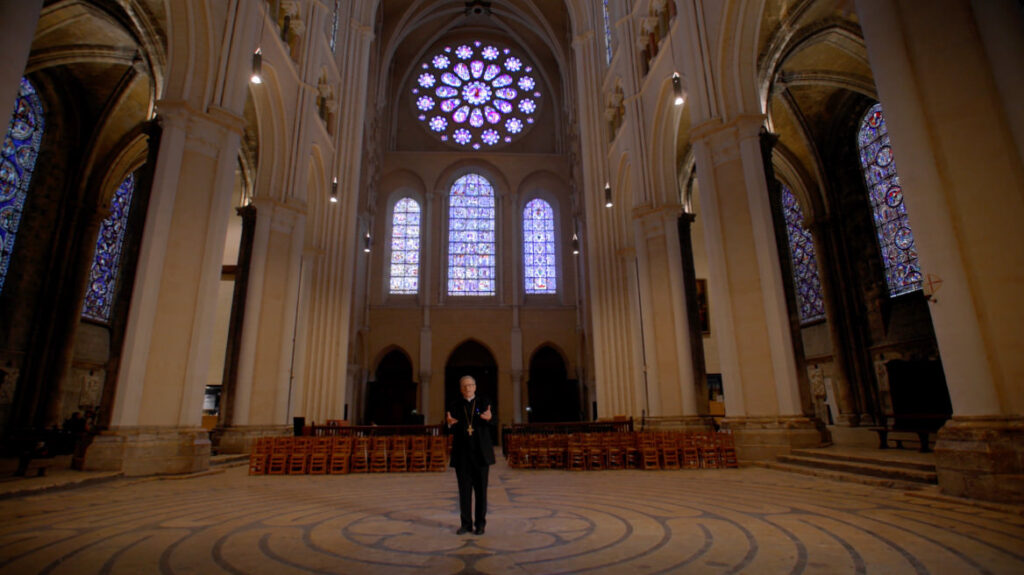
Kaczmark, who conducts informal asides with Barron throughout the film, said he was after something that captured candid moments.
“When things are authentic, there’s a sense of connection you have to it,” Kaczmark said. He recalled arriving in France during a difficult stretch in his own life: “I had been going through just some more challenging things in life leading up to the trip. These cathedrals, they’re beautiful, but for most of us are so far away, and I wanted to bring in the human aspect—when someone watches this, especially if they’re going through something.”
The film doesn’t shy away from the stranger parts of the cathedrals. Barron spends time on the gargoyles, the demons, and other unusual carvings that medieval builders put in plain sight.
“Yes, the saints and the sinners, the good and the bad, the ugly—it’s all in God’s creation and somehow in God’s providence fits,” Barron said. He added: “The loss of a sense of humor is a sign that you’ve lost your religion.”
Stanley said keeping that material in the film was a matter of trust with the audience.
“If we get to the point where we remove everything that could offend someone … people feel we’re giving them only part of the story. You lose trust,” he said. “You lose the ability to show them how to actually live in reality.”
What They Want From You
Petrusek closed by asking each panelist what he hopes audiences do after the credits roll.
Stanley: “Making a change in our church, making a change in our country doesn’t start at the top. It starts with all of us. It starts with little decisions and little calls to holiness.”
Kaczmark: “God works in those little times. And it’s really the people in your life. It’s your family members. … In the small ways you do grand things.”
Grunow: “Manifest your faith to this culture as Christians—less by arguing and more by building and creating a civilization that represents Christ.”
Barron: “Come closer to the Lord. The cathedral is meant to be a great symbol of Christ. … The whole purpose is to Christify you. When you go into a building like that, you’re being Christified. You’re being turned into the image of Jesus.”
“That’s what I would hope,” Barron concluded. “Watch the movie and say, ‘I want to enter more deeply into the mystery of Christ.’”
Word on Fire, working in tandem with Fathom Entertainment, has set a goal of getting “Heaven in Stone and Glass” into 1,000 theaters. Based on what I saw Saturday night, I hope Barron exceeds that goal—so others can see what people built for the glory of God and be inspired to build something themselves.


Read the first chapter of The Woketopus right now for FREE
Today, even with President Trump’s victory, leftist elites have their tentacles in every aspect of our government.
The Daily Signal’s own Tyler O’Neil exposes this leftist cabal in his new book, The Woketopus: The Dark Money Cabal Manipulating the Federal Government.
In this book, O’Neil reveals how the Left’s NGO apparatus pursues its woke agenda, maneuvering like an octopus by circumventing Congress and entrenching its interests in the federal government.
You can read the first chapter of this new book for FREE in this eBook, The Woketopus: Chapter One using the secure link below.
TRENDING ARTICLES


The Daily Signal depends on the support of readers like you.
RELATED ARTICLES




Don’t miss the

Don’t miss the signal