
AI Companies, Data Centers Must Defend Themselves—Silence Is No Weapon Against the Exploding Backlash

Artificial intelligence companies and the data centers that power them are devoting mouth-watering sums to achieve their potential. The Wall Street Journal reports that Microsoft, Alphabet (Google’s parent company), Meta, and Amazon are “expected to spend more than $670 billion this year” on capital expenditures. McKinsey & Company forecasts that “global spending on data centers could reach $7 trillion by 2030.”
As this cash cascades, one would expect citizens and politicians to dispatch marching bands and cheerleaders to celebrate these virtually infinite investments and seduce the CEOs who allocate them.
Hardly.
AI firms and data centers would be lucky to be treated like Rodney Dangerfield.
On June 2, voters in Monterey Park, California, approved a permanent moratorium on data centers. It passed 86% to 14%. Interconnected Capital’s database confirms 127 data center bans in jurisdictions across 40 states, including 11 perpetual prohibitions.
Sen. Bernie Sanders, I-Vt., and Rep. Alexandria Ocasio-Cortez, D-N.Y., have introduced a federal freeze on data centers. Sanders also proposes 50% nationalization of the largest AI companies.
TRENDING ARTICLES



Some AI haters want blood.
“The ship may have sailed on nonviolence,” said Stop AI activist Sam Kirchner, per Zusha Elinson’s superb expose on anti-AI extremism in Monday’s Wall Street Journal. On April 6, someone fired 13 shots at the home of Indianapolis City Councilman Ron Gibson. A note on his doorstep read: “NO DATA CENTERS.”
Four days later, police say, Daniel Moreno-Gama hurled a flaming Molotov cocktail at OpenAI CEO Sam Altman’s San Francisco mansion. Moreno-Gama, 20, then allegedly drove to OpenAI’s nearby headquarters, attempted to shatter its glass doors with a chair, and announced his wish to burn it down and kill those inside.
Moreno-Gama pleaded not guilty to two federal counts of attempted murder and other crimes, including exploding or igniting a destructive device. At that time of the incident, officials say, he carried an anti-AI screed on his person.
How do these companies defend themselves amid escalating acrimony and aggression? What is the great, big, beautiful tomorrow that AI envisions? What is the case for data centers?
Who knows?
I have looked fruitlessly for any such advertising or public relations campaign. What little message exists fails miserably to confront AI’s foes.
“Granola is not for breakfast,” a Manhattan billboard declared. “It’s the AI notepad for meetings.” This is the only ad I have seen that suggests how AI improves anyone’s life.
Rather than engage everyday people, most AI ads parrot techno-jargon.
“Encore: The data layer for physical AI,” a sign stated beside Highway 101, just south of San Francisco. Another: “Best AI runs on Coreweave.”
Reconcile AI is maddeningly cryptic: “AI for prod.”
“You can just build [a game engine] with CODEX,” explained one OpenAI ad. If you work at Nintendo, great. If you are no tech bro, ho hum.
AI companies do pitch to marketing professionals:
An AirOps ad says: “See how AI search describes your brand, then optimize for it.”
Wooing marketing MBAs is fine. But such messages do not soothe workers who fear AI will wolf down their jobs with no upside to such downsizing.
Neither technobabble nor marketing lingo impress regular consumers. Most AI ads are akin to the F-150 truck ditching its durability claim—“Built Ford Tough”—and instead selling “5-link coil rear suspension with Panhard rod!”
While AI companies say little to average Americans, at least their lips move—slightly. The data-center industry is getting jackhammered in the court of public opinion. It has yet to plead not guilty.
The precisely three pro-data center messages I have seen are all by outsiders.
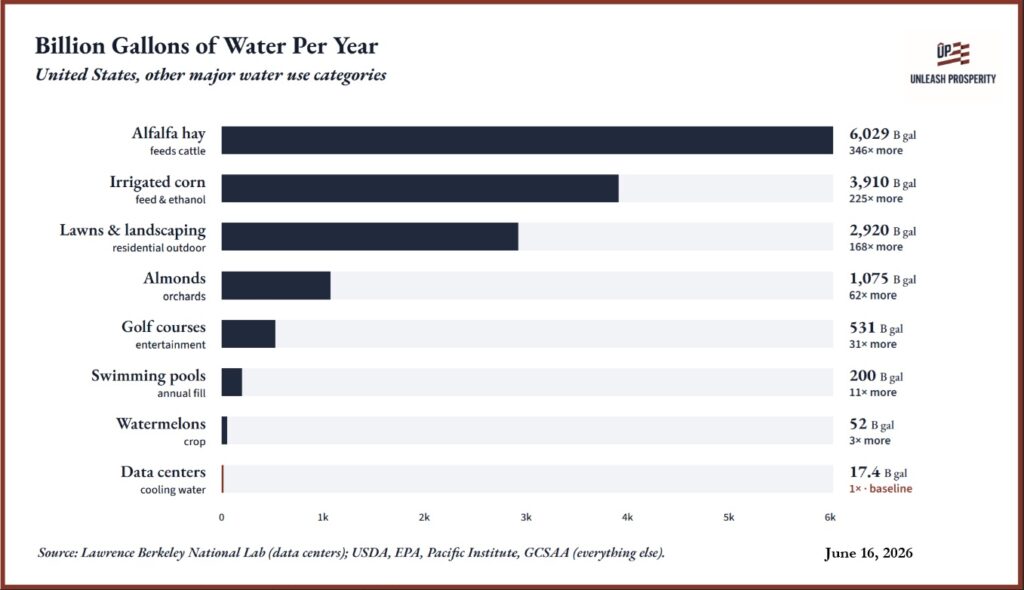
• The pro-market group Unleash Prosperity’s first-rate graph provides desperately needed perspective on water-cooled data centers’ humungous H2O use—a key criticism.
Data centers devour 17.4 billion gallons of water annually. How dare they?
What about watermelons? They absorb 52 billion gallons of water—thrice what the “evil” data centers require.
Golf courses use 531 billion gallons—31 times what data centers use.
Imagine that Americans suddenly craved data centers, and they exploded 200-fold. They still would use less water than the 3.91 trillion gallons required to grow corn for food and ethanol—225 times what data centers swallow.
Data-centerphobes should yank the hay from cows’ mouths and demand a permanent moratorium on alfalfa hay farms. They guzzle 6.03 trillion gallons annually—346 times what the “demonic” data centers gulp. When will OpenAI’s adversaries lob Molotov cocktails at hay farms?
• Free-market stalwart John Stossel’s YouTube video details how decades-old government limits on electricity force AI companies and data centers to compete with consumers for megawatts. Between 2000 and 2025, Stossel laments, “Connecting a new plant to the grid has gone from two years to now eight years.”
• Meanwhile, critics contend that every patch of grass in Virginia soon will be paved over as data centers proliferate and benefit only their multi-billionaire owners. Regardless, The Atlantic praised these facilities—from the Left.
Data centers occupy 3% of Loudoun County’s land but pay almost half of its property taxes, Elias Wachtel reported on June 12. “We’ve been able to build 32 schools, and 16 fire stations, and six libraries, and miles of roads, and more than 1,000 acres of parks and recreation, and started an affordable-housing program,” Loudoun’s Chief Development Officer Buddy Rizer, told Wachtel, “all while lowering the tax rate on our citizens.”
The data center industry should turn that into a 30-second ad, stick $100 million behind it, and run it until Americans cry: “Uncle!”
Instead, the apparent strategy is for AI and data-center executives to hide beneath their desks and hope that their nemeses go away. They won’t. They will torture these companies until they are demoralized into surrender, partially or fully nationalized, or strangled with red tape.
From higher productivity to faster cures and deeper innovation, AI offers possibilities still unimagined. And yet the AI and data center industries fail to defend themselves against these potentially lethal assaults.
AI’s mortal enemies are scaling the front gates. They face not even slingshot fire.
We publish a variety of perspectives. Nothing written here is to be construed as representing the views of the Daily Signal.

Read the first chapter of The Woketopus right now for FREE
Today, even with President Trump’s victory, leftist elites have their tentacles in every aspect of our government.
The Daily Signal’s own Tyler O’Neil exposes this leftist cabal in his new book, The Woketopus: The Dark Money Cabal Manipulating the Federal Government.
In this book, O’Neil reveals how the Left’s NGO apparatus pursues its woke agenda, maneuvering like an octopus by circumventing Congress and entrenching its interests in the federal government.
You can read the first chapter of this new book for FREE in this eBook, The Woketopus: Chapter One using the secure link below.




The Daily Signal depends on the support of readers like you.
RELATED ARTICLES





Don’t miss the

Don’t miss the signal