America Won’t Lose the AI Race for Lack of Ideas—but We Might Lose It for Lack of Compute

The front line in the fight over AI runs through Utah.
In Box Elder County, a remote valley near the Great Salt Lake, residents are fighting a proposed AI data center, which would be one of the largest ever. Some 4,000 people filed formal objections over its water use. Developers pulled their application but say they plan to try again.
Utah isn’t the only such battle. Across the country, data centers are hitting local resistance. In Northern Virginia, residents oppose new power lines and substations. In Florida, a massive project collapsed after local pushback. In rural America, landowners are rallying to stop projects they once would have welcomed. Even state lawmakers are getting nervous. Some now talk about outright bans on new data centers.
On the surface, residents are protesting the use of water, power, and land. But there have been thousands of data centers built in the past without much fanfare. Why are so many Americans suddenly so opposed to data centers in their area?
Critics of these campaigns argue that this is the result of dark and even foreign money. Investor Kevin O’Leary has claimed these campaigns are funded by China, which stands to gain the most from a slowdown in AI development in the U.S. Interior Secretary Doug Burgum recently said that these protests “are not organic and local. Some of this is foreign-sourced dark money” that used to be spent on climate change protests.
This isn’t idle speculation. The American Energy Institute has found evidence that foreign sources (many in Europe) have spent some $39 million on the campaigns.
TRENDING ARTICLES



Still, as a political fact, the local hostility to these data centers is real. And some of the complaints make sense.
Large language models such as Grok, Claude, and ChatGPT are not just software. They need “compute,” that is, hardware, infrastructure, and energy. In other words, they need data centers and their prerequisites.
Building and sustaining data centers requires large spaces, massive construction projects, and stacks and stacks of servers using advanced GPUs, which draw as much power as a small city. To stay cool—which they must—data centers need either water or cooling systems that use even more electricity. They raise concerns about noise and air pollution.
Take just one of the examples above: electricity. Prices have climbed fast in recent years and data centers have played a role in this. The Department of Energy estimates “that data centers consumed about 4.4% of total U.S. electricity in 2023 and are expected to consume approximately 6.7 to 12% of total U.S. electricity by 2028.”
Next, AI lacks the intuitive appeal of, say, farms, rockets, and car factories. It doesn’t help that many tech entrepreneurs speak of AI as a threat to all that is good and holy. “With artificial intelligence, we are summoning the demon,” Elon Musk said at an MIT conference way back in 2014. “You know all those stories where there’s the guy with the pentagram and the holy water and he’s like … yeah, he’s sure he can control the demon, [but] it doesn’t work out.”
Finally, among conservatives at least, Big Tech companies such as Google and Meta (the parent company of Facebook), don’t exactly enjoy stellar reputations. They overwhelmingly support left-wing causes. They also targeted and censored conservatives and heterodox voices during the lockdowns.
Is it any wonder that their sudden appeal to patriotism seems cynical? As Mike Cernovich put it on X:
Data centers are a concrete symbol of an industry that, in the mind of much of the public, is opaque, scary, and led by oligarchs who often seem hostile to everyday Americans. This makes them ideal targets for public anger.
The Disastrous Data Center Bottleneck
Alas, none of this changes the fact that a data center bottleneck is a looming disaster if we want to stay ahead of the Chinese Communist Party.
Today, the U.S. leads the world in artificial intelligence and in compute. The U.S. has eight times more capacity than any other country. American spending on data centers was about $425 billion in 2025. Some $52 billion was spent just on construction. And still, demand is expected to triple between now and 2030.
China is behind the U.S., but it has far fewer local veto points. If our rival in the Far East needs more land or water, it takes it. If it needs more electricity, it can build another coal-fired power plant without worrying much about local critics or fussy environmentalists.
Separation of power, local control, and public input distinguish us from the one-party autocracy in China. We don’t want to lose the very things that make our country better than China. If we limit our own ability to train and deploy advanced AI, however, we could quickly lose our edge and even our status as the unique rival to Chinese hegemony.
AI is not a quirky side gig of lefties clustered on the east and west coasts. It is the most powerful general-purpose technology of our age—perhaps of any age. Like electrification, internal combustion engines, and computers, it will touch every other industry and sector. And right now, it is advancing so quickly that staying even six months ahead of China could prove decisive.
If the U.S. falls behind in the AI race, it will probably not be because we lacked the expertise or the energy resources. It could be because, in 2026, we could not find a way to preserve the virtues of our constitutional republic while opening the data center bottleneck.

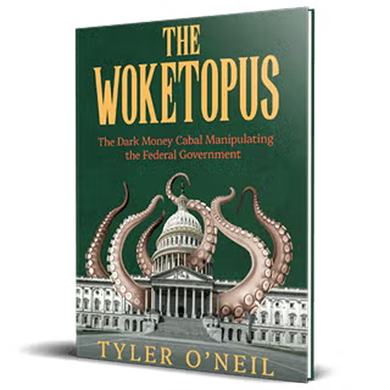
Read the first chapter of The Woketopus right now for FREE
Today, even with President Trump’s victory, leftist elites have their tentacles in every aspect of our government.
The Daily Signal’s own Tyler O’Neil exposes this leftist cabal in his new book, The Woketopus: The Dark Money Cabal Manipulating the Federal Government.
In this book, O’Neil reveals how the Left’s NGO apparatus pursues its woke agenda, maneuvering like an octopus by circumventing Congress and entrenching its interests in the federal government.
You can read the first chapter of this new book for FREE in this eBook, The Woketopus: Chapter One using the secure link below.
TRENDING ARTICLES


The Daily Signal depends on the support of readers like you.
RELATED ARTICLES





Don’t miss the

Don’t miss the signal