
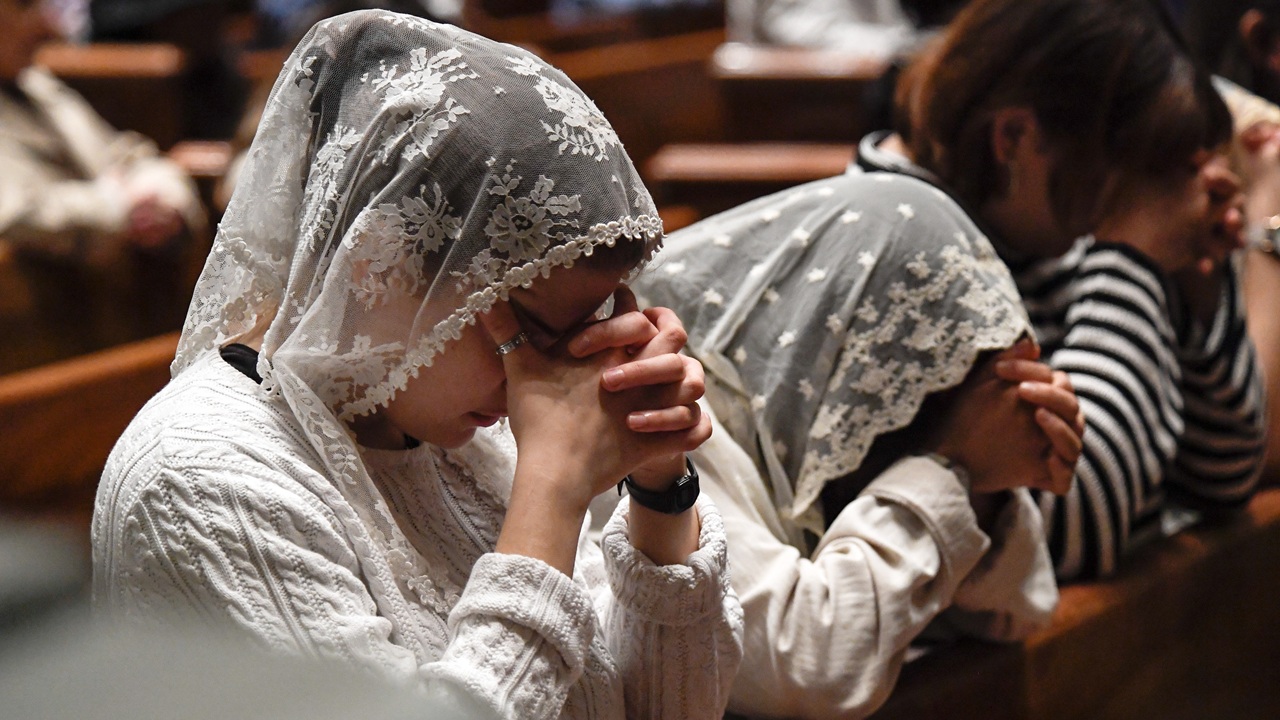
A few weeks ago, The New York Times reported on a new trend of young adults returning to or joining the Catholic Church, despite decades-long cultural attacks on that institution from political and cultural elites.
The article quotes Archbishop Mitchell Thomas Rozanski of St. Louis, who said, “In our age of uncertainty, and in our age of great anxiety, is a thirst and hunger for God and stability that faith brings to people’s lives.”
It would seem that this is not just wishful thinking. The overall percentage of Gen Z identifying as Christians has increased in recent years. Around 45% identified as such in 2023, with 51% doing so in 2025.
What is driving this return to faith?
Young adults, tired of digital isolation and cultural cynicism, desire authentic faith and community. They want more than the world has to offer—a higher purpose than the cultural mantra of “you do you.” They desire community beyond text messages and swiping right on their smartphones.
I would like to think that they are yearning for God and the stability that faith brings in a world of increasing chaos. Why? Because, as Alexis de Tocqueville noted back in the early 1800s in his observations about America, churches and other faith communities “form a society,” and without them, society disintegrates into individualism and moral confusion—which pretty much sums up our current political and cultural state.
TRENDING ARTICLES



As I write in my new book “What Really Matters: Restoring a Legacy of Faith, Freedom, and Family,” it is faith that gives us purpose, molds men into strong and compassionate leaders, provides protection and provision for women and children, and binds us together rather than pulls us apart.
And as Tocqueville witnessed, America was built on civic groups and other associations such as churches. Without them, society quickly becomes morally, emotionally, and physically adrift.
In contrast, when a nation has a vibrant and unifying faith, the “all about me” mantra that results in increasing isolation and disillusionment becomes increasingly less appealing. That is what I believe is happening with these young adults.
What else might be driving these young people back to faith? The answer can perhaps be found in these words from the late James Q. Wilson, written in 2002: “The right and best way for a culture to restore itself is for it to be rebuilt, not from the top down by government policies, but by the bottom up by personal decisions. On the side of that effort, we can find churches—or at least many of them—and the common experience of adults that the essence of marriage is not sex, or money, or even children: it is commitment.”
Being committed to a church body strengthens other commitments in life—as Wilson noted—to marriages and families, which provide the cornerstone upon which a healthy society is constructed.
Membership in a faith community can provide the cure for isolation and loneliness.
It is faith that provides the spiritual and emotional bonds between two adults, who make a lifelong marital commitment to each other, and in turn to nurturing and raising emotionally and spiritually healthy children.
It is faith that results in good personal decisions, rather than disastrous ones.
It is faith that brings personal and cultural restoration, rather than placing a government-subsidized bandage to try to stem the bleeding while ignoring the cause of the problem in the first place.
Most of all, it is faith that builds a solid personal foundation upon which positive life-changing results can be built—results that are not possible from secular governmental solutions, which offer no antidote or hope for an empty and searching soul, but instead pit neighbor against neighbor in a zero-sum war.
That is why we need to look at the current trend of increased interest in faith by young adults as a long-term investment instead of a short-term gain. With so many cultural headwinds seeking to drive them away from faith, we need to seize the opportunity to help keep them on the path of faith, rather than letting their commitment be strangled by the thorns of this world.
It is this faith that will allow young people—and our society—to flourish and commit to the common good, rather than to wither and succumb to selfish desires.
To do that, we must continue to provide young adults with not a watered-down faith, but one that provides hope, community, and moral certainty—which is what a society built upon the foundation of “faith, freedom, and family” exemplifies.
We publish a variety of perspectives. Nothing written here is to be construed as representing the views of the Daily Signal.


Read the first chapter of The Woketopus right now for FREE
Today, even with President Trump’s victory, leftist elites have their tentacles in every aspect of our government.
The Daily Signal’s own Tyler O’Neil exposes this leftist cabal in his new book, The Woketopus: The Dark Money Cabal Manipulating the Federal Government.
In this book, O’Neil reveals how the Left’s NGO apparatus pursues its woke agenda, maneuvering like an octopus by circumventing Congress and entrenching its interests in the federal government.
You can read the first chapter of this new book for FREE in this eBook, The Woketopus: Chapter One using the secure link below.
TRENDING ARTICLES


The Daily Signal depends on the support of readers like you.
RELATED ARTICLES




Don’t miss the

Don’t miss the signal
