
Supreme Court Considers Whether the First Step Act Allows Reduction in Criminal Sentences
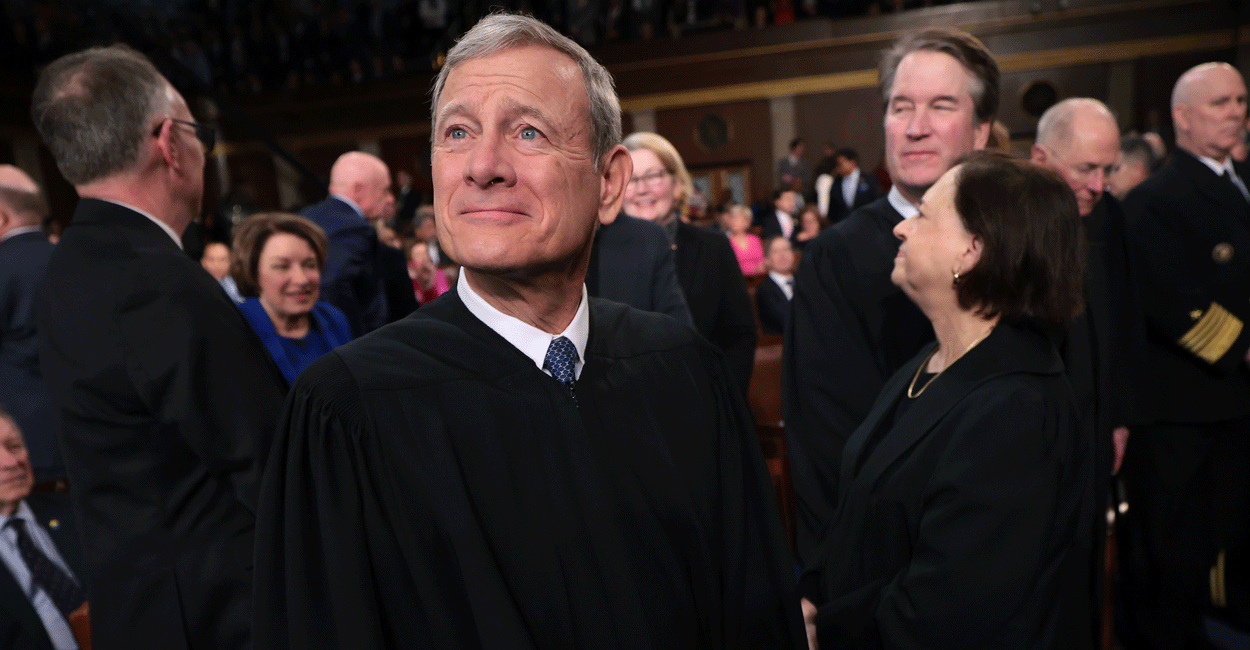
The Supreme Court heard arguments Wednesday on whether convicted felons can petition for reduced sentencing under the First Step Act, a criminal justice reform law that President Donald Trump signed during his first term.
The cases focus on what criteria a federal judge can consider in reducing a prisoner’s sentence, and whether this can include the sentencing law from 2018.
The U.S. Sentencing Commission has said judges can use the 2018 reform law as a factor to consider in deciding whether to reduce a sentence. However, judges have differed on whether sentences issued before the First Step Act are bound to existing law.
The Justice Department has argued for maintaining the existing sentences.
The Supreme Court heard three separate criminal sentences on Wednesday: Fernandez v. United States and then the consolidated case of Rutherford v. United States and Carter v. United States.
The First Step Act, enacted in 2018, permits district courts to reduce some lengthy sentences if there is an “extraordinary and compelling reason.”
TRENDING ARTICLES



A jury convicted Joe Fernandez of participating in a 2000 murder-for-hire conspiracy, even though the government’s key witness had admitted to lying to authorities in previous cases. He received a mandatory life sentence in 2014. Seven years after sentencing, a district court judge found “extraordinary and compelling reasons” to reduce Fernandez’s sentence, including the possibility that Fernandez had been innocent.
The U.S. Court of Appeals for the 2nd Circuit reversed the ruling, finding that the First Step Act’s compassionate release was not the proper venue for litigating his potential innocence or challenging the conviction’s validity.
Benjamin Gruenstein, arguing for Fernandez, said the government was taking an unreasonable position.
“Under the plain meaning of the statute, if a court finds an error that’s significantly increased the length of the defendant’s sentence, that fact can contribute to a finding of extraordinary and compelling reasons to reduce the sentence,” Gruenstein told the justices. “Even when a court finds no error, it may nonetheless decide that the circumstances surrounding the defendant’s sentence were so unusual and unfair as to be extraordinary and compelling. That’s what happened here. The government’s position is extreme. It contends that no argument related to a defendant’s judgment may even be considered in the extraordinary and compelling calculus.”
However, Deputy Solicitor General Eric Feigin argued the reform law creates “narrow exceptions” for reducing sentences that are not otherwise specifically addressed.
“What you’ve just heard and what’s in their briefs is a proposal to make it instead an open-ended loophole to challenge the validity of sentences, continuously through a potentially endless series of collateral attacks on the criminal judgment,” Feigin told the justices.
The other consolidated case involves two separate individuals convicted in robbery cases, Daniel Rutherford and Johnnie Carter, who each claimed similar “extraordinary and compelling” reasons for a reduction in their sentences under the First Step Act.
Right on Crime, a conservative group that advocates for sentencing reforms, filed an amicus brief in the Rutherford v. United States case.
Rachel Wright, the national policy director for Right on Crime, said in a video post that early release for inmates with medical issues or who are otherwise low risk strengthens law enforcement and is fiscally responsible.
“It’s still holding accountable those offenders who have committed the crimes, they’re incarcerated, but it’s allowing for equal justice under the law,” Wright said. “You should not have a totally different sentence, sometimes ranging from 15 to 20 years longer, just based on the time that you committed the crime.”
Rutherford received a mandatory minimum sentence of 32 years and Carter received 57 years. Under the First Step Act, which reversed some mandatory minimum sentences, their sentences would have been 18 years and 36 years, respectively. District courts denied their petitions for a reduced sentence. The U.S. Court of Appeals for the 3rd Circuit affirmed both sentences.


Read the first chapter of The Woketopus right now for FREE
Today, even with President Trump’s victory, leftist elites have their tentacles in every aspect of our government.
The Daily Signal’s own Tyler O’Neil exposes this leftist cabal in his new book, The Woketopus: The Dark Money Cabal Manipulating the Federal Government.
In this book, O’Neil reveals how the Left’s NGO apparatus pursues its woke agenda, maneuvering like an octopus by circumventing Congress and entrenching its interests in the federal government.
You can read the first chapter of this new book for FREE in this eBook, The Woketopus: Chapter One using the secure link below.




The Daily Signal depends on the support of readers like you.
RELATED ARTICLES





Don’t miss the

Don’t miss the signal
