
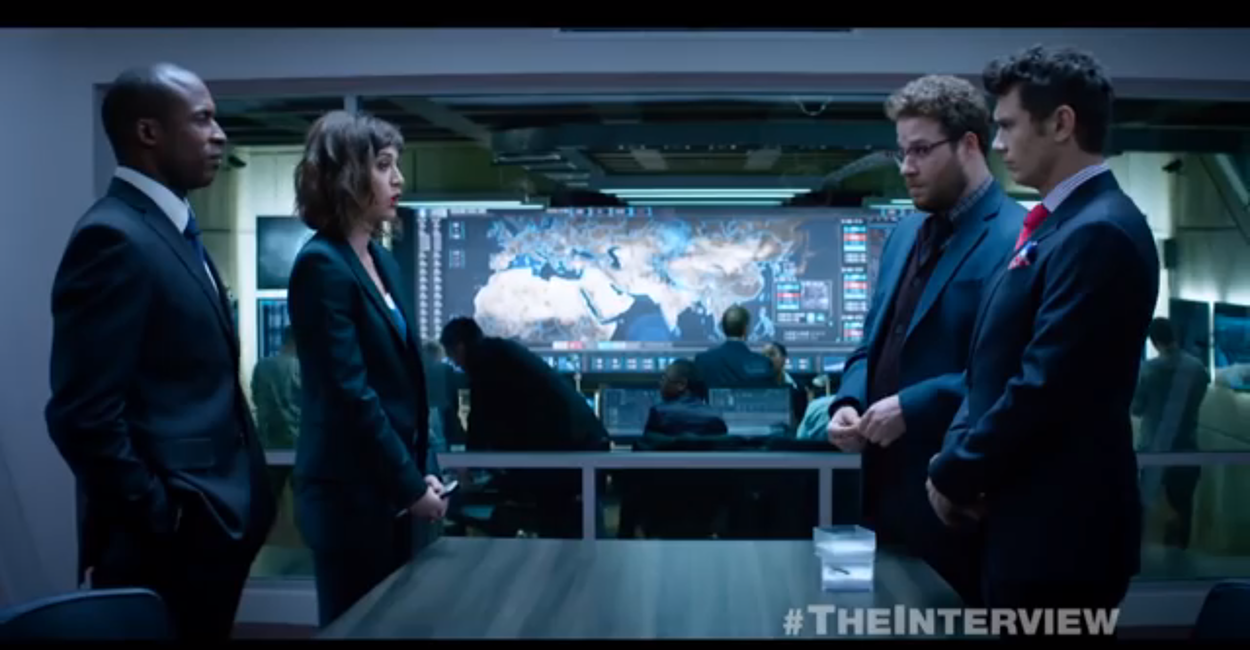
How should the United States respond to the cyberattack on Sony Pictures? One group says we should hack them back.
After the FBI said North Korea was responsible for the hack, the Human Rights Foundation launched a campaign called #HackThemBack, an initiative to “hack” the Kim regime by providing its citizens with information about liberty, freedom and human rights.
The activists will conduct the “hack” by launching films, books and USBs full of Korean-language Wikipedia pages into North Korea.
The foundation will use “hydrogen balloons to airlift material beyond the DMZ (demilitarized zone); land-based smuggling routes through the dictatorship of China; and radio transmissions and programming to reach those who own forbidden tunable short wave radios” to send information into the Hermit Kingdom.
The Human Rights Foundation called #HackThemBack a “nonviolent” and a “civil society response.”
TRENDING ARTICLES


“#HackThemBack is a peer-to-peer approach, where anybody who is concerned can empower the underfunded yet courageous men and women who are bringing about change in North Korea through the power of information and ideas,” said chief operating officer Sarah Wasserman in a statement. “Totalitarianism cannot bear an informed and educated citizenry, aware of the option to live in freedom, to participate in their own destinies, and to enjoy the civil rights that so many take for granted in a democracy.”
The foundation said North Korea is dependent on propaganda to control its citizens. Despite the authoritarian regime, HRF said, North Koreans are “hungry for a better life.” They risk their lives to watch contraband Hollywood films.
Films and TV shows the group has previously launched into North Korea include “Braveheart,” “Freedom’s Fury,” “Titanic,” “Team America” and “Desperate Housewives.” They hope to include “The Interview” in a future launch.
At the Oslo Freedom Forum in October 2014, Yeonmi Park, a North Korean defector and a member of HRF, described how seeing “Titanic” changed her outlook on North Korean life.
“When I was growing up in North Korea, I never saw anything about love stories between men and women,” Park said. “There is no books, no songs, no press, no movies about love stories. There is no ‘Romeo and Juliet.’ Every story was to brainwash about the Kim dictators.”
She said when she saw the film, she “was wondering if the director and the actors would be killed,” thinking “How could they release such a movie? I was so curious.”
Park said that North Koreans are taught through propaganda that “dying for the Kim regime was the most honorable thing anyone could do,” and the regime produces films to reinforce this belief. She described being “inspired” as a child by one such film.
Then, Park saw “Titanic”—and it gave her “a taste of freedom”:
I realized that ‘Titanic’ showed me a human story about love, beauty, humanity … it wasn’t propaganda, but a story about people dying for love, a man willing to die for a woman. It changed my thinking. It changed the way I saw the regime and the endless propaganda. ‘Titanic’ made me realize that I was controlled by the regime.
In a recent issue brief, David Inserra, a Heritage Foundation research associate for homeland security and cybersecurity, and Bruce Klingner, a senior research fellow for Northeast Asia at The Heritage Foundation, advocated several courses of action the United States could take to respond to the cyberattack, including returning North Korea to the state sponsors of terrorism list:
North Korea poses a growing national security threat to the United States and its allies. Pyongyang continues to augment and refine its nuclear and missile arsenals. In recent years, the regime has conducted cyber attacks against government and private targets. Without a firm response from the U.S. to North Korea’s hack of Sony and subsequent threat of terrorism, such attacks and threats against the U.S. and her interests will only grow more common.
The United States recently issued more sanctions on North Korea after the attack. The Obama administration called the attack “supported by” Pyongyang, while Pyongyang has repeatedly denied responsibility.
You can learn more about the #HackThemBack initiative on Indiegogo.


Read the first chapter of The Woketopus right now for FREE
Today, even with President Trump’s victory, leftist elites have their tentacles in every aspect of our government.
The Daily Signal’s own Tyler O’Neil exposes this leftist cabal in his new book, The Woketopus: The Dark Money Cabal Manipulating the Federal Government.
In this book, O’Neil reveals how the Left’s NGO apparatus pursues its woke agenda, maneuvering like an octopus by circumventing Congress and entrenching its interests in the federal government.
You can read the first chapter of this new book for FREE in this eBook, The Woketopus: Chapter One using the secure link below.
TRENDING ARTICLES


The Daily Signal depends on the support of readers like you.
RELATED ARTICLES


Don’t miss the

Don’t miss the signal
