
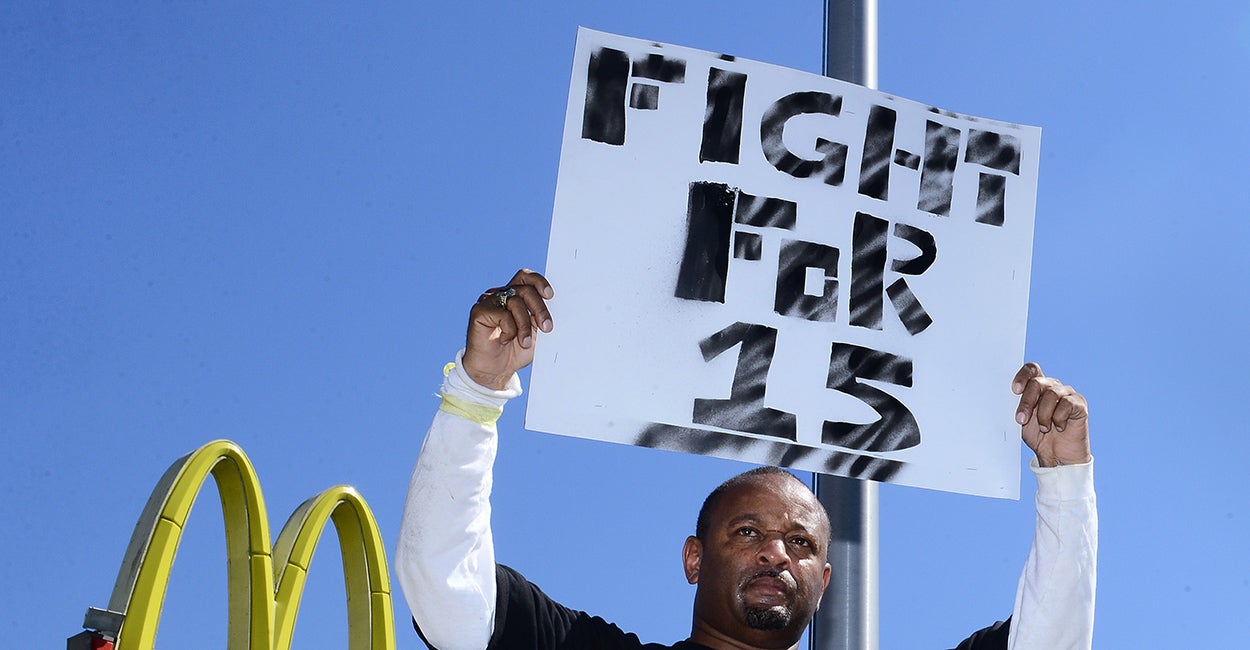
The Los Angeles City Council voted to raise the city’s minimum wage to $15 an hour by 2020, a move that will help some workers at the expense of others and lead to higher prices for consumers as businesses pass along the new expense.
Occupational Employment Statistics estimates that there are 837,000 people in Los Angeles County working in professions where at least 75 percent of the employees make less than $15 in 2020 inflation-adjusted dollars. (In 2020, $15 will buy what $13.41 bought in 2014, according to the Congressional Budget Office forecast.) Those professions include one in seven workers in the county. Since the proposed law only applies to the City of Los Angeles, workers elsewhere in the county will be exempt.
Which professions will see the largest impact? Job losses are most likely in sizable professions where current wages are far below $15 an hour and which can easily be relocated or replaced with a substitute for cheap labor.
One of the largest affected groups is food-service workers. In the four lowest-wage food-service professions, including dishwashers and fast-food cooks, most workers earn less than $10.31 an hour. Food-service jobs are safe from relocation—nobody wants to drive to Pasadena for a hamburger—but studies show that customers are very sensitive to prices. And higher costs could lead to a decrease in employment for food-service workers.
Using peer-reviewed research, my colleague James Sherk estimated that a $15 minimum wage would cause a 36 percent drop in hours worked in fast food. If the effects are the same for all low-wage food-service occupations, the “Fight for 15″ will cost more than 20,000 Angelenos their jobs in those occupations alone. This estimate includes back-of-the-envelope adjustments for the share of people living in the city of Los Angeles and inflation.
Other affected occupations include cashiers, waiters and waitresses, parking lot attendants, and those who pack and package goods by hand.
TRENDING ARTICLES



Los Angeles has an old-school garment industry employing 27,000 sewing machine operators, three-quarters of them earning less than $10.56. Unlike food-service workers, their jobs could easily be moved. National Public Radio interviewed a few garment workers last year, and one, Elia Reyes, said that she picks up bottles and recycles them for money when she can’t find daily work cutting fabric. With a $15 minimum wage, Reyes will find fewer jobs and may spend more days gleaning from others’ litter.
Originally published in The Wall Street Journal

Read the first chapter of The Woketopus right now for FREE
Today, even with President Trump’s victory, leftist elites have their tentacles in every aspect of our government.
The Daily Signal’s own Tyler O’Neil exposes this leftist cabal in his new book, The Woketopus: The Dark Money Cabal Manipulating the Federal Government.
In this book, O’Neil reveals how the Left’s NGO apparatus pursues its woke agenda, maneuvering like an octopus by circumventing Congress and entrenching its interests in the federal government.
You can read the first chapter of this new book for FREE in this eBook, The Woketopus: Chapter One using the secure link below.




The Daily Signal depends on the support of readers like you.
RELATED ARTICLES





Don’t miss the

Don’t miss the signal