
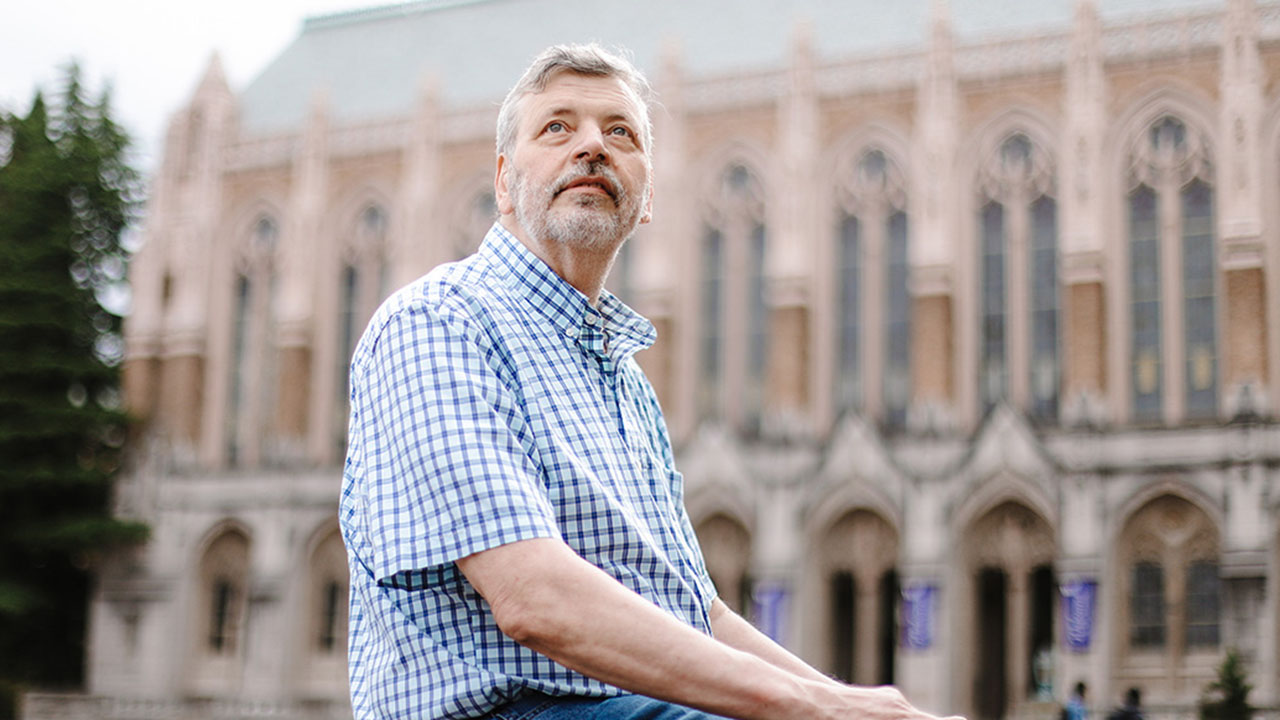
A Washington state computer science professor who won a First Amendment lawsuit against his university over its response to his mock land acknowledgement says the campus culture that fueled the controversy remains firmly entrenched.
“It’s kind of scary. They broke the law. The U.S. Court of Appeals for the “9th Circuit said you broke the law, and they’re saying, ‘Well, we think we behaved appropriately,’” Stuart Reges, the professor, told the Daily Signal in an interview Monday.
Reges sued the University of Washington, claiming it discriminated against his viewpoint when he published the mock land acknowledgement in a syllabus. The U.S. Court of Appeals for the 9th Circuit ruled in his favor, and the university agreed earlier this month to pay $600,000 to settle the case, without admitting wrongdoing.
Reges said the university’s response will only entrench a broader intellectual problem.
“I’ve been seeing this growing orthodoxy on campus that’s being imposed by progressive faculty, and particularly, staff,” he said. “I’ve been seeing this silencing of alternate viewpoints, even among liberals.”
“If a liberal faculty member says something that’s wrong, not sufficiently supportive of trans rights, for example, they’re attacked,” Reges argued. “I’ve been trying to push back against this imposed orthodoxy in whatever ways I can.”
TRENDING ARTICLES
“The settlement agreement states that there is no admission of any wrongdoing or liability,” Victor Balta, the university spokesman, told the Daily Signal in a statement Monday. “We effectively agree to disagree and determined that the most reasonable option was to settle rather than incur additional legal fees as we moved toward a damages trial on remand or leave it to the court to decide the final terms.”
The Land Acknowledgment Case
The University of Washington’s school of computer science recommended in 2019 that instructors include an “indigenous land acknowledgement” in their course syllabi, without dictating what the acknowledgment must say. The University of Washington’s official statement “acknowledges the Coast Salish peoples of this land.”
In 2022, Reges added a statement to his syllabus: “I acknowledge that by the labor theory of property the Coast Salish people can claim historical ownership of almost none of the land currently occupied by the University of Washington.”
Reges told the Daily Signal he sees land acknowledgements as “a kind of useless performative statement,” and attacked the academic monoculture for saying “you’re only allowed to say a land acknowledgement that implies the progressive point of view that this is stolen land.”
“I just thought it was fun to be able to challenge that concept, and they just freaked out,” he recalled.
When students complained about his note, the university publicly declared that the leadership was “horrified.”
“They removed it from my syllabus,” he recalled. “They apologized to my students. They told my students, ‘Here’s three ways to report Professor Reges if he insults you again,’ and they created an alternate section of the course, so that students who were so deeply offended that they couldn’t learn Java programming from me could take it on videotape from a different instructor.”
“Those are adverse employment actions, that’s a violation of the First Amendment,” he said, explaining the 9th Circuit’s rationale.
He noted that the university encouraged land acknowledgments, allowed statements that toed the leftist line, but censored his.
“You can either forbid them all, you can allow them all, but what you can’t do is to allow the progressive ones and then deny the conservative one—that’s viewpoint discrimination,” he explained, citing law professor Eugene Volokh.
Other Universities Weigh In
Four other Washington universities—Washington State University, Western Washington University, Central Washington University, and Eastern Washington University—filed an amicus brief in February, asking the 9th Circuit to rehear the case after it ruled in Reges’ favor.
The universities argued that the 9th Circuit’s ruling “could inhibit administrators’ ability to effectively redress student and faculty complaints,” and claimed that the University of Washington should win the case to allow schools to “ensure safe learning environments.”
Reges claimed the filing amounted to a defense of the University of Washington’s handling of the controversy.
“They said that they need these kinds of rules to be able to create a safe learning environment,” Reges noted. “You want to have a campus where ideas that are considered harmful are not expressed. Expressing an idea is harming people?”
He expressed concern about the long-term future of the university.
“The most radical, the most progressive, are the young faculty,” Reges warned. “They’re the ones who are going to be in charge in 20 years.”


Read the first chapter of The Woketopus right now for FREE
Today, even with President Trump’s victory, leftist elites have their tentacles in every aspect of our government.
The Daily Signal’s own Tyler O’Neil exposes this leftist cabal in his new book, The Woketopus: The Dark Money Cabal Manipulating the Federal Government.
In this book, O’Neil reveals how the Left’s NGO apparatus pursues its woke agenda, maneuvering like an octopus by circumventing Congress and entrenching its interests in the federal government.
You can read the first chapter of this new book for FREE in this eBook, The Woketopus: Chapter One using the secure link below.
TRENDING ARTICLES

The Daily Signal depends on the support of readers like you.
RELATED ARTICLES

Don’t miss the

Don’t miss the signal
