
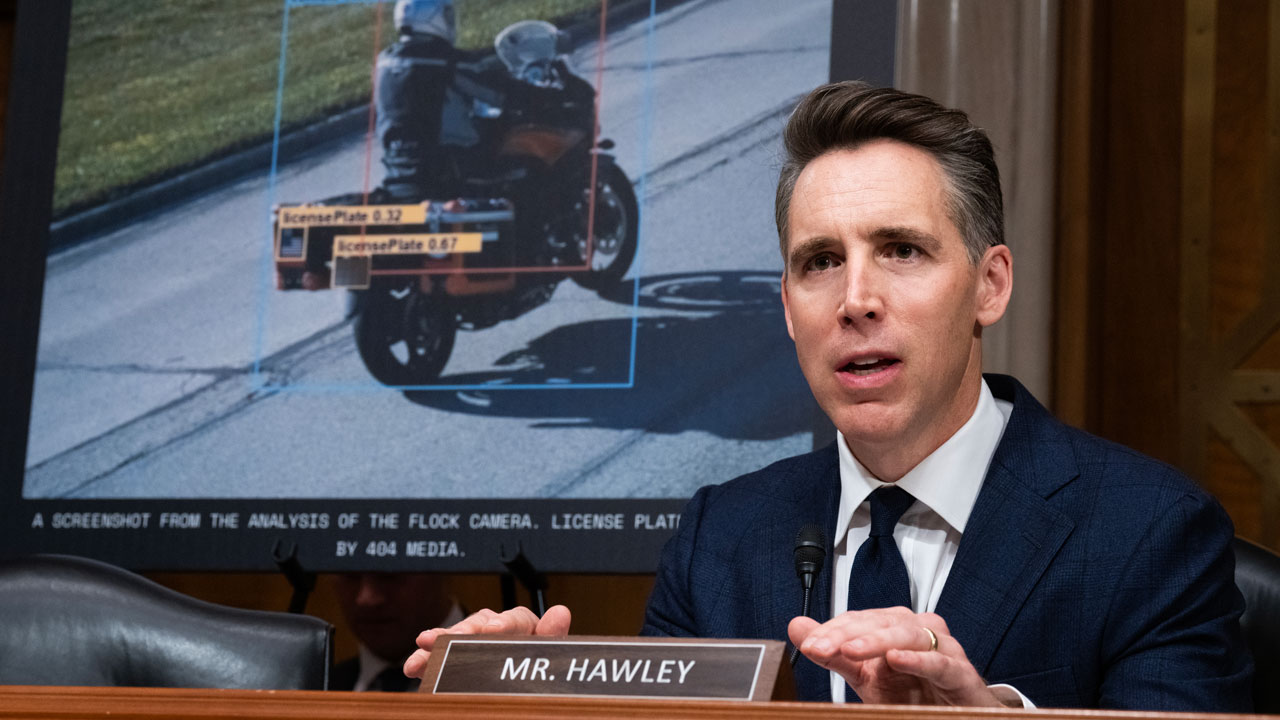
As Americans grow increasingly concerned about privately owned surveillance cameras, powered by artificial intelligence, spreading across the country by the thousands, senators are investigating whether they want to act. While the cameras were initially meant to provide safety, there are concerns from both parties that surveillance has surpassed safety.
“This hearing is about a simple thing. It’s trying to get to the bottom of what is going on with the expanding surveillance network that appears to be going coast-to-coast in this country,” Sen. Josh Hawley, R-Mo., chairman of the Senate Judiciary Committee’s subcommittee on crime and counterterrorism, said.
“I have in mind the hundreds of thousands of individual cameras all linked to the cloud, all powered by AI that seem to be spreading all across the country,” Hawley said, opening the subcommittee’s Wednesday hearing.
“The question is: Where are all of these images going? Who’s using them? What are the privacy protections for them? How do we make sure that this kind of surveillance is consistent with the Constitution of the United States?” he continued.
The Big Name in the Game: Flock
There are roughly 120,000 Flock Safety cameras operating throughout the country in every state except Alaska. They take over 20 billion images every month and are stored in and accessible through the cloud. This doesn’t account for the other major companies with similar operations: Axon, Motorola Solutions, and Verkada. Hawley invited the CEOs of each of these companies to testify before his subcommittee to explain their operations, but they all declined to appear.
TRENDING ARTICLES



The Flock CEO, Garrett Langley, did respond to Hawley’s request via a letter and answered some of the senators’ questions.
“If they feel like if they want to correct the record on something, great. We’d love to hear from them,” Hawley told reporters after the hearing. “I appreciate the Flock CEO responding to my inquiries in part. But the truth is … he gave us only a few pieces of documentation, all stuff that’s already public. I really think that we need to know more, and I think the public deserves to know,” he continued.
“They are refusing to be accountable,” Sen. Richard Blumenthal, D-Conn., told reporters when asked about the CEOs refusing to appear.
“I think there’s overwhelming evidence that we need more accountability; we need safeguards, including possibly a warrant requirement for the use of these kinds of surveillance systems,” he continued.
A Bipartisan Solution Might Be Possible
A big point during the hearing was the difference between traditional license plate readers, used by law enforcement for years, and the AI-powered surveillance cameras that can be accessed by the public.
“There’s a big difference between traditional law enforcement tools like license plate readers and what this is,” Hawley told the Daily Signal.
“In Missouri, we’ve been using license plate readers forever. Our cops do it. I think that’s very valuable. But that’s really different than the technology we’re talking about today, and I think that’s something that I’ve only recently come to appreciate, and I bet most folks are just getting up to speed on. Citizens know, though. They know when they’re being tracked. They don’t want to be tracked and treated like criminals,” he continued.
There are voters who are onboard with the cameras being used for safety to target criminals and track child predators, but they might not understand the risks that come with such surveillance.
One of the hearing witnesses, Lindsey Isaacs, was wrongfully accused of murder based solely on unsubstantiated Flock camera footage. Isaacs spent 13 days in jail, including 86 hours in solitary confinement, before being released.
Both parties have concerns about surveillance. Conservatives are concerned about their constitutional right to liberty. Democrats fear it could be used to target women crossing state lines to receive an abortion or help immigration officers track illegal immigrants.
“I think there are some clear potential solutions that would have bipartisan support,” Blumenthal told the Daily Signal.
“I think there’s a need for bipartisan cooperation here, and I think there are some clear solutions, for example, setting time periods for data retention. Prohibiting or safeguarding against a national database. There are some guidelines where I know Sen. Hawley and I have common ground, and I think other Republicans and Democrats would too,” he concluded.


Read the first chapter of The Woketopus right now for FREE
Today, even with President Trump’s victory, leftist elites have their tentacles in every aspect of our government.
The Daily Signal’s own Tyler O’Neil exposes this leftist cabal in his new book, The Woketopus: The Dark Money Cabal Manipulating the Federal Government.
In this book, O’Neil reveals how the Left’s NGO apparatus pursues its woke agenda, maneuvering like an octopus by circumventing Congress and entrenching its interests in the federal government.
You can read the first chapter of this new book for FREE in this eBook, The Woketopus: Chapter One using the secure link below.


The Daily Signal depends on the support of readers like you.
RELATED ARTICLES





Don’t miss the

Don’t miss the signal