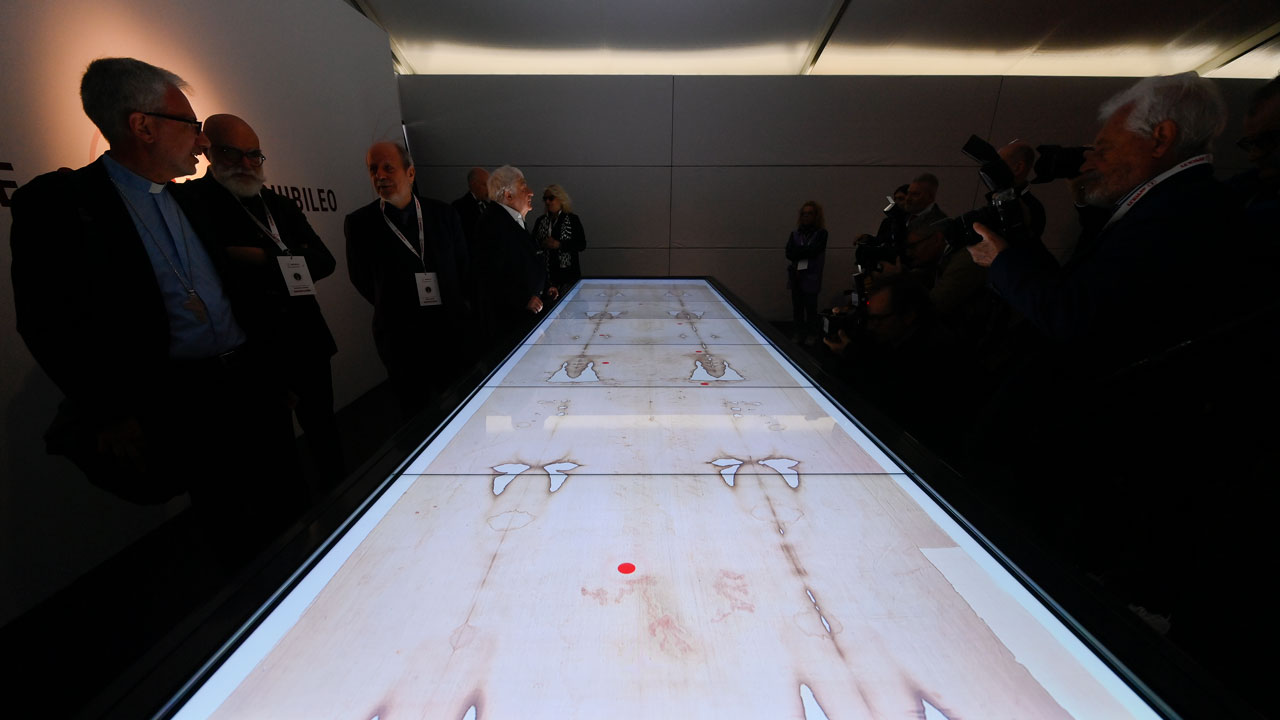
Over the centuries, countless Christians have been moved to prayer by the Shroud of Turin. The Shroud famously bears the image of a crucified man. Many—including myself—believe the Shroud to be the burial cloth of Jesus Christ and the image to be a miraculous picture of God made man. The Shroud gives viewers the chance for a face-to-face meeting with Jesus himself.
The Shroud has always been met by some with skepticism. Its verifiable history goes back to the 14th century, when a bishop argued that this supposed relic was a forgery.
In 1988, the cloth was scientifically analyzed, and at the time it seemed like the skeptics might be right. Through the (then) most advanced carbon dating techniques, researchers dated the Shroud of Turin to sometime between 1260 and 1390. Last summer, arguments arose again due to the claims of a Brazilian 3D artist named Cicero Moraes. Until last summer, it seemed that the evidence said the shroud was not the burial cloth of Christ.
This prompted all of the latest evidence to be brought together in support of the authenticity of the Shroud. However, new evidence has changed things. Research, founded on a technique named Wide Angle X-Ray Scattering, concluded that the cloth is from the 1st century (the same time period as Jesus’ birth and death). This method of analysis analyzes the deterioration of the thread and penetrates deep into the core structure of the fabric.
Further study revealed that the carbon dating testing was contaminated. The cloth was left unprotected for centuries and the testing does not have the same accuracy as Wide Angle X-Ray Scattering. Furthermore, new DNA research on the cloth has concluded that the genome pattern suggests the person was born in the Middle East.
Despite lengthy investigation, scientists have not been able to decipher how the image was made on the fabric. There is no pigment on the cloth. There is no detectable ink. The image on the cloth seems to be both unexplainable and unrepeatable—at least by human beings.
TRENDING ARTICLES



The best explanation scientists have posited is that some sort of electromagnetic radiation (seen as a burst of intense light) somehow left marks on the cloth.
William West, an Australian journalist, collects much of the updated research in his book titled “Riddles of the Shroud: Questions Science Can’t Answer.” He writes: Forensic pathologists have noted the following:
“The perfect wounds and blood deposits on the cloth were not disturbed by the removal of the body. When you dress a wound in a cloth bandage, it sticks hard, and when the bandage is removed, the blood clots break up and traces of flesh can be found on the cloth. There is no evidence that the blood deposits on the Shroud have been disturbed. It appears that the body simply ‘dematerialised’ in a way that did not disturb the blood, at the same time leaving behind an image that could not have been created in the Middle Ages, any more than in the first century.”
For the faithful, recent analysis enabled by new technology has provided confirmation of the relic’s authenticity. But more important than scientific arguments about the shroud is the proof of what happens when people pray with it.
Last summer, the new scientific analysis of the Shroud of Turin made me want to venerate it. I printed a 4by6 foot image of the Shroud and placed it on the shelf in our small prayer space at home. For more than a year, I have gazed on this image daily when I first wake up in the morning and when I pray before going to bed.
Looking upon the face of Jesus each day for a year has altered me.
The science behind the miraculous nature of the shroud is amazing, yes. But seeing the face of Jesus Christ has moved me to speak to him more personally and intimately. Venerating images of Christ transforms us.
We all seek to meet God, face-to-face. We desire to encounter him as a real living person—not as a part of our imagination.
God does not desire for us merely to rattle off words to Him; He wants us to be in genuine union with Him. Jesus warned, “In praying, do not babble like the pagans, who think that they will be heard because of their many words” (Matthew 6:7).
We are meant to hear Jesus Christ and meet Him as a real person who is alive—our Savior in our presence. I knew that truth intellectually, but viewing the face of Jesus each day has challenged me to live it.
The Shroud of Turin can aid us in making prayer more real, authentic, and moving.
It is not merely a tool for defending the truth about who Jesus was. It is not simply a weapon to show that Christianity is valid and unlike any other religion. The Shroud facilitates a meeting between the viewer and the Creator of the Universe. In the small and dimly lit chapel of my own home, I have witnessed the power of seeking to spend time with an image of the literal face of Jesus.
So seek His face. Look at the shroud. Gaze at the savior, your Creator.
We publish a variety of perspectives. Nothing written here is to be construed as representing the views of the Daily Signal.


Read the first chapter of The Woketopus right now for FREE
Today, even with President Trump’s victory, leftist elites have their tentacles in every aspect of our government.
The Daily Signal’s own Tyler O’Neil exposes this leftist cabal in his new book, The Woketopus: The Dark Money Cabal Manipulating the Federal Government.
In this book, O’Neil reveals how the Left’s NGO apparatus pursues its woke agenda, maneuvering like an octopus by circumventing Congress and entrenching its interests in the federal government.
You can read the first chapter of this new book for FREE in this eBook, The Woketopus: Chapter One using the secure link below.
TRENDING ARTICLES


The Daily Signal depends on the support of readers like you.
RELATED ARTICLES





Don’t miss the

Don’t miss the signal