
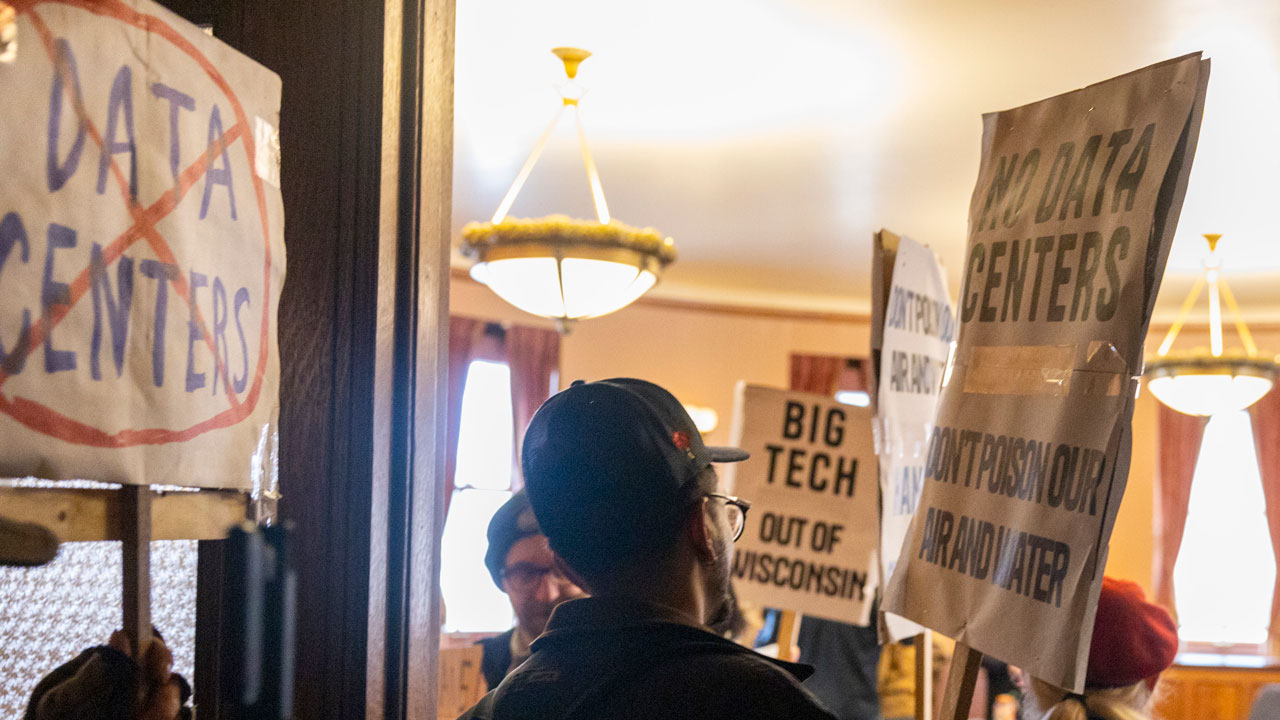
FIRST ON DAILY SIGNAL—Republican gubernatorial candidate Tom Tiffany is betting Wisconsin voters’ growing opposition to data centers can help flip the governor’s mansion, and new polling suggests he may have found one of the most potent issues in the race.
After the state’s Democrat primary last week, Tiffany moved quickly to define his opponent, the Milwaukee County executive, as “Data Center David Crowley” in a new campaign ad.
Two-thirds (66%) of Wisconsin voters have an unfavorable opinion of data centers and 79% say companies that build the sprawling facilities should be required to compensate communities for lower utility bills and taxes.
The League of American Workers shared the polling data exclusively with the Daily Signal. The survey of 1,434 registered voters was conducted Aug. 14-18 and has a margin of error of plus or minus 2.9 percentage points.
Tiffany and Crowley are locked in a dead heat for Wisconsin governor. The poll puts Tiffany at 41% compared to Crowley’s 43%, which falls within the margin of error. Another 5% would prefer someone else and 10% didn’t express a preference.
Tom Tiffany’s Attack Ad
In recent days, Tiffany drew national attention for his data center attack on Crowley. His campaign ad uses video of Crowley voicing his support for data centers.
TRENDING ARTICLES



“There’s an opportunity for us to really become AI and a data hub not only for the entire country, but for the entire globe,” Crowley said Democrat primary candidate forum.
Opposition to data centers is not new, but recent polling suggests it is intensifying.
Last October, a Marquette Law School Poll found that 55% of Wisconsin voters believed the costs of data centers outweighed the benefits. By February, that figure had jumped to 70% and then hit 76% in July.
The League of American Workers poll shared with the Daily Signal found that only 15% of Wisconsin registered voters hold a favorable opinion of data centers compared to 66% unfavorable—a net rating of minus 51 points.
In a state as politically divided as Wisconsin, there’s agreement on data centers: 58% of Republicans, 70% of Democrats, and 71% of independents have an unfavorable view.
“The decline in support for data centers over the last year in my polling is just remarkable,” said Steve Cortes, founder and president of the League of American Workers. “This issue becomes a lightning rod and it seems to ignore most traditional partisan/demographic battle lines.”
Close Race for Governor
The findings arrive amid one of the nation’s most closely watched governor’s races.
Democrat Gov. Tony Evers is retiring, and last week’s primaries set up a contest between Tiffany, a Republican congressman who represents Wisconsin’s 7th District, and Crowley, a Democrat who has served as Milwaukee County executive for six years.
According to the poll, Tiffany is viewed favorably by 37% and unfavorably by 44%. Crowley drew a 34% favorable and 31% unfavorable rating, with 35% expressing no opinion of the Democrat.
With less than three months before Election Day, Tiffany is attempting to define him.
On the question of which candidate voters would trust more to manage their money, Tiffany and Crowley tied at 37%.
“This poll, like other battleground states, shows that the macro backdrop is a challenge for Republicans,” Cortes said, “but also that these key races are totally winnable, in part because the Democrats have nominated radical extremists who turn off most voters.”
Data Center Debate
Data centers have emerged as one of the most unexpected issues of the 2026 election cycle.
Mike Allen’s influential Axios newsletter declared Thursday: “Data centers scramble midterms.”
“A populist fever is coursing through the midterms, forcing campaigns to retreat and recalibrate as they confront a groundswell of hostility toward AI data centers,” the publication wrote. “Candidates in both parties are racing to distance themselves from projects their own leaders spent years courting.”
Axios cited elections in Ohio, Texas, Pennsylvania, Wyoming, and the race in Wisconsin.
Tiffany hit the airwaves with his commercial Tuesday.
“Data Center David Crowley won’t roll back tax incentives. Our lakes run dry. Family farms paved over. Why? Because Crowley’s campaign is funded by the people building them. Big Tech wins. Wisconsin pays,” a narrator says in the ad.
Crowley’s campaign quickly fired back with a critique of Tiffany’s votes in Congress. Campaign spokesman Jonathan Fera said Tiffany was lying about Crowley’s record because he “can’t defend his own extreme record of backing [President Donald] Trump’s cost-raising agenda.”
Tiffany has said he would end state subsidies for data center projects, give local communities final say, protect farmland, require developers to absorb costs, and prohibit nondisclosure agreements.
Crowley opposed a statewide moratorium on data centers during the Democrat primary, preferring to leave decisions up to local leaders. He has not ruled out tax incentives, though he says any should be tied to measurable returns for the state.
Several major data center projects are already under construction in Wisconsin, including a $7 billion project from Microsoft in Mount Pleasant. Vantage Data Centers, Oracle, and OpenAI are partnering on a projected $15 billion facility in Port Washington. It led to a failed recall campaign against the mayor.
Affordability Dominates in Poll
Even as data centers grab more headlines, the primary issue for Wisconsin voters remains cost of living.
Seventy-two percent of respondents said taxpayers are not getting good value for the property tax increases, which had the largest jump in 15 years under Democrats. The opinion was shared among both Trump voters (73%) and Harris voters (70%).
On education spending, 60% said the state’s K-12 tax increases were not a good bargain for taxpayers. Even among Democrats, more said no than yes, 52% to 26%.
The survey also asked about Crowley’s record in Milwaukee County. His support for a county sales tax increase was unpopular: 40% said they were less likely to support him because of it.
Interest in the November election is high. Fifty-six percent of Wisconsin voters rated their interest in the midterms a 6 or 7 on a 7-point scale.


Read the first chapter of The Woketopus right now for FREE
Today, even with President Trump’s victory, leftist elites have their tentacles in every aspect of our government.
The Daily Signal’s own Tyler O’Neil exposes this leftist cabal in his new book, The Woketopus: The Dark Money Cabal Manipulating the Federal Government.
In this book, O’Neil reveals how the Left’s NGO apparatus pursues its woke agenda, maneuvering like an octopus by circumventing Congress and entrenching its interests in the federal government.
You can read the first chapter of this new book for FREE in this eBook, The Woketopus: Chapter One using the secure link below.


The Daily Signal depends on the support of readers like you.
RELATED ARTICLES




Don’t miss the

Don’t miss the signal