
Per the terms of the recent U.S.-Iran Memorandum of Understanding, the U.S. Treasury had waived sanctions on some Iranian crude oil exports for 60 days. That move quickly sent American gas prices downward. Then, on July 6, Iran renewed attacks on shipping that got the waiver revoked. But for China, there seems to be little good news either way regarding its energy security.
An uncomfortable reality for Beijing is that its strategic ambitions are conditioned on access to cheap imported energy.
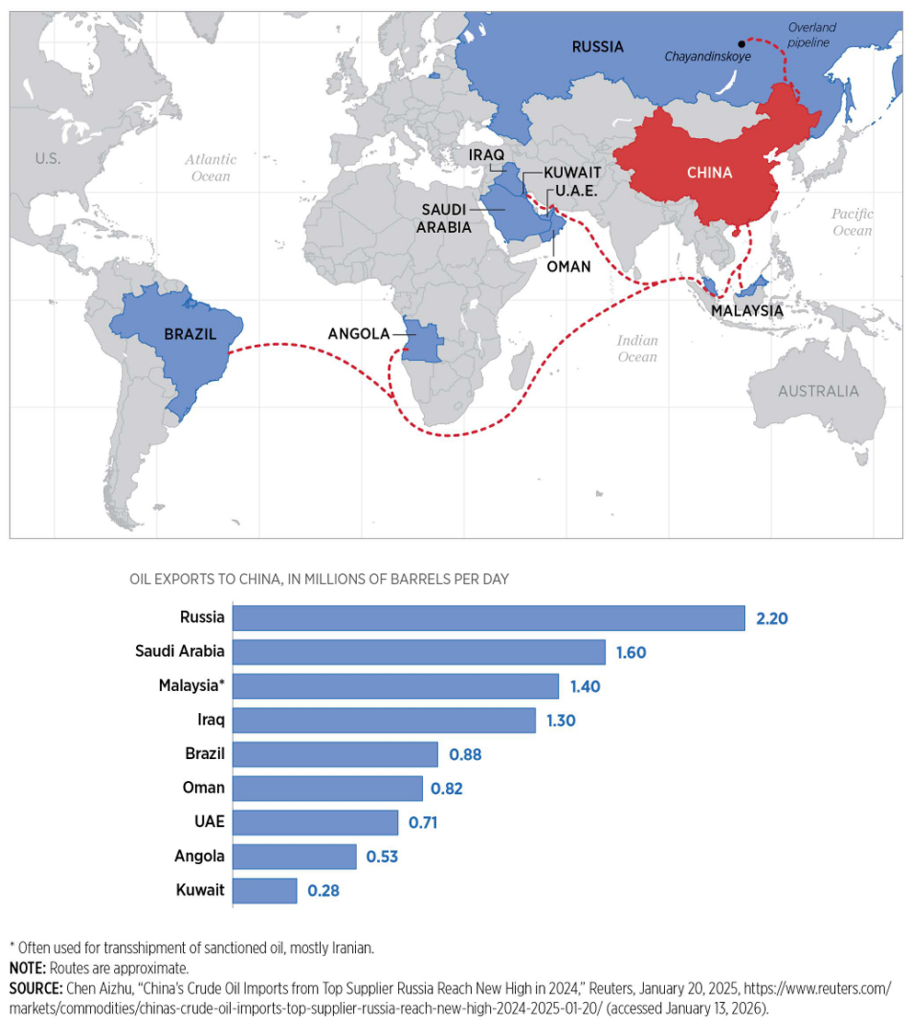
China’s status as the world’s second-largest economy, backed by the world’s largest navy and commercial fleet, makes it an energy-hungry industrial and military goliath. Since 2000, its energy imports have grown by 984%, and today Beijing imports over 20% of its energy needs, importing over 70% of its crude oil needs and approximately 40% of its LNG needs. But it is reliant on foreign oil and natural gas, much of it from countries of questionable stability, often forced to operate in the shadows of legality under sanctions.
President Donald Trump’s moves on Venezuela and Iran this year have agitated China’s energy dilemma. The emerging energy market reality is proving a strategic vulnerability for Beijing. China’s economy, military, and ambitions are increasingly at the mercy of Washington.
Significant disruption could cripple China’s crude oil imports and rapidly deplete its reserves, according to the new report “Tidalwave” from The Heritage Foundation. Even some casual observers began to suspect this was in fact occurring during the recent closures of the Strait of Hormuz.
According to the U.S. Energy Information Administration, in 2024, Beijing consumed approximately 16.3 million barrels of petroleum daily, though it produced only 4.3 million barrels of crude oil domestically. The nation’s domestic crude oil production has steadily increased in recent years, but consumption has continually outpaced production, forcing China to depend heavily on imported energy. The Daqing oil field in northeastern China and the Shengli oil field in Shandong remain the pillars of China’s domestic crude oil production despite decades of extraction.
TRENDING ARTICLES



China is the world’s largest importer of natural gas, importing approximately 5.7 trillion cubic feet in 2023, with more than 60% arriving as liquefied natural gas from Australia (34%), Qatar (23%), and Russia (11%).
The Energy Information Administration estimates that roughly 92% of China’s crude oil imports move over maritime routes. Tankers carrying petroleum from the Persian Gulf, Africa, and Latin America travel across vulnerable sea lanes and chokepoints like the Strait of Hormuz near a range of potential foes.
Approximately 80% of China’s imported crude oil passes through the Strait of Malacca, making it a longstanding concern for Chinese strategists. The recent conflict with Iran and closure to shipping via the Strait of Hormuz have demonstrated in real terms to Beijing such vulnerability. Beijing had hoped its massive strategic petroleum reserves would mitigate this vulnerability, but recent news indicates these reserves may not be adequate.
According to the Energy Information Administration, China held an estimated 1.4 billion barrels of strategic crude inventories by the end of 2025, while the U.S. Strategic Petroleum Reserve contained approximately 413 million barrels of commercial crude inventories.
Senior Chinese officials were reported to be inspecting the country’s strategic petroleum reserve under suspicions about the reliability of Beijing’s reported reserves. Meanwhile, the U.S. is a net energy exporter with a remarkable degree of energy security. The U.S. also possesses sizeable domestic refining capacity and geographically secure North American energy partners, which could help address any energy shocks.
Today’s energy market shocks will likely spur Beijing to accelerate energy diversification.
All told, the ongoing shocks to the global energy market are creating a new normal that will persist well into the future, in part thanks to pipelines. At the dawn of the current conflict, there was an average of 153 transits per day through the Strait of Hormuz. This number dropped to fewer than 15 in a matter of days.
Saudi Arabia and the United Arab Emirates can partially bypass the Strait of Hormuz through pipelines. UAE alone is capable today of transporting approximately 1.8 million barrels of crude per day, and it intends to expand this to 3.3 million barrels of crude per day by 2027.
Saudi Arabia’s East-West pipeline connects to the port of Yanbu, moving 7 million barrels of crude per day, and there are plans to add an additional 2 million barrels a day to its capacity in coming years. That represents today just under half of the roughly 20.9 million barrels of crude shipped through the Hormuz Strait before the conflict—meaning these pipelines cannot cover for Hormuz, not to mention that they provide no alternative routes for Qatar’s LNG exports.
Chinese strategists have long been aware of the vulnerability of the nation’s energy needs, and they have sought alternative energy sources (e.g. solar, nuclear) and diversified markets. A most remarkable investment has been in Russia’s remote Arctic: Yamal LNG export facility in northern Siberia.
Chinese banks committed about $12 billion to develop Yamal LNG production through state-backed financing and procurement of specialty ships for the Arctic transit. Those ships are a fleet of 15 Arc7 icebreaking tankers designed to sustain year-round exports. Today, Yamal LNG is the world’s fifth-largest LNG terminal and is an increasingly important source of imported gas for China, but Chinese shipments must still pass through the Bering Sea—near the U.S.
While Yamal does not eliminate China’s broader energy vulnerabilities, it is one example of Beijing’s attempts to secure overland and less vulnerable Arctic energy.
China has also run into limitations with its Russian neighbor regarding overland pipelines. Two pipelines are key to China’s overland petroleum imports: the Eastern Siberia-Pacific Ocean pipeline system with Russia, and one from Kazakhstan.
The Eastern Siberia-Pacific Ocean network provides China with 820,000 barrels of crude oil per day, representing roughly 7% of total crude oil imports shipped to China. The Kazakhstan-China Oil Pipeline delivers Central Asian oil directly into Western China and last year saw a 4% increase to roughly 400,000 barrels of crude oil daily, accounting for approximately 3.5% of China’s crude oil imports.
Together, these pipelines mitigate but don’t eliminate China’s reliance on vulnerable sea routes for critical energy. Poor maintenance and capital investment in Russia’s pipelines are risking their viability and precluding potential expansion of capacity—plus, sanctions and the conflict in Ukraine are making it even more difficult to extract its Arctic energy reserves.
Overall, China has few good options to securely meet its energy needs and fuel its leaders’ aspirations to challenge American global leadership.
Beijing’s energy issues have been amplified by Trump’s recent successes in Iran and Venezuela. At a March 2021 hearing before Congress, the Indo-Pacific commander, Adm. Philip Davidson, made clear that Beijing was making every preparation to prevail in a war over the fate of Taiwan by 2027.
Trump has likely bought America some time to prevent such a war.


Read the first chapter of The Woketopus right now for FREE
Today, even with President Trump’s victory, leftist elites have their tentacles in every aspect of our government.
The Daily Signal’s own Tyler O’Neil exposes this leftist cabal in his new book, The Woketopus: The Dark Money Cabal Manipulating the Federal Government.
In this book, O’Neil reveals how the Left’s NGO apparatus pursues its woke agenda, maneuvering like an octopus by circumventing Congress and entrenching its interests in the federal government.
You can read the first chapter of this new book for FREE in this eBook, The Woketopus: Chapter One using the secure link below.
TRENDING ARTICLES


The Daily Signal depends on the support of readers like you.
RELATED ARTICLES


Don’t miss the

Don’t miss the signal
