
By 1774, North Carolina had spent years learning to resist authority. The Regulation had exposed resentment toward corrupt colonial officials, the Stamp Act crisis had produced organized resistance to Parliament, and the women of Edenton had demonstrated that the Patriot cause was no longer confined to male politicians.
Events beyond North Carolina were forcing its people to choose. Within less than two years, the colony would move from protesting British policies to creating its own government, fighting a war within its own borders, and authorizing its representatives to support independence.
On Aug. 8, 1774, Rowan County freeholders adopted the Rowan Resolves, asserting the General Assembly’s authority over taxation and that Parliament’s attempt to tax the colony violated their constitutional rights. Yet they still professed loyalty to King George III; North Carolina was resisting Parliament while insisting that it remained loyal to the Crown.
That same month, the First Provincial Congress met at New Bern. Seventy-one delegates gathered to coordinate resistance, approve a boycott of British goods, and select William Hooper, Joseph Hewes, and Richard Caswell for the Continental Congress in Philadelphia.
A parallel political structure was emerging—one increasingly operating outside the authority of the royal governor.
During her 1775 visit to Wilmington, Scottish gentlewoman Janet Schaw recorded another remarkable display of resistance: the town’s women burned their tea in a solemn procession.
TRENDING ARTICLES



Whether inspired by Edenton or acting independently, Wilmington’s women were joining a movement that had already attracted attention across the Atlantic. The previous autumn, 51 women in Edenton had signed their names to a declaration supporting the boycott of British goods. “The Morning Chronicle and London Advertiser” printed their declaration, calling it an “honourable and spirited association.” But ridicule followed, most famously in Philip Dawe’s satirical print “A Society of Patriotic Ladies, at Edenton in North Carolina.”
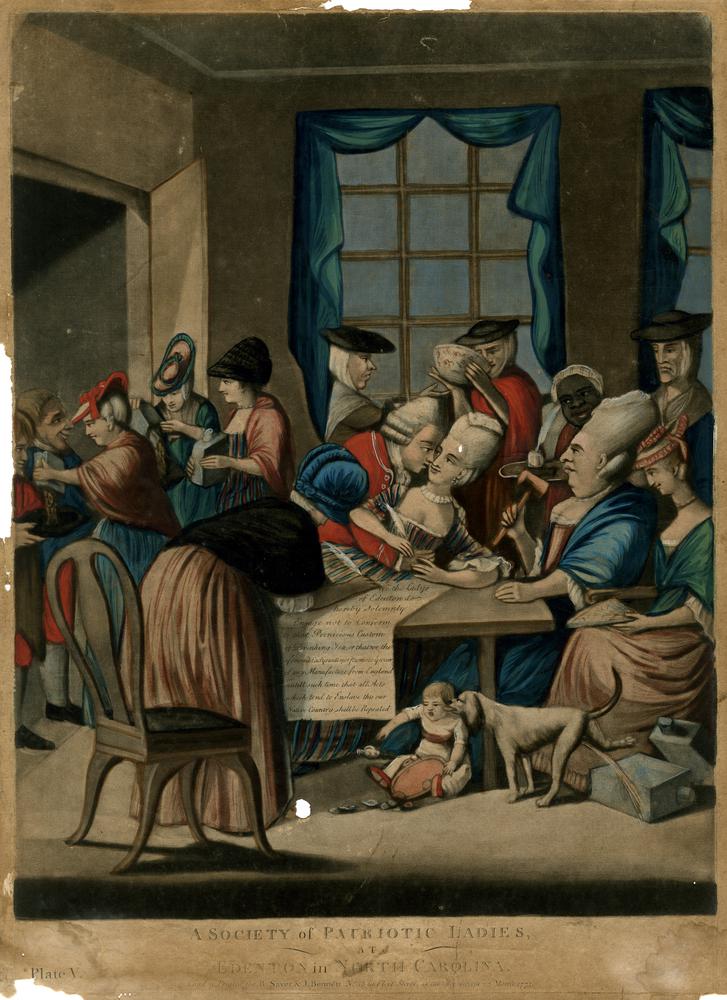
The crude cartoon portrayed the women as unattractive, unfeminine, frivolous, and neglectful of their domestic responsibilities. It also depicted an enslaved black woman, introducing the contradiction of slavery into a pointed satire of women who had publicly opposed British oppression.
Resistance was becoming bolder. Gov. Josiah Martin, increasingly isolated, fled the royal capital at New Bern for Fort Johnston on the Cape Fear River, effectively abandoning the royal government.
In July, John Ashe and Cornelius Harnett led forces against the fort. Martin escaped aboard the Cruizer, but the Patriots seized and burned Fort Johnston. North Carolinians were no longer merely protesting British policy; they were dismantling royal authority.
The backcountry was moving just as rapidly.
On May 31, 1775, Mecklenburg County adopted the Mecklenburg Resolves, declaring Parliament’s authority null and asserting the authority of the Provincial Congress.
Other communities followed. On June 20, residents of Cumberland County signed the Liberty Point Resolves, pledging their lives and fortunes to defend American freedom.
In August, citizens of Tryon County adopted their own resolves, promising to resist British force with force. Political authority was rapidly shifting from the Crown to the Patriot movement.
Then came war.
North Carolina soldiers crossed into Virginia in 1775 to support Whig (Patriot) forces fighting British troops and Tories (Loyalists) around Norfolk and Great Bridge. On Dec. 9, the Whigs defeated British and Tory forces at Great Bridge, helping drive royal forces from the region. North Carolina’s Patriot movement had now become a military force beyond the colony’s borders.
British commanders believed North Carolina’s deep internal divisions made it vulnerable to a Loyalist uprising. Martin encouraged the colony’s disaffected Regulators and Highland Scots to take up arms, while British commanders planned to send thousands of regular troops and weapons to support them.
Martin hoped to raise as many as 10,000 Loyalists. In reality, only about 1,600 assembled at Cross Creek—present-day Fayetteville—and began marching toward the coast to join the British expedition. Patriot leaders moved quickly to intercept them.
On Feb. 27, 1776, the two forces met at Moore’s Creek Bridge.
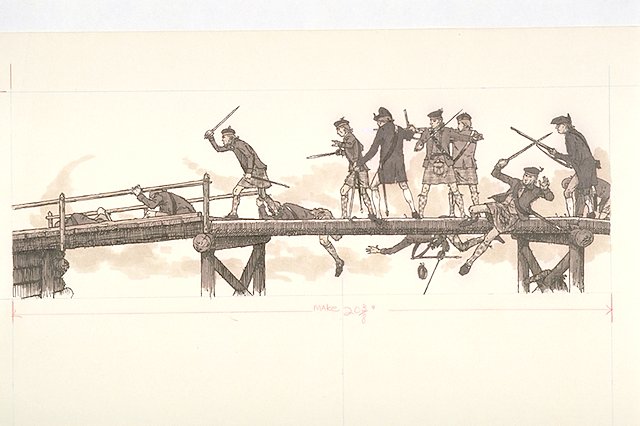
The battle lasted only minutes. Patriot forces had removed much of the bridge flooring and coated the remaining timbers with wax, soap, and tallow. When the Highland Loyalists charged across the slippery bridge, Patriot musket and artillery broke the attack. The Loyalists suffered a decisive defeat, while the Patriots lost only a handful of men.
Moore’s Creek changed North Carolina.
British strategy depended upon mobilizing Loyalists inside the colony. Instead, the Patriot victory shattered the largest Loyalist force assembled in North Carolina and effectively ended the immediate threat of a British-Loyalist takeover. Martin’s hopes of restoring royal authority collapsed. The victory strengthened Patriot control of the colony.
British forces nevertheless arrived along the Cape Fear in the spring of 1776, but disease, weather, logistical problems, and the collapse of Loyalist resistance undermined the campaign.
Brunswick Town, once a center of royal power on the lower Cape Fear, became a symbol of the failed expedition. The British ultimately abandoned the 1776 campaign to secure North Carolina.
While British power was failing, North Carolina’s political transformation was reaching its climax.
On April 4, 1776, the Fourth Provincial Congress assembled at Halifax. On April 12, it unanimously adopted the Halifax Resolves.
From Halifax, North Carolina gave its delegates at the Continental Congress in Philadelphia authority to “concur with the delegates of the other Colonies in declaring independency” and to form foreign alliances.
It was the first official action by an American colonial government instructing its delegates to support independence from Great Britain.
North Carolina had crossed a line.
In 1765, its citizens had resisted a tax imposed without their consent. In 1771, Regulators had fought their own colonial government. In 1774, political communities had organized outside royal authority. In 1775, Patriots had seized forts, formed governments, raised armies, and defeated Loyalists. By April 1776, North Carolina was no longer simply resisting British policy; it had taken the first official colonial step toward independence.
The tinderbox had finally ignited.
Two hundred and fifty years later, Halifax remembered that moment.
In April 2026, thousands gathered at Historic Halifax for Halifax Resolves Days, and for the first time since 1776, the original document came home. It was displayed only steps from the site of the courthouse where North Carolina had taken that historic step toward independence.
WITN, a local television station, interviewed Jeff Dickens, a living-history interpreter portraying Col. John Bradford, one of the delegates to the Provincial Congress. He said, “Well today is a big deal because we’re putting our lives and liberty at stake because we’re prepared to stand up to the king and tell him we’re not gonna be ruled by a tyrant 3,000 miles away.”
The document came home 250 years later, but the spirit that produced it never really left.
This article is part of a series on the American Revolution in South Carolina, North Carolina, and Georgia.

Read the first chapter of The Woketopus right now for FREE
Today, even with President Trump’s victory, leftist elites have their tentacles in every aspect of our government.
The Daily Signal’s own Tyler O’Neil exposes this leftist cabal in his new book, The Woketopus: The Dark Money Cabal Manipulating the Federal Government.
In this book, O’Neil reveals how the Left’s NGO apparatus pursues its woke agenda, maneuvering like an octopus by circumventing Congress and entrenching its interests in the federal government.
You can read the first chapter of this new book for FREE in this eBook, The Woketopus: Chapter One using the secure link below.

The Daily Signal depends on the support of readers like you.
RELATED ARTICLES




Don’t miss the

Don’t miss the signal
