
Alaska Senate Candidate Backed Income Tax Plan Critics Say Would Hit Lower-Income Earners Harder Than Millionaires
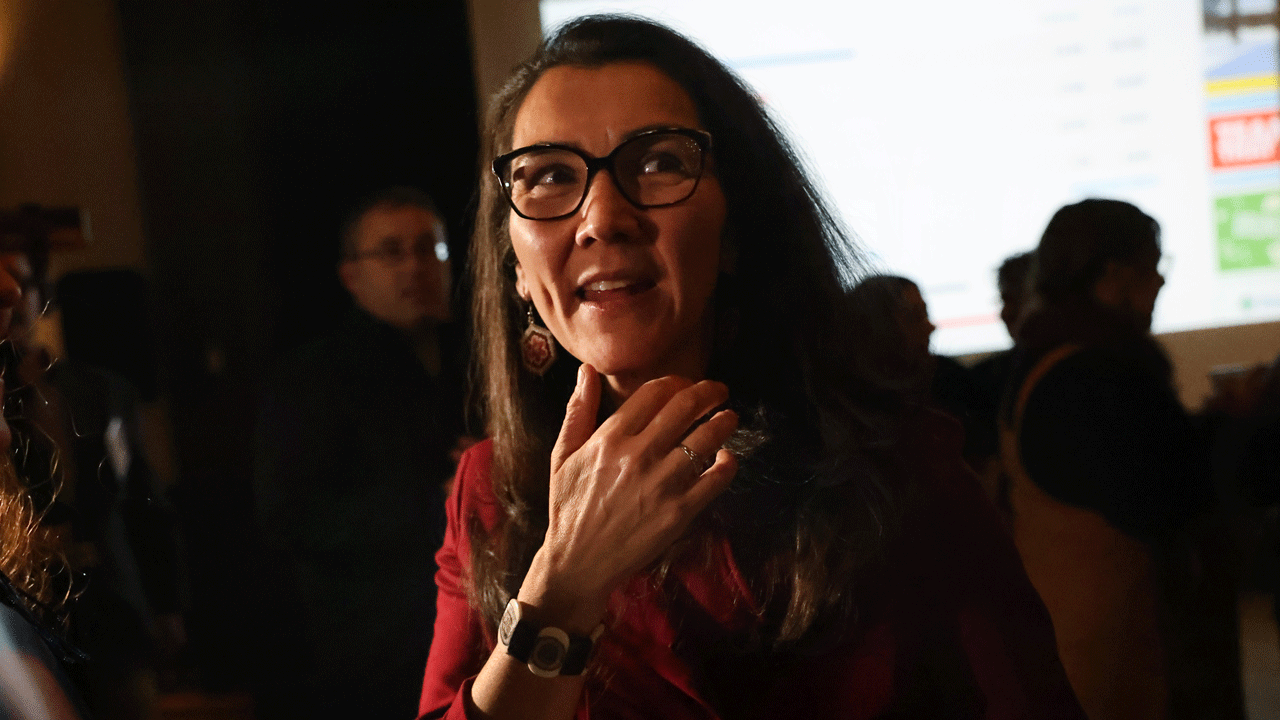
Alaska Senate Democrat nominee Mary Peltola once voted in the state Legislature for an income tax proposal that critics called regressive because its highest earners would have paid lower tax rates than many working families.
Legislative records show that while serving under the name Mary Kapsner in 2002, Peltola voted in the state House of Representatives for House Bill 303, which would have reinstated Alaska’s state income tax, repealed decades earlier. She is currently running in one of the nation’s most competitive Senate races.
Peltola, who served one term in the U.S. House of Representatives, entered the 2026 Senate race to challenge Republican Sen. Dan Sullivan. The Cook Political Report and Sabato’s Crystal Ball at the University of Virginia’s Center for Politics rate the Alaska Senate race as a toss-up. Meanwhile, Inside Elections rates the race as lean Republican.
Most states with income taxes have either a progressive income tax or a flat tax. However, under the 2002 Alaska proposal, tax rates would have slightly increased from low- to middle-income earners before then declining as income rose for higher-earning individuals and households, a proposal critics called a regressive tax.
Under House Bill 303, the bill’s highest-rate schedule, the first $10,000 of adjusted gross income would have been taxed at 1.35%. Income between $20,000 and $50,000 would have been taxed at a 2.7% marginal rate.
After that point, however, the marginal rates steadily declined. Income between $200,000 and $500,000 would have been taxed at 0.41%, income between $500,000 and $1 million at 0.07%, and income above $1 million at 0.05%.
TRENDING ARTICLES



Legislative records show the bill passed the Alaska House but stalled in the Senate before the Legislature adjourned, ending its chances of becoming law during the 2002 session. The proposal has not been enacted in the years since.
Peltola’s campaign noted that 12 Republicans in the House, about half the caucus, voted for the proposal and noted an Anchorage Daily News report that called it a “victory for Republican moderates” when it cleared the House. In 2002, Alaska faced a fiscal crisis and had to use the budget reserve to cover about 30%, or $750 million, of the basic budget.
As a state lawmaker and member of Congress, Peltola has supported tax relief and lower energy prices and will “stand up to anyone to take on the rigged system in D.C.,” Peltola spokesman Harry Child said.
“While Dan Sullivan has voted time and time again to strip Alaskans of their health care, gut lifesaving emergency services, and benefit his Lower 48 special interest backers, Mary has spent her entire career working across the aisle to lower costs and put Alaskans first,” Child told the Daily Signal.
The 2002 proposal was a regressive income tax, said Republican National Committee spokesman Nick Poche.
“Mary Peltola has a consistent anti-Alaskan voting record. She wanted to impose an income tax, she told her fellow Democrats to vote against opening up Alaska for resource development, and she constantly sided with the Lower-48 radical left,” Poche told the Daily Signal about House Bill 303.
In July 2002, the left-leaning American Prospect magazine panned the proposal, though mostly blaming the Republican-controlled legislature for adopting “an explicitly regressive state income tax.”
As lawmakers struggled for a plan to close a budget gap, the Prospect noted, “To break the stalemate, John Davies, a liberal House Democrat from Fairbanks, put forward an unusual ‘compromise’ plan” that included “slightly graduated [tax] rates over the low- and middle-income ranges.”
“To satisfy Republicans’ zeal to protect the wealthy, however, marginal rates sharply declined thereafter, eventually falling to only 0.05 percent for incomes above $1 million.”
As an alternative, the Senate GOP majority increased the tax on alcoholic beverages, the Prospect reported.
For his part, Sullivan voted for the 2017 Tax Cut and Jobs Act, as well as the 2025 One Big Beautiful Bill Act, both of which critics on the left called regressive.
A report by the left-leaning Cetner for Budget and Policy Priorities said the “2017 Trump tax Law was skewed to the rich, expensive, and failed to deliver on its promises.” Similarly, the center asserts the One Big Beautiful Bill–the 2025 legislation that extended Trump’s 2017 tax bill–saying the bill cut taxes for the wealthy but harmed social services.
Meanwhile, the left-leaning Institute on Taxation and Economic Policy said the Trump tax cuts from the first administration disproportionately benefited the richest Americans and were a “windfall for the wealthy.” The institute said the 2025 bill mostly benefited high earners and corporations.


Read the first chapter of The Woketopus right now for FREE
Today, even with President Trump’s victory, leftist elites have their tentacles in every aspect of our government.
The Daily Signal’s own Tyler O’Neil exposes this leftist cabal in his new book, The Woketopus: The Dark Money Cabal Manipulating the Federal Government.
In this book, O’Neil reveals how the Left’s NGO apparatus pursues its woke agenda, maneuvering like an octopus by circumventing Congress and entrenching its interests in the federal government.
You can read the first chapter of this new book for FREE in this eBook, The Woketopus: Chapter One using the secure link below.




The Daily Signal depends on the support of readers like you.
RELATED ARTICLES





Don’t miss the

Don’t miss the signal