
Editor’s note: This is a lightly edited transcript of today’s edition of “Victor Davis Hanson: In His Own Words” from Daily Signal senior contributor Victor Davis Hanson. Subscribe to Victor Davis Hanson’s own YouTube channel to watch past episodes.
Sami Winc: Your presidents today are, as you’ve been speaking of, Bill Clinton and then also [James] Monroe, who followed on [James] Madison’s work and is probably most famous for the Monroe Doctrine.
Victor Davis Hanson: Yes. James Monroe was our fifth president. [George] Washington, [John] Adams, [Thomas] Jefferson, Madison, Monroe, and he was … Just think of it.
He was, after Washington and Jefferson and Madison, he was the fourth president from Virginia, and that was at that time called the Virginia Dynasty. I think there would be four more. I don’t know if I remember them all, but there was [John] Tyler and Benjamin Harrison and Woodrow Wilson. I’m sure Woodrow Wilson was a Virginian.
He was a Southerner, abject racist, by the way, not that that’s always to be equated with Southerners. It’s not.
But [Monroe’s] known now for a couple of things. Liberia, the capital is Monrovia. Remember that? He was a big advocate of reverse colonization as a solution to the slavery problem, and during his administration, it didn’t work out too well because slaves, African slaves had been there for 200 years. So they were no more African than white people were.
TRENDING ARTICLES



You know what I mean? So, it didn’t work out too well. But he also had seen this during Madison and his presidency, they had closer ties with …
After the War of 1812, they kinda shifted, and they normalized their relationship with Britain, number one, and they had seen what the French Revolution had done and Napoleon that followed had done to Europe.
And they were very skeptical of the Spanish Empire. So, there was a new idea that the United States would follow Washington, would not get involved with foreign powers. But they had established a much better relationship with Britain. They were going back to being pro-British again. And the result of that was they were very skeptical of the Spanish.
And so, under Monroe, they annexed Florida. And he and Madison were really instrumental in carrying out the, not the spirit of the Louisiana Purchase, but the actual implementation of it.
So, this was a period where they doubled the size of the United States, and he was … But one of the things he did not want were imperial European powers intervening in the Western Hemisphere.
That was largely Spain, because the Spanish Empire had a very different attitude about colonization. It was not open to Europeans. It was not open to Protestants. You had to get permission of the Spanish Crown, and you had to get the permission of the Spanish Crown and its Catholic manifestation.
And he was worried that Spain was playing too great a role and would get too powerful right on our border with Mexico.
Winc: I think that was the period, the 1820s, when the Spanish Empire was falling all over Latin America. Like, there were revolutions,
Hanson: It was. It was starting. But the impetus was that he felt that the imperial …
All the Founders have thought that the imperial tradition of the French in Canada, the Spanish and the British in Canada, the British in America, the Spanish south of the border was nefarious, toxic. So, it was the duty of the United States to get them out. And get them out in the sense to get the French out and buy their land off and get the Spanish out of the United States and buy Florida or settle it.
And by extension, they did not want Spain to then start dictating to these national liberationist fronts. They really did believe that Bolívar and San Martín, all these people were gonna create United Stateses.
They weren’t. They weren’t gonna last is what I’m saying. They had a very different origin and maturity than we did.
The Spanish crown was very different than the British crown. They weren’t the same. There was no Spanish enlightenment like there had been a British and Scottish enlightenment.
He’s known now for the Monroe Doctrine, which in 2013 [John] Kerry said that he had renounced. It was no g- But now it’s sort of been reinvigorated.
I think most people consider him a very good president, better than average. But he’s also kind of the end of a president either selecting his former opponent as secretary of state or vice president, or there’s not a big difference in the party between the Whigs, and the Federalists party was dying at this time, and the Republican Party, the people for the Republic, I should say, it’s different than the later Republican Party.
They were gaining ground, but I think they call it the era of good feelings or the era of good relations.
It was ending. So you’re gonna get a modern antithetical two-party system of really angry, and it’s gonna be characterized by we want a strong federal government and we want internal improvements, and we want taxation and tariffs versus a Jeffersonian, we wanna be left alone and have states’ rights, et cetera.
So, anyway, the idea of an aristocracy has only got one more president left, John Quincy Adam, and then that’s over with. The idea that you’re gonna come from New England or Tidewater, Virginia, it’s gonna be populism. You know, Zachary Taylor and James Polk and Andrew Jackson.
As far as Bill Clinton goes, elected in ’92, he never got over 50% of the vote.
I don’t think he ever did. I think he got 41 or 42% in ’92, and he got 49.6 or something in ’96. That was largely because of Ross Perot. Ross Perot, for what all the Democrats wanna say, he took more votes away from George Bush than he did from Bill Clinton, and he was responsible, and he knew that. He said that he wanted to help the Democrats.
He said they’d become normal again under Clinton. He was a leftist, and the Republicans, when they ran against him, tried to say that when he was a student at Oxford, you remember that he … I like that new word. He was adjacent to the communist other students, and they said that he was smoking marijuana. That was when smoking marijuana was disqualifying, and he said he did smoke, but he never inhaled.
And that was the beginning of, “I never had sex with that woman,” because the type of sex he had with the woman he didn’t say qualifies with traditional notions of sex.
Winc: What was that thing where they kept saying he said, “Well, that depends upon what is is”?
Hanson: Yes, he was being asked by the special prosecutor, and he said it depends on the definition of is, meaning are you, basically, are you having sex?
Did you have sex? And it was sort of like, “Now? Well, no, I’m not.” You know what I mean?
Winc: Was the special prosecutor Fitzpatrick? Was that the one?
Hanson: No, he was the one that went after Scooter Libby, as I remember. Oh, that’s right. That’s right. It was Kenneth Starr. Ken Starr. I met him and I knew him a little bit.
He was a very fine person. He was dean of the Pepperdine Law School, and, and he got a really bad …
You can chalk that up to James Carville. He got on TV and he just character assassinated him. “And there, that special prosecutor, he’s a cigarette lawyer. He’s a cigarette lawyer. That’s what he is. He just is sending cigarettes, cigarettes, cigarettes.”
That’s what he did. I met James Carville once when I was speaking on a Hillsdale cruise. He was incidentally on the same boat, and he came up to me, and he tried to tell me that the T-34 was the best tank in World War II. I see you’re talking on World War II. The Sherman was …
And I said, “That’s just so stereotypical, James. Do you have any idea of maintenance and hours of maintenance to make it, you know … ” The T-34 had no radios in it. It stored its shells verydangerously at the front of the compartment and they could blow up.
It was a very good tank, but it was basically based on a Christie American chassis. And the Sherman, for all of its defects, it was a medium tank. It was not intended for …
Oh, I was explaining on, “No, no, the Sherman’s no good. It’s no good.” Very dogmatic guy.
Not to mention that he didn’t … He and Doug Schoen and Mark Penn made sure that Clinton and Dick Morris got the white working class. And they all staged that Sister Souljah moment where they went to Jesse Jackson’s Rainbow Coalition, and they deliberately said to her, and she said, “Why do we Black people kill each other?
Why don’t we just go for a change and kill white people in their neighborhoods?”
And he said, “You should be ashamed of you should be ashamed of yourself.” And that that took a lot of independence. They said, “Wow, he’s not that left-wing after all.” He’s known really for a couple of things.
Whatever you can say about him, in 2000, 1999, 1998, 1997, he had a balanced budget. He had a surplus. He was paying down the debt. Now, conservatives will tell you it was because Newt Gingrich forced him to cut, cut, cut. He did, but he also gave in to an increase in the income tax. That was the big grand deal.
And it worked. And they had a balanced budget. Had we continued on that we would have no national debt now. We would have paid it off. We wouldn’t be thirty-one trillion in debt.
So you gotta give him credit for that.
And I went back not too long ago, I wrote about in “The Dying Citizen,” but if you look at the charter of the ’92 Democratic Convention and the ’96 Democratic, and I think that was written by Mark Penn, maybe people listening will correct me, and Doug Schoen, with input from some other people.
It’s a Republican … I mean, it says, “We want closed borders. We want legal-only immigration. We want juvenile murderers and violent criminals charged as adults. We want everybody to pay their fair share. We want to make sure people are not cheating on their income taxes. And we are for a strong defense.”
And you know, he bombed—It was kind of a misadventure—but he bombed [Slobodan] Milosevic and got the Serbs out of Kosovo, seventy-seven days, without congressional authority, of course.
Where he was faulted, he had numerous opportunities to stop, al-Qaeda and [Osama] bin Laden, and he passed up on them.
He could have stopped it.
We publish a variety of perspectives. Nothing written here is to be construed as representing the views of the Daily Signal.

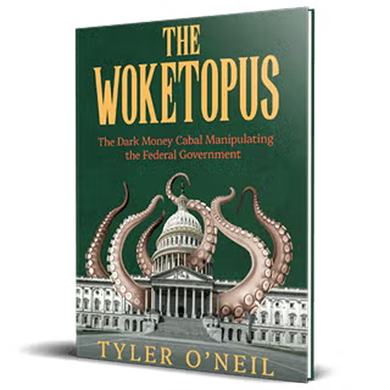
Read the first chapter of The Woketopus right now for FREE
Today, even with President Trump’s victory, leftist elites have their tentacles in every aspect of our government.
The Daily Signal’s own Tyler O’Neil exposes this leftist cabal in his new book, The Woketopus: The Dark Money Cabal Manipulating the Federal Government.
In this book, O’Neil reveals how the Left’s NGO apparatus pursues its woke agenda, maneuvering like an octopus by circumventing Congress and entrenching its interests in the federal government.
You can read the first chapter of this new book for FREE in this eBook, The Woketopus: Chapter One using the secure link below.
TRENDING ARTICLES


The Daily Signal depends on the support of readers like you.
RELATED ARTICLES


Don’t miss the

Don’t miss the signal