





























There’s a price to be paid for bad policies divorced from human nature.
The Associated Press reported Sunday that Oregon’s first-in-the-nation law to decriminalize hard drugs is finally facing serious backlash. This may come as a surprise, but according to AP, the state has seen an “explosion of public drug use fueled by the proliferation of fentanyl and a surge in deaths from opioids, including those of children.”
Who could have seen that coming?
Measure 110, passed by the Oregon state Legislature in 2020, decriminalized several hard drugs. It also set up a fund with taxes from cannabis sales, to invest in “recovery.”
What Oregon residents got was a whole lot of drugs with no recovery in sight.
The penalties for hard drug use are now so light as to be nearly worthless.
For instance, citizens caught with under a gram of heroin are subject to a ticket and a maximum fine of $100. That’s barely more than the cost of a parking ticket these days.
It gets even better.
“Those caught with small amounts of drugs can have the citation dismissed by calling a 24-hour hotline to complete an addiction screening within 45 days, but those who don’t do a screening are not penalized for failing to pay the fine,” The Associated Press reported.
In 2021, according to AP, “only 1% of people who received citations for possession sought help via the hotline.”
I’m shocked, shocked to learn that people caught using heroin aren’t following through.
What’s really taken off is fentanyl use, which has become a national epidemic. It’s made worse, of course, by Oregon’s permissive environment.
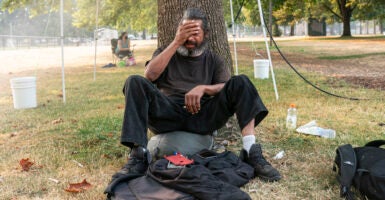
So now the state, which already had an issue with drug abuse and homelessness, is in a full-blown crisis.
The situation is so bad that some Democrat state lawmakers are considering rolling back the drug decriminalization law.
“Everything’s on the table,” said state Sen. Kate Lieber, a Democrat who co-chairs a new joint legislative committee created to tackle addiction, according to AP. “We have got to do something to make sure that we have safer streets and that we’re saving lives.”
The fentanyl scourge hit Oregon hard, but nowhere is the problem more acute than in the state’s most notable progressive paradise: Portland.
Portlandia has really been hit with a perfect storm of bad policies.
In June 2020, the city defunded the police following the death of George Floyd in the custody of Minneapolis police. It was then rocked with nearly 200 days of protests, many of them violent.
Portland was in anarchy. Violent crime exploded to an almost unprecedented extent.
Of course, Portland now struggles to staff its beleaguered police department, despite pivoting and refunding the police.
“With just 1.26 officers per every 1,000 residents, the Portland Police Bureau (PPB) ranks 48th among the nation’s 50 largest cities for its staffing-to-population ratio,” the Manhattan Institute’s Charles Fain Lehman wrote in September. “As a result, PPB struggles to provide even basic service, taking up to half an hour to respond to high-priority calls.”
Qualified applicants don’t want to be police officers in Portland? Incredible, I know.
But violent crime and lack of police is only part of the equation. Oregon’s drug decriminalization and Portland’s toxic drug culture are clearly making things much worse.
“All roads in downtown lead to fentanyl,” said David Baer, a member of the Portland Police Bureau’s bike squad, in an interview with Fox News. “Whether that’s stolen cars, whether that’s burglaries or thefts or organized retail theft, there’s almost always a fentanyl nexus. So we spend a lot of our time currently policing fentanyl and trying to stop that flow.”
Portland city leaders tried to ban public drug use, but a state law prohibits local governments from passing laws to criminalize the public use of controlled substances.
“The 1971 law was established to address substance abuse as a health problem, rather than a crime,” Oregon Public Broadcasting reported.
Now city leaders have poor health and a whole lot of crime.
Portland has become the poster-child model city for open-air drug markets on the West Coast.
It’s maybe even worse than the situation in San Francisco, where a visit last week by a communist dictator prompted the city to clean up a bit and roll out the red carpet.
This is only a temporary fix, though. In the end, the problem for San Francisco and Portland isn’t drugs. Not really. The problem is ideology.
Have an opinion about this article? To sound off, please email [email protected] and we’ll consider publishing your edited remarks in our regular “We Hear You” feature. Remember to include the URL or headline of the article plus your name and town and/or state.

