
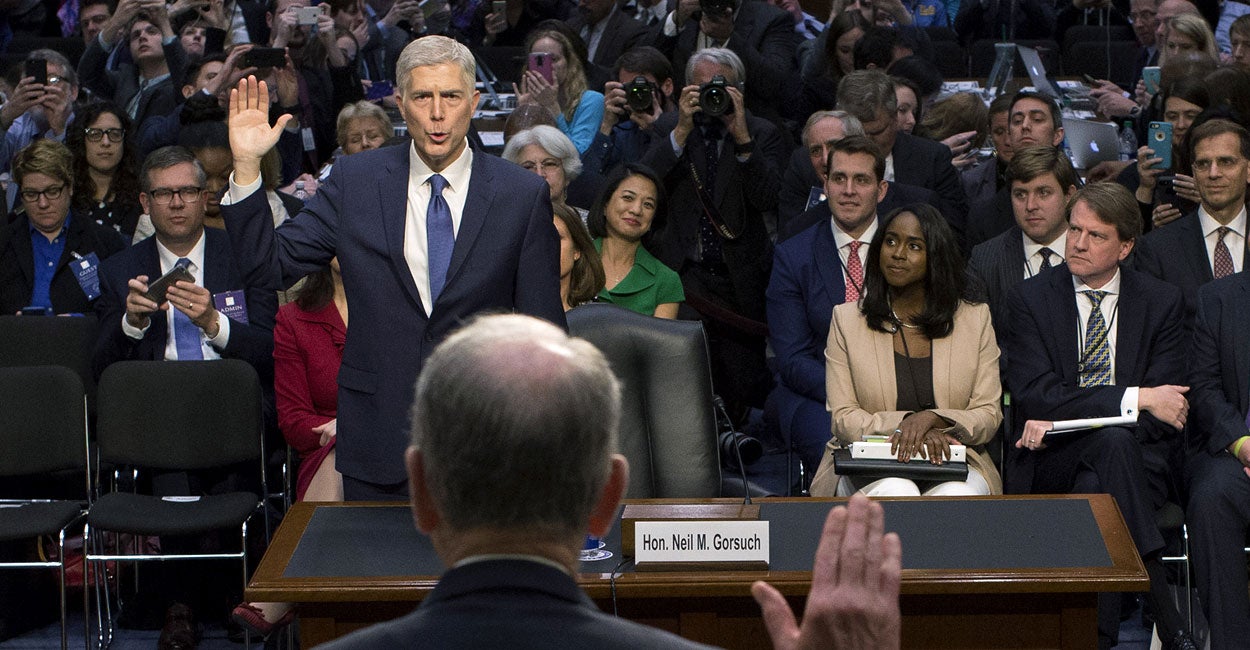
On Thursday, in the Senate Judiciary Committee’s business meeting, Chairman Charles Grassley, R-Iowa, addressed efforts to force judicial nominees to express personal views on issues or cases in their confirmation hearings.
Senators routinely press nominees, for example, to say whether particular Supreme Court precedents, such as Brown v. Board of Education or Roe v. Wade, were correctly decided. Nominees, however, consistently decline to do so, emphasizing instead that they will apply all relevant precedents, whether or not they personally agree with those precedents.
Grassley was correct to oppose this approach. The push for nominees to express personal views undermines not only the impartiality on which the legitimacy of our judicial system depends, but the confidence of our fellow citizens in that system.
America’s Founders established a system of government designed to maximize ordered liberty by limiting government. The key word in the preceding sentence is “designed.” The liberty that this system makes possible exists by design, not by accident. And the judiciary, as part of that system, is also designed to work in a particular way.
Federal judges interpret and apply the law, such as statutes and the Constitution, as it is and apply it to decide individual cases. They must do both tasks, interpretation and application, impartially by eliminating their personal views as much as possible.
When they take the oath of judicial office, these nominees will swear to “administer justice without respect to persons, and do equal right to the poor and to the rich, and that I will faithfully and impartially discharge and perform all the duties incumbent upon me.”
TRENDING ARTICLES



Similarly, Rule 2.2 of the American Bar Association’s Model Code of Judicial Conduct states that a judge “shall uphold and apply the law, and shall perform all duties of judicial office fairly and impartially.” One of the comments explaining this rule advises that “[a]lthough each judge comes to the bench with a unique background and personal philosophy, a judge must interpret and apply the law without regard to whether the judge approves or disapproves of the law in question.”
No one could disagree with that principle, but it should apply to all of the legal authorities that a judge will use to decide cases. That includes not only statutes or constitutional provisions, but also judicial precedents.
If a judge must “interpret and apply the law without regard to whether [he or she] approves or disapproves of the law in question,” it cannot be appropriate to demand that the same individual, as a nominee, express such approval or disapproval as a condition of becoming a judge.
Originally published by National Review.

Read the first chapter of The Woketopus right now for FREE
Today, even with President Trump’s victory, leftist elites have their tentacles in every aspect of our government.
The Daily Signal’s own Tyler O’Neil exposes this leftist cabal in his new book, The Woketopus: The Dark Money Cabal Manipulating the Federal Government.
In this book, O’Neil reveals how the Left’s NGO apparatus pursues its woke agenda, maneuvering like an octopus by circumventing Congress and entrenching its interests in the federal government.
You can read the first chapter of this new book for FREE in this eBook, The Woketopus: Chapter One using the secure link below.
TRENDING ARTICLES


The Daily Signal depends on the support of readers like you.
RELATED ARTICLES




Don’t miss the

Don’t miss the signal