
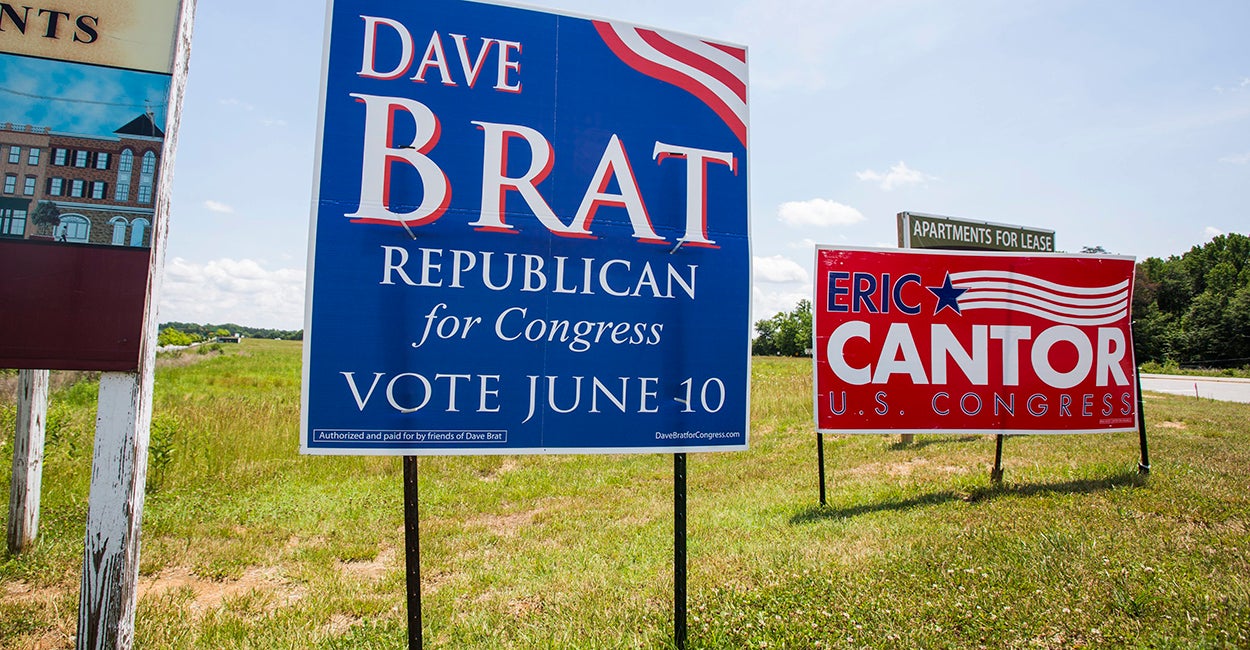
Money can’t guarantee an outcome in an election. As we saw this week, the person with the most money does not automatically win.
Underdog economics professor Dave Brat ousted six-term Congressman and House Majority Leader Eric Cantor in the Virginia primary, but it was not because campaign finance laws had “leveled the playing field.” Leading up to his 11 point defeat, Cantor spent more than $5 million on his campaign while Brat dropped only $123,000. In other words, Cantor had a tremendous financial advantage – but still lost. The “stunning” win for congressional hopeful Brat left people “in awe.” This was the first time in history that a challenger beat the House majority leader in a primary. It has been 20 years since the last majority leader or speaker lost reelection in the general election.
Cantor had a huge advantage over Brat because of his incumbency. Over the past forty years, 90 percent of House members have been reelected. It is already rare for incumbents, especially those in leadership, to lose, but Senator Tom Udall’s (D-MN) proposed amendment to give Congress the power to restrict the raising and spending of money in elections, would make it even rarer.
The advantages of incumbency are many. More often than not, challengers lack the name recognition, the political organization, and the experience of running a campaign that an incumbent possesses.
Because more money enables more speech, limiting the amount of money which may be spent would stifle challengers’ speech and allow sitting lawmakers to tie the hands of candidates and ordinary Americans who are trying to unseat them, as this Heritage report details. As the Supreme Court of the United States noted in Buckley v. Valeo, “virtually every means of communicating ideas in today’s mass society requires the expenditure of money.”
Those who claim the Supreme Court’s recent campaign finance decisions give the rich “more say in elections” are wrong. In fact, the majority of contributions that federal candidates raise are small donations below the individual contribution limits imposed by Congress. But the First Amendment protects individuals regardless of their economic status. As Hans von Spakovsky points out, “Some individuals may be financially able to contribute more overall, but the First Amendment doesn’t guarantee a level playing field—just the equal opportunity to speak, associate, and engage in political activity.” After all, it is “our law and our tradition that more speech, not less, is the governing rule,” as the Supreme Court stated in Citizens United v. FEC.
TRENDING ARTICLES


Amending the First Amendment would not “level the playing field.” Instead, it would force the teams to cut their players.


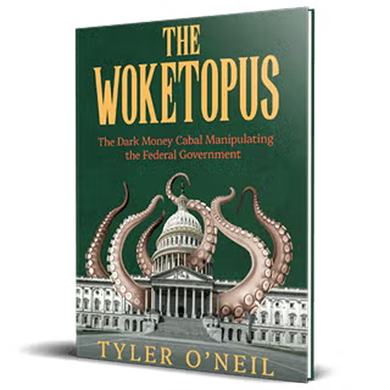
Read the first chapter of The Woketopus right now for FREE
Today, even with President Trump’s victory, leftist elites have their tentacles in every aspect of our government.
The Daily Signal’s own Tyler O’Neil exposes this leftist cabal in his new book, The Woketopus: The Dark Money Cabal Manipulating the Federal Government.
In this book, O’Neil reveals how the Left’s NGO apparatus pursues its woke agenda, maneuvering like an octopus by circumventing Congress and entrenching its interests in the federal government.
You can read the first chapter of this new book for FREE in this eBook, The Woketopus: Chapter One using the secure link below.



The Daily Signal depends on the support of readers like you.
RELATED ARTICLES





Don’t miss the

Don’t miss the signal