
Welcome to the eighth in our series “Landmark Speeches in American History.” We are celebrating America’s 250th anniversary with articles by prominent authors about how some of the greatest speeches in our history—by celebrated orators like Ronald Reagan, Abraham Lincoln, and Martin Luther King Jr.—honored the vision of our founding document, the Declaration of Independence.
Ronald Reagan’s Berlin Wall speech wasn’t supposed to happen the way it did: But it did happen, and as a result, it forever transformed world history.
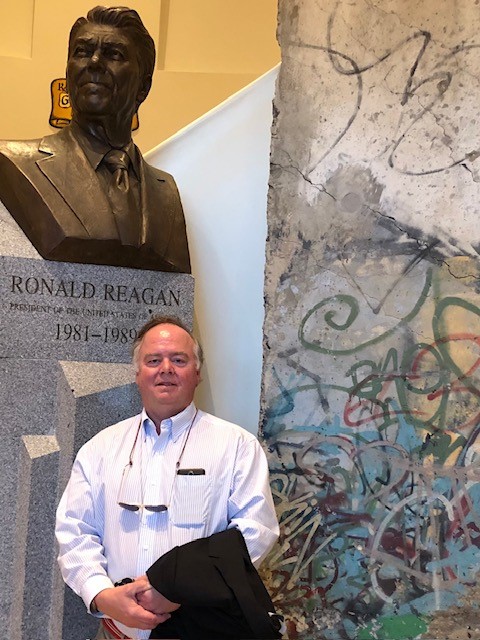
The whole matter of that history-altering speech played out in subsequent years. The German government refused to put a statue of Reagan on German property despite the fact that he freed millions behind the Iron Curtain and defeated the Soviet Union. So, the statue went up on U.S. Embassy property in Berlin instead.
Nor did it celebrate Reagan’s 100th birthday despite his great work for the German people.
To read the full speech, click here.
One German politician knew his history when he said, “Ronald Reagan’s determination and clear message brought down the Iron Curtain in Europe. We should permanently remember this great friend of Germany in a prominent place.” He said reunification would not have been possible without Reagan.
TRENDING ARTICLES


However, his words fell silent. The Germans have never honored Reagan.
Some German politicians were known as being petty, in addition to other much more serious foibles. The old adage applied: “The problem with Germans is they are either at your feet or at your throat.”
The complexities involving the city of Berlin retrace to postwar Germany: how the Allies administered the country and the city.
The city was isolated as the Cold War was beginning to heat up. Berlin became a flashpoint in East-West relations. Millions of imprisoned people made their way to East Berlin, then successfully fled to West Berlin and freedom. The Soviets responded by closing the border thus dooming the hopes of millions more who did not want to live under the evil subjugation. Those who tried to escape were prosecuted by the Soviets.
The Truman Doctrine—first established by President Harry Truman—said that America and the West would oppose Soviet expansion by aiding threatened countries economically and militarily if necessary.
After World War II, the Allies, in their borderline wisdom, divided control over the city among the four principal allies. The U.S., Great Britain, and France would control West Berlin, and the Soviets would control East Berlin. The city itself was deep inside East Germany.
But to stem the tide of people fleeing Soviet slavery, the Soviets built a wall in August of 1961. It became the most tangible example of the struggle between East and West. On one side, there was slavery and deprivation as caused by the Soviet state, on the other side there was freedom and prosperity.
Back in 1963, the great anticommunist President John F. Kennedy spoke there, making clear his opposition to Soviet communism. Speaking to a huge audience, JFK outlined the struggle between the two economic states and, to show his strong support for the citizens of the city, said “as a free man, I take pride in saying ‘Ich bin Ein Berliner!’”
Millions went wild. Nonetheless, the wall—unfortunately—stood for many more years.
The Reagan Doctrine took Truman’s Doctrine one step further and said the U.S. would not only oppose Soviet expansion, but that it would aid democratic movements that were developing in Soviet-occupied territories.
Reagan, as always, was on offense.
Previous presidents such as Richard Nixon, Gerald Ford, and Jimmy Carter had pursued détente policies with the Evil Empire—basically slow-motion surrender.
Reagan rejected détente outright.
President Ronald Reagan spoke at the Berlin Wall on June 12, 1987, with a backdrop of the Brandenburg Gate.
Reagan’s original speech, drafted by Reagan speechwriter Peter Robinson, was a tough denunciation of Soviet communism and the wall separating communist East Berlin from free West Berlin. Robinson knew Reagan, the tough anticommunist, would appreciate the draft speech
Reagan’s original speech contained many hard-hitting descriptions of Soviet communism, but, as in all foreign policy draft speeches, the bureaucrats at the State Department reviewed the remarks before they were given.
As could have been expected, the “striped pants set” at the department deleted all of the tough comments in Reagan’s remarks. However, Reagan did not back down; he put the tough rhetoric back in. The State Department took it out again. Reagan put it back. At one point he stormed, “I’m the president, aren’t I?”
They submitted alternative draft speeches, which Reagan rejected. He was determined to give the original speech drafted by Robinson, throwing everything he had at the Soviets—including the bully pulpit.
And he did.
“Mr. Gorbachev, tear down this wall!”
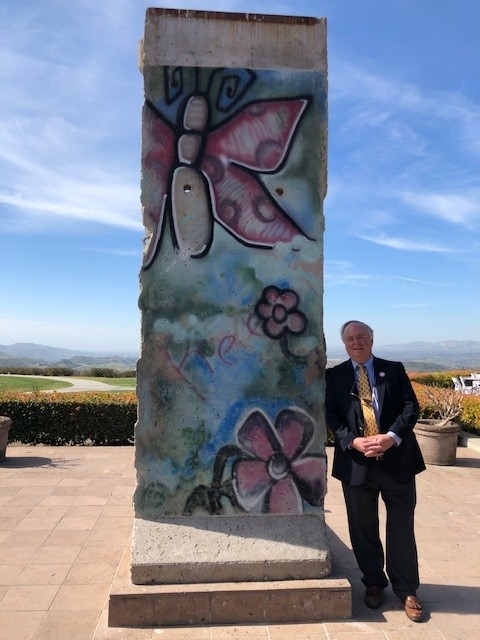
And now, in a final piece of justice, freedom and the defeat of communism, a large piece of the Berlin Wall stands at the Reagan Library in Simi Valley, California. It is a lasting reminder of Reagan’s history-altering speech and the greatness of the man.
We publish a variety of perspectives. Nothing written here is to be construed as representing the views of the Daily Signal.


Read the first chapter of The Woketopus right now for FREE
Today, even with President Trump’s victory, leftist elites have their tentacles in every aspect of our government.
The Daily Signal’s own Tyler O’Neil exposes this leftist cabal in his new book, The Woketopus: The Dark Money Cabal Manipulating the Federal Government.
In this book, O’Neil reveals how the Left’s NGO apparatus pursues its woke agenda, maneuvering like an octopus by circumventing Congress and entrenching its interests in the federal government.
You can read the first chapter of this new book for FREE in this eBook, The Woketopus: Chapter One using the secure link below.

The Daily Signal depends on the support of readers like you.
RELATED ARTICLES



Don’t miss the

Don’t miss the signal
