






























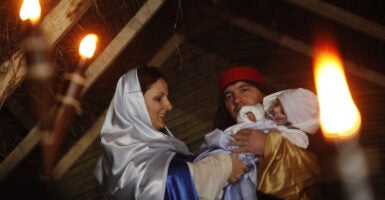
The time leading up to the celebration of Christmas Day is often chaotic. Families are frantically finishing up their final shopping and gift wrapping. Traffic increases and patience seems to run thin as we rapidly approach the celebration of the birth of God in time.
However, it also teaches us a tremendous amount about the power of marriage.
In the words, witness, and experience of Mary and Joseph, we can learn how to gain a healthier view of marriage as well as craft practices that will truly impact the most important relationship that a human being can have with another human being.
Mary and Joseph provide the blueprint for how to love one’s spouse abundantly, respect him or her passionately, and trust in God lavishly.
Before we investigate the power of their witness, let’s first take a look at the state of marriage in America. According to Bowling Green University, “There were 2,315,440 marriages and 989,518 divorces (in 2022), both of which are increases from the counts from 2021 (2,052,806 and 948,862 respectively).” For every 2.34 marriages, there was one divorce.
Remaining married truly depends on the value one places on their spouse. Studies show that “the odds of a stable marriage increase when a spouse is committed, protective, religious and romantic.”
Two of the critical characteristics for a fulfilling marriage (commitment and religiosity) have deep ties to the moral life—hinting that learning from those who have been most committed and religious can only strengthen marriage bonds today.
Mary and Joseph exhibit more holiness and commitment than any marriage in history.
In antiquity, there were two stages of marriage. The first was betrothal, where the man and woman were married but not yet living together. Then, after a period of time, they would move into the same home and begin their life together.
Mary is a teenager when the angel Gabriel appears to her. She is betrothed (married but not yet living with) a man named Joseph.
When she is alone, an angel invites her to be the Mother of God. Her response is one of utter abandonment and trust in the will of God. Mary notes that she is the “handmaid of the Lord” (Luke 1:38). Her life will be at the service of God.
What God says and what He asks of her is for her good, so she will always follow it. She is like a glove (a handmaid) that God has placed on His hand.
Through her, God will act in the world in a real and definitive manner. She allows herself to be used by God. Not in the way that we use a tool. She is no object. She is the holy vessel by which God will enter the world.
Mary was defined by her complete giving over of herself to God. Through this commitment, and God’s grace, she was able to be the best wife and mother possible. Her faith made her love for Joseph and Jesus stronger.
She saw that her marriage was not merely a human decision of what she desired but a sacred covenant that mirrored the love God had for her. She abandoned herself to this fact and her marriage and motherhood blossomed because of it.
Abandonment was also required of St. Joseph.
Joseph finds out that Mary is having a baby, and they are not living together. The only thought could be that she was unfaithful to him. It is then that an angel appears to him in a dream and tells him that Mary conceived through the power of God.
In this one moment, Joseph decides to abandon his future to the word of Mary and the word of the angel. He gives over his entire heart to serving the Mother of God and Jesus Christ simply because he was told to.
We are told that “When Joseph awoke, he did as the angel of the Lord had commanded him” (Matthew 1:24). He and Mary married.
The Greek word used for “commanded” is prosetaxen, which literally means “to go to one’s station.” For the rest of his days, he never doubted that Mary had told the truth. He took it to heart that this was the Son of the Most High God and he took up his station to love her and Jesus.
The commitment and faith of Mary and Joseph define their marriage. In a culture that is quick to applaud those who desert their marriage because they don’t feel in love, commitment is needed now more than ever. Because marriage is not simply a contract between two people who agree to remain together if they choose it. Marriage is a sacred covenant that is unbreakable. The only way for such a supernatural reality to flourish is to rely on God.
In the Catholic classic on marriage, “Three to Be Married,” Archbishop Fulton Sheen communicates this truth beautifully. Sheen wrote: “How can one love self without being selfish? How can one love others without losing self? The answer is: By loving both self and neighbor in God. It is His Love that makes us love both self and neighbor rightly.”
The best way to ensure you love your spouse as he or she deserves is to love God more. It is then that we can live out our commitment in a way that is not giving honor to the bare minimum of remaining together but overflows into loving one’s husband or wife as God loves them: unconditionally.
For it is the unconditional love of God that breaks through as a person in Jesus Christ. It is Jesus born of Mary and guarded by Joseph in the manger that can heal our marriages and form them into a love that goes above and beyond. Because all marriages desire to be stronger.
So, mirror Mary and Joseph—and find that commitment and faith lead to a relationship of love reflecting God’s love to the world. It is this love that all marriages are called to reflect.
We publish a variety of perspectives. Nothing written here is to be construed as representing the views of The Daily Signal.

