

Summary
- Cognitive warfare goes beyond brainwashing by altering how individuals make decisions.
- Adversaries exploit social media algorithms to manipulate users and advance their own objectives.
- Policymakers must recognize these sinister efforts and develop effective countermeasures to protect Americans.
You may never have heard of cognitive warfare, but that doesn’t mean it isn’t impacting your life. Cognitive warfare is similar to brainwashing, but it is much more sinister and has resulted in lethal effects. Case in point: the Japanese death cult Aum Shinrikyo’s sarin gas attack of 1995. Beyond the headlines of the time was an effective use of cognitive warfare, which manipulates and alters human decision-making to advance an adversary’s objectives.
Today, one doesn’t need to be in a death cult to fall victim to cognitive warfare. It’s taking place on social media, and all users are vulnerable.
But the sarin gas attack of 1995 is an important case study that can help us to recognize how vulnerable our chronically online society has become.
Aum Shinrikyo’s members believed that they had a social responsibility to commit acts of destruction. The group’s leader, the blind Shoko Asahara, used complex cognitive tools over time to manipulate his followers’ value structures on a neurological level.
Asahara’s most remarkable accomplishment was altering the value structures of a key police officer involved in investigating the organization. Hiroshi Nakamura, a well-regarded police officer, confessed to an attempted assassination of his commissioner general, Takaji Kunimatsu. During the subsequent investigation, the cognitive scientist Dr. Hideto Tomabechi recognized the telltale signs of a cognitive campaign targeting Nakamura.
TRENDING ARTICLES



Effective cognitive warfare campaigns take time to work, with most successful attempts being against the naïve or the young. The effort differs from simple brainwashing in that it operates at a subconscious level to alter neurological connections. As such, cognitive tools manipulate the brain’s emotional connections and distort them to alter people’s value systems. This differs from psychological operations because the goal is not merely altering perceptions but changing the way individuals make decisions.
Today, social media platforms have long been used by adversaries as a means of pushing disinformation. The Black Lives Matter movement, the Russia-Ukraine war, and the recent Brazilian elections have all been impacted by disinformation campaigns formulated to alter the perception of specific targets.
Americans have been aware of social media disinformation for years, but far less scrutiny has been applied to the question of whether more insidious cognitive warfare operations have also been perpetrated.
Two generations have now been raised while perpetually plugged into screens. Social media algorithms reward “ragebait”—posts that incense anger and outrage—because they maximize engagement. Sophisticated adversaries know this and flood social media with bot accounts that push content that supports their views.
Users may think they are exercising free will, but algorithms orchestrate what is trending and what shows up at the top of social media feeds, and adversaries exploit these algorithms.
Tomabechi recently published a book presenting his research on cognitive warfare. In it, he argues that the landscape of the brain can be manipulated to draw people to make decisions. He further argues that this can lead people to effectively be drawn into a world crafted by someone else.
The crucial questions are clear: How do we cure patients of such malign influence? How do we mitigate the effects and inoculate ourselves to the future of this warfare?
These questions are becoming particularly acute as AI’s presence becomes pervasive. It is important to understand how cognitive tactics can be disseminated and tailored to the individual for greatest effect. Malicious actors can use AI on social media in real time to adapt to an individual. Given the large-scale adoption of social media—billions of accounts globally—this threat can be replicated on a massive scale.
The iPhone was released in 2007. Ten years later, TikTok entered the digital scene, and with it an open door to nefarious cognitive warfare campaigns. Given its Chinese origins, TikTok provides a useful tool for cognitive warfare campaigns run in concert with the Chinese Communist Party’s United Front Work Department influence operations.
Could concerted manipulation of American perceptions be underway today? It’s hard to know for sure, but consider that amongst the general populace once anti-American views are now being mainstreamed. For example, positive views of socialism have grown from 36% to 43% since 2010. A recent study found that 42% of college students would rather live in a socialist country than a capitalist one.
Many students now face backlash from their professors for expressing dissenting beliefs, and some college campuses have instituted “free speech zones,” designed to dictate where students can exercise their constitutional rights.
But are policymakers even aware this is happening?
Foreign and domestic adversaries are able to use digital platforms to access large, connected populations. In the case of TikTok, China feeds desensitizing information to certain audiences while keeping educational content in the feeds of its own people. To combat this, some countries, such as India, have placed bans on TikTok.
Given the danger, it is imperative we do better in identifying when a cognitive assault is being waged and what its target is—and employ countermeasure. One early adopter of such countermeasures is Japan’s Ministry of Defense.
There is an urgent need to identify and defend against cognitive warfare efforts being waged by American adversaries. These sinister efforts seek to undermine core American principles and values.

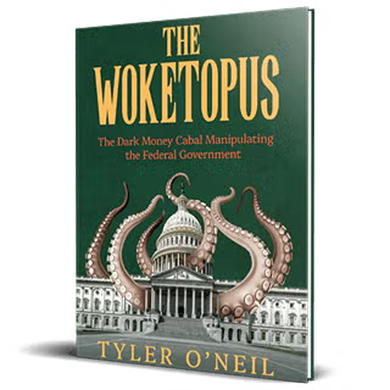
Read the first chapter of The Woketopus right now for FREE
Today, even with President Trump’s victory, leftist elites have their tentacles in every aspect of our government.
The Daily Signal’s own Tyler O’Neil exposes this leftist cabal in his new book, The Woketopus: The Dark Money Cabal Manipulating the Federal Government.
In this book, O’Neil reveals how the Left’s NGO apparatus pursues its woke agenda, maneuvering like an octopus by circumventing Congress and entrenching its interests in the federal government.
You can read the first chapter of this new book for FREE in this eBook, The Woketopus: Chapter One using the secure link below.

The Daily Signal depends on the support of readers like you.
RELATED ARTICLES





Don’t miss the

Don’t miss the signal