
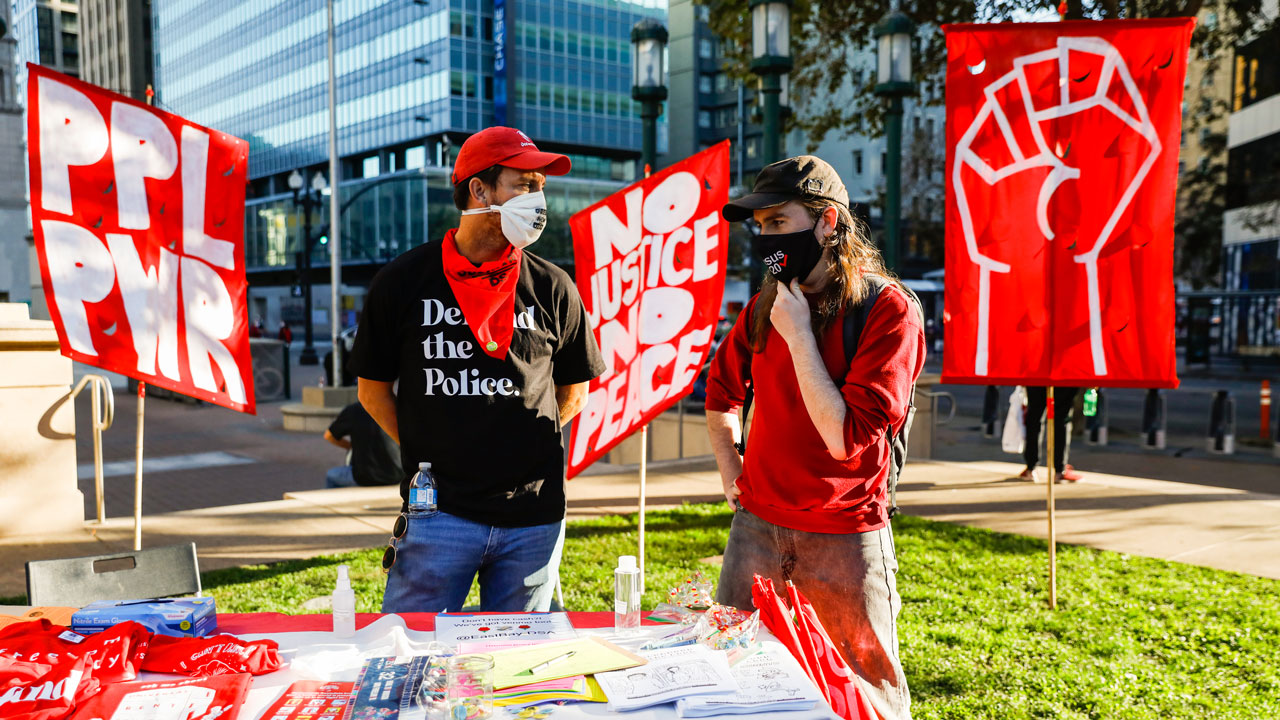
When Fox News’ Shannon Bream interviewed Megan Romer, the co-chair of the Democratic Socialists of America, about the DSA’s extremist manifesto, Romer confirmed that it includes abolishing the presidency, the Senate, the Supreme Court, Immigration and Customs Enforcement, the Pentagon, private ownership of companies, and national borders.
It also includes abolishing prisons, a goal that started in 2016 in the form of the progressive prosecutor movement.
Abolishing prisons is the predictable outgrowth of efforts by earlier radicals, including American Marxists and communists, to forever alter—indeed, to abolish—the American way of life as we know it.
The high priestess of the prison abolitionist movement is Angela Davis, who wrote, “Imagine a world without prisons,” in her bestselling diatribe “Are Prisons Obsolete?” Patrisse Cullors, a radical Marxist acolyte of Davis, went further, calling for “getting rid of police, prisons and jails, surveillance, and courts.”
Those are not throwaway lines. They are not rhetorical excesses from the fever swamps of academic conferences. They are the animating premises of a movement that has now migrated from radical pamphlets and law-school symposia into one of the most consequential offices in American public life: the elected prosecutor’s office.
The so-called progressive prosecutor movement, which my colleagues and I have written about extensively over the past several years, is better understood as the rogue prosecutor movement. It is the predictable outgrowth of decades of radical agitation aimed at delegitimizing the American criminal justice system, capitalism, constitutional self-government, and the rule of law.
TRENDING ARTICLES



Long before the first rogue prosecutor was hand-selected, financed, and installed in office, radical activists had argued for the abolition of capitalism, prisons, corporations, police departments, and courts. They demanded wealth redistribution, socialized medicine, reparations, and the wholesale transformation of American civil society.
For years, those ideas lived in the shadowy corners of the radical Left. Most Americans regarded them as so detached from reality as to be almost laughable. The mistake was assuming that ideas that are laughable cannot become dangerous.
They can. And they have.
The intellectual roots of this movement are abolitionist and Marxist. The central belief is that America’s core institutions are systemically racist and therefore cannot be improved; they must be dismantled. Everything is inherently racist: Capitalism. Police. Prisons. Courts. Prosecutors.
That is why the movement’s favorite words are not justice, accountability, victim, safety, or deterrence. Its vocabulary is “mass incarceration,” “carceral state,” “over-policing,” “decarceration,” “structural racism,” “school-to-prison pipeline,” and “shrink the justice system.”
These phrases were not manufactured by prosecutors trying cases, meeting victims, and working with police officers. They were nurtured by activists, academics, and donors who viewed the criminal-justice system not as a means of protecting the innocent and punishing the guilty, but as a machinery of oppression to be reverse-engineered and dismantled.
Davis’ call to “imagine a world without prisons” is foundational. So too is the abolitionist demand, echoed by Cullors and others, to eliminate the institutions that restrain lawlessness.
Their project is not merely to reduce prison populations or improve conditions of confinement. Their project is abolition. They equate prisons with slavery, capitalism with exploitation, and prosecution with racial control. Once one accepts those premises, the conclusion follows: the prosecutor who enforces the law is not a public servant but an impediment.
The rogue-prosecutor movement emerged when activists realized that they did not need to repeal criminal statutes if they could capture the official charged with enforcing them. Legislatures may pass laws. Governors may sign them. Citizens may expect them to be enforced. But if the prosecutor refuses to bring whole categories of cases, the law on the books becomes a dead letter.
That is prosecutorial nullification, and it is one of the movement’s core tactics. The national rise began in earnest around 2015, when activists and donors discovered that district attorney races were low-turnout, relatively inexpensive contests.
Most voters did not know who their prosecutor was, much less the philosophical stakes of the office. That civic ignorance created an opening. A handful of wealthy donors, including George Soros, political operatives, and criminal-justice activists could spend sums that dwarfed local campaign budgets, replace independent law-and-order prosecutors with defense-oriented candidates, and radically alter the operation of the criminal justice system without persuading legislatures or the public to change the law.
The playbook is now familiar.
First, identify a liberal city or county where the electorate is inattentive to prosecutor races.
Second, recruit a candidate who speaks the language of “reform” but is committed to a defendant-centered vision of prosecution.
Third, flood the race with outside money.
Fourth, demonize the incumbent as racist, punitive, or beholden to police.
Fifth, once elected, implement a package of policies that erodes law enforcement from within.
Those policies include refusing to prosecute entire categories of crime, eliminating or sharply limiting cash bail, downgrading charges, refusing sentencing enhancements, treating repeat offenders as victims of circumstance, undermining cooperation with police, and imposing office-wide mandates that substitute ideology for case-by-case judgment.
Some rogue prosecutors have fired experienced career prosecutors shortly after taking office, precisely because those professionals understood the duty of the office: to seek justice, protect the public, and enforce the law as written.
This is not prosecutorial discretion as traditionally understood. Real prosecutors exercise discretion every day. They decline weak cases. They evaluate evidence. They consider victims’ wishes, defendants’ criminal histories, constitutional violations, evidentiary problems, available diversion programs, and the circumstances of each case. That is judgment.
What rogue prosecutors practice is different. They announce in advance that whole categories of validly enacted laws will not be enforced. They do not exercise discretion; they repeal by refusal.
If a prosecutor may nullify drug laws, theft statutes, trespass offenses, gun enhancements, or bail provisions because he dislikes them, another prosecutor could nullify environmental laws, fraud statutes, hate-crime enhancements, or any other category of law. The principle is lawless regardless of the target.
The same ideological impulse explains the movement’s pro-criminal, anti-victim posture.
If criminals are primarily victims of capitalism, racism, poverty, policing, and prisons, then punishment becomes suspect and victims become inconvenient. The mother whose son was murdered, the shopkeeper whose business was looted, the elderly woman assaulted in the street, the commuter robbed on the train—each is subordinated to the movement’s preferred defendant-centered narrative.
The irony is cruel. The very communities the movement claims to champion often suffer the most from its policies. Residents of high-crime neighborhoods want what every American wants: safe streets, functioning schools, open stores, decent jobs, and the ability to raise children without fear. They do not want ideological experiments performed on their neighborhoods by billionaire-funded activists or academics insulated from the consequences of disorder.
The stakes could not be higher.
When prosecutors refuse to prosecute, police pull back, victims stop cooperating, criminals learn that consequences are negotiable, and neighborhoods decay. Stores close. Families leave. Schools suffer. Public transportation is becoming less safe. The social fabric frays. Civilization is not destroyed all at once. It is eroded block-by-block, case-by-case, policy-by-policy, until citizens conclude that either government cannot or will not perform its first duty: protecting the innocent from violence and disorder.
The antidote is not complicated.
Voters must pay attention to prosecutor races. Legislatures must defend their constitutional role. Governors and attorneys general must use lawful tools to check prosecutors who nullify statutes. Bar associations and courts must remember that the prosecutor’s duty is not to advance a revolutionary theory but to seek justice. And citizens must reject the lie that public safety and compassion are opposites.
America does not need prosecutors who imagine a world without prisons, police, jails, courts, surveillance, or accountability. It needs prosecutors who understand that justice requires moral clarity, constitutional fidelity, and courage.
The rogue prosecutor movement is abolition by other means. If Americans do not defeat it politically, legally, and intellectually, the movement will continue doing what its architects intended: dismantling the institutions that make ordered liberty possible—and with them, the safety and freedom of the communities they claim to serve.

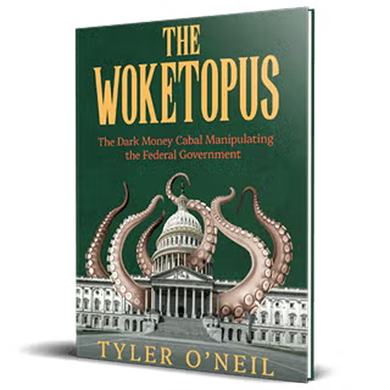
Read the first chapter of The Woketopus right now for FREE
Today, even with President Trump’s victory, leftist elites have their tentacles in every aspect of our government.
The Daily Signal’s own Tyler O’Neil exposes this leftist cabal in his new book, The Woketopus: The Dark Money Cabal Manipulating the Federal Government.
In this book, O’Neil reveals how the Left’s NGO apparatus pursues its woke agenda, maneuvering like an octopus by circumventing Congress and entrenching its interests in the federal government.
You can read the first chapter of this new book for FREE in this eBook, The Woketopus: Chapter One using the secure link below.
TRENDING ARTICLES


The Daily Signal depends on the support of readers like you.
RELATED ARTICLES





Don’t miss the

Don’t miss the signal