


















“Never be separated from the Americans.”
That was the advice Winston Churchill gave to his countrymen in the last meeting with his cabinet in 1955.
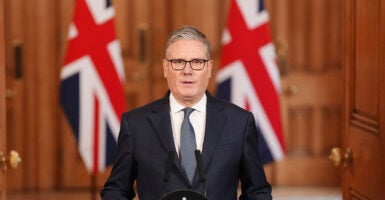
Unfortunately for the United Kingdom, current Prime Minister Keir Starmer has clearly ignored that advice. He appears to be doing his best to pull the plug and drain whatever is left of the once mighty and revered British Empire.
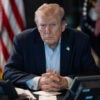
On Tuesday, while at a meeting with German Chancellor Friedrich Merz, President Donald Trump lambasted Starmer’s response to America’s ongoing military operation in Iran.
Trump said he was “not happy” with the U.K. for its initial decision to restrict U.S. access to launching strikes from the Diego Garcia base in the Chagos Islands.
Trump said that blocking the use of the base made it necessary for U.S. military aircraft to go on much longer and more difficult missions from elsewhere to conduct their strikes. He then went with the brutal putdown, “This is not Winston Churchill we are dealing with.”
I’ll say not.
Starmer ended up reversing his decision after Iran attacked a British military base in Cyprus. In some sense, that looks even more pathetic. Did he not see this coming?
This brutal monologue by Alex Phillips, a British journalist outraged by Starmer’s “leadership,” was absolutely perfect.
“It horrifies me to read that,” Phillips said of the Iranian attacks on British military personnel. “Our amazing armed forces deserve all the credibility, they deserve good resources, they deserve our full support, they deserve to be protected for crying out loud, and we were exposed out there. … And now France and Greece have to come to our rescue.”
Sad days indeed for the British to be hoping the French Navy can step in and bail them out. But maybe that’s necessary when this is the size of your mighty “fleet.”
Unfortunately, the disaster for Starmer and the U.K. goes beyond his hapless preparations for the Iran strikes.
Given the enormity of the current military operation in Iran, it’s easy to miss the extremely consequential changes happening in the relations between the U.S. and the U.K.
That Spain initially decided (then apparently un-decided) not to assist the U.S. is no real surprise. Spain’s ruling left-wing government appears to have the support of billionaire financier Alex Soros and has frequently been at odds with the U.S.
But the Anglo-American alliance has long been called the “special relationship,” for a good reason. Since the United States entered World War II, the two countries—united by a common language and a similar-enough culture—have typically worked closely together in war and peace.
Yet, Starmer has made a series of baffling and catastrophic decisions that have put his government at odds with Trump and the U.S. while weakening his country’s overall position in the world.
First, his government suspended some intelligence sharing with the U.S. as it struck narco-terrorists in the Caribbean in the lead-up to the extraction and arrest of Venezuelan President Nicolas Maduro. That was a significant move given that the U.S. and U.K. are members of the so-called Five Eyes intelligence-sharing alliance alongside Canada, Australia, and New Zealand.
The fruit of this decision and others is that Starmer seemed blindsided by the U.S. strikes on Iran.
His response was weak and vacillating, lawyerly in the worst way imaginable.
While Starmer seemed utterly paralyzed and inconsequential, a most consequential event took place that may seal the fate of the U.K. as even a middling power.
Major insurance companies began halting some of their coverage of ships traveling through the Strait of Hormuz.
Trump stepped in and announced on Truth Social that the U.S. Development Finance Corporation would step in and provide insurance, backed by the might of the U.S. military, of course.
Trump is obviously concerned about global economic stability, but this potentially signals a huge shift in the maritime shipping insurance market.
You see, while the British Navy has largely rusted out and the U.K. largely abandoned its territorial possessions, the country was still quite dominant in the extremely lucrative shipping insurance industry.
It has long been speculated that that British maritime insurance industry was buoyed by MI6 and British intelligence. What’s going to happen if the U.S. begins to withdraw its intelligence and moves into the market as the most reliable insurance provider?
Not great for the sleeping British Lion.
Our once invaluable ally is sinking into oblivion. Starmer’s government appears more concerned with appealing to the global Left and the rising Muslim voting bloc in his country than in defending its common interests or cultivating the relationship with its strongest ally.
Or maybe China has deeper tendrils into the highest levels of the U.K. government than it would admit.
If we’ve truly entered a new, post-“special relationship” era, Starmer is largely to blame for the bottom falling out. This comes at a time when the U.K. faces transformational and increasingly toxic demographic changes and a shameful retreat from free speech.
Meanwhile, Trump and the U.S. won’t stay still. America will move on and work more closely with better, stronger, and more reliable allies if that’s what needs to be done.
This would signal a sad and undesirable undoing of a remarkable partnership that once held up the free world.

