




























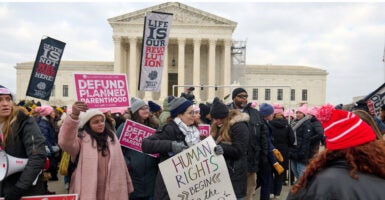
Fifty-three years ago, the U.S. Supreme Court handed down one of its most consequential and controversial decisions: Roe v. Wade.
That Jan. 22, 1973, decision would not make it to its 50th birthday. Its victims, an estimated 63 million of them, however, would never reach the age of 1.
As a result of the decision handed down on Jan. 22, 1973, abortion became legal in all 50 states. Doe v. Bolton, a decision handed down that same day, signaled that women could obtain an abortion for pretty much any reason, given how purposefully vague the health exceptions were.
Roe wasn’t merely wrongly decided due to its enormous ramifications and controversial nature, but also because it was not legally sound. The justices based their decision on a “penumbra,” or a feeling about what the Constitution says about the right to privacy. The court first used the penumbra style of reading the Constitution in the 1965 case Griswold v. Connecticut. The court expanded it to abortion with Roe.
The Roe decision divided pregnancy into three trimesters. Although abortion had to remain legal during the first trimester, states could regulate abortion in the second trimester. During the third trimester, states could ban abortion with exceptions for the life of the mother or even just her health. That health exception could mean whatever a woman and her doctor said it meant.
America thus held the distinction of being one of only a few nations where elective abortion was allowed past 20 weeks, halfway through pregnancy.
Since that tragic day in 1973, the pro-life movement has worked to overturn the decision and protect unborn life.
Since the first anniversary of the Roe decision, pro-lifers have organized the annual March for Life in Washington, D.C. This year’s March for Life will take place on Jan. 23.
From the start, pro-abortion advocates have tried to pit women against their unborn children. But these marches show the pro-life movement cares for both a mother who finds herself considering an abortion and the child she is carrying. A constant theme at the March for Life has been to “Love Them Both.”
And the pro-life movement has loved them both. From pregnancy resource centers to post-abortion healing, the pro-life movement has been there for women and children at every turn.
The pro-life movement has secured some major political wins as well. Polling conducted each year by Marist/The Knights of Columbus continues to show that a majority of Americans support prohibiting taxpayer dollars from going towards elective abortions. That policy is passed each year as a budget rider known as the Hyde Amendment.
Because of this steadfast work, the age of Roe ended with the Dobbs v. Jackson Women’s Health Organization decision in 2022.
While Roe was the law of the land for close to 50 years, Dobbs overturned Roe, just as other cases have rectified historic injustices written by the court’s hand.
Such an effort shows that faith, determination, hope, and resilience do pay off.
Thanks to the Dobbs decision, Americans are able to decide the abortion issue at the state level. Abortion is now banned in 13 states, and many more have other limits that would not have been able to go into effect under Roe.
The hard work of the pro-life movement is certainly not over, especially as there are nine states without a gestational ban on abortion. Further, even red states, such as Ohio, allow for abortions later in pregnancy due to a state constitutional amendment passed in 2023.
Even if there’s more work to be done to end the scourge of abortion, the anniversary of Roe v. Wade in a post-Dobbs world feels more celebratory and less somber. America is that much more beautiful when it protects life, and is able to do so now that Roe is no longer the law of the land.

