
Summary
- Athenians built the Parthenon through persuasion, debate, and a democratic vote.
- It celebrated ordinary citizens with a dignity once reserved for the divine.
- Today, it reminds Americans to fiercely guard their own inherited liberty.
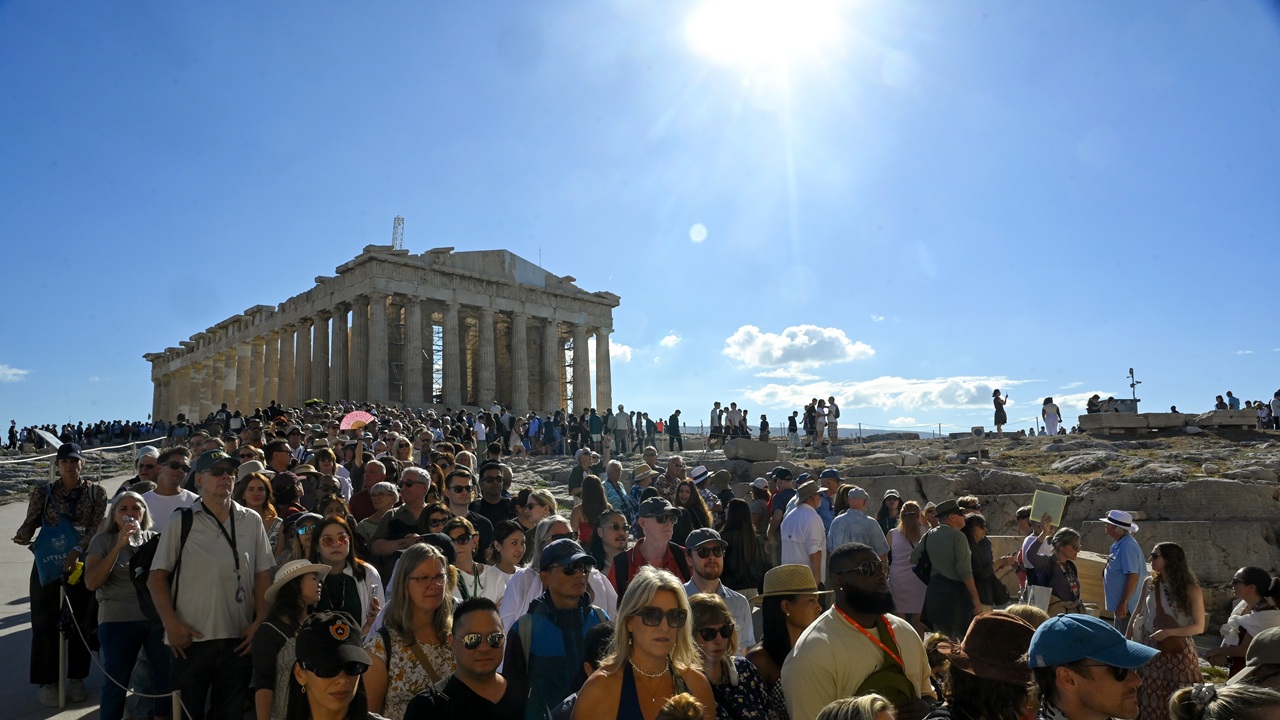
For 30 years after the Persians burned Athens in 480 B.C., the rubble sat untouched atop the city’s great stone Acropolis. The Greeks had sworn to leave it there as a reminder of what they had lost and what might come again. The great statesman Pericles, however, finally persuaded his fellow citizens that the ruins had served their purpose. What rose in their place, the Parthenon, has stood for nearly 25 centuries.
As Americans mark the 250th anniversary of our own experiment in self-government, it is worth remembering why.
The Parthenon is usually admired as an architectural masterpiece, which it is. But it was also the first great monument built by a democracy, paid for by a vote, and designed to memorialize the national identity of a free citizenry.
Pericles was Athens’ most powerful politician, but he was no king. He had no executive authority to spend public money; he could only persuade the Ecclesia, the assembly of citizens that met on the Pnyx below the Acropolis, to adopt his policies—in this case, building the Parthenon with the Delian Treasury, which was the collective wealth of the Greek city-states led by Athens.
When the building costs ballooned into a scandal, his opponents pounced. Plutarch records that they accused him of decking out Athens like a vain woman in jewels and temples, using money the city’s allies had contributed for their common defense. Pericles responded by offering to pay for it himself, and to put his own name on the temple. The assembly, suddenly picturing a monument to one rich man who might start thinking like a monarch, decided the city should pay after all.
TRENDING ARTICLES



It is a thoroughly democratic story: messy, contentious, a little cynical, and ultimately decided by the people. The result was a temple that belonged to Athens rather than to Pericles.
The building’s sculpture drove the point home. The west pediment, the first thing visitors saw as they climbed the hill, showed the city’s founding myth: Athena and Poseidon competing for the Acropolis, with the choice left to the people who lived there. Poseidon offered a salt spring; Athena the olive tree. The Athenians chose the useful gift over the impressive one.
In their own telling, Athenians had not passively received the patronage of the goddess. They had voted for her.
High inside the temple’s colonnade, a frieze depicted not gods or legendary heroes but Athenians themselves: the horsemen, maidens, and citizens of the Panathenaic procession, the city’s great civic festival. The legendary sculptor Phidias gave these mortals an idealized dignity once reserved for the divine, and gave the gods a new naturalism. This was the birth of the classical style that depicted man not as he was, but as he might aspire to be.
Pericles made the connection explicit. In the winter of 431 B.C., as Thucydides records, he delivered his funeral oration for the first Athenians killed in the war with Sparta.
Athens, Pericles said, was a pattern to others rather than an imitator; its government favored the many instead of the few; advancement came from merit, not class. And Athenians regarded debate not as an obstacle to action but as “an indispensable preliminary to any wise action at all.” The newly completed Parthenon looming over the city behind him was the visual proof of the city’s exceptionalism.
Pericles had created the paradigmatic classical temple that has come to embody democratic ideals, an achievement all the more remarkable when we consider the challenges he faced both personally and professionally.
His ambitions sparked a disastrous war with Sparta. Athenian democracy excluded women, rested on slavery, and could turn vicious; about 40 years after the Parthenon was completed, the city would condemn the great philosopher Socrates to death for impiety. Pericles’ successors exploited democratic procedures for their own ends, and within a generation Athens had lost its war and, eventually, its freedom. Socrates’ student Plato concluded with some cause that democracy was among the worst forms of government.
But even these failings cannot obscure the fact that the Athenians were the first to attempt what had never been tried: to govern themselves by persuasion rather than force, establishing the democratic model that would be continuously repeated in different forms for millennia in the West, from Rome to Venice to Florence to Holland to France to England and eventually to the United States.
America’s founders, who were well aware of this lineage, borrowed Greek columns for our public buildings not as mere decoration but as a visual claim of descent from the first free people, beginning with Nicholas Biddle’s Second Bank in Philadelphia—a commercial building designed as a Greek temple.
The Parthenon reminds us that liberty is not a natural condition. It was won by citizens who rose above their very human weaknesses to fight the Persians, sustained by those who argued in the assembly, and carved in marble so later generations would see what self-government could inspire.
Twenty-five centuries later, the building still stands as a reminder to fiercely guard our own liberty and prove ourselves worthy of what we have inherited.

Read the first chapter of The Woketopus right now for FREE
Today, even with President Trump’s victory, leftist elites have their tentacles in every aspect of our government.
The Daily Signal’s own Tyler O’Neil exposes this leftist cabal in his new book, The Woketopus: The Dark Money Cabal Manipulating the Federal Government.
In this book, O’Neil reveals how the Left’s NGO apparatus pursues its woke agenda, maneuvering like an octopus by circumventing Congress and entrenching its interests in the federal government.
You can read the first chapter of this new book for FREE in this eBook, The Woketopus: Chapter One using the secure link below.

The Daily Signal depends on the support of readers like you.
RELATED ARTICLES




Don’t miss the

Don’t miss the signal
