


























Most justices appeared skeptical of a federal law banning gun possession for illegal drug users and addicts during Supreme Court arguments Monday.
Intermingling gun rights and the war on drugs, the case has put the ACLU and the National Rifle Association on the same side, while President Donald Trump’s Justice Department is defending the existing law.
The case comes out of Texas, where a federal grand jury indicted Ali Danial Hemani, a marijuana user, in February 2023 for violating a law prohibiting firearm possession by a user of illegal drugs or a controlled substance. He sued to dismiss the indictment.
The federal prohibition is part of the 1968 Gun Control Act.
Sarah Harris, the principal deputy solicitor general, on Monday argued the law doesn’t infringe on the Second Amendment in part because of longstanding “habitual drunkard” laws that have been around since the Colonial era.
Those laws impose certain restrictions on individuals with addiction that could pose a danger to themselves or others, she noted.
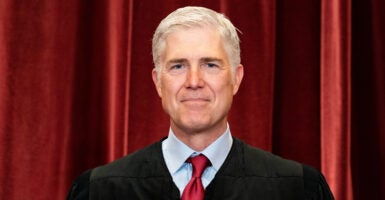
Justice Neil Gorsuch asked “whether this defendant would qualify as a habitual user.”
“The habitual drunkard, the American Temperance Society, back in the day, said has eight shots of whiskey a day, only made you an occasional drunkard,” he said. In the founding era, Gorsuch said, “you had to do double that.”
“John Adams took a drink of hard cider with his breakfast every day,” Gorsuch added. “James Madison reportedly drank a pint of whiskey every day. Thomas Jefferson said he wasn’t much of a user of alcohol; he only had three or four glasses of wine a night.”
“Are they all habitual drunkards who would be properly disarmed for life under your theory?” Gorsuch asked Harris.
Harris replied, “No,” adding of the defendant, “We know he uses marijuana a few times, about every other day.”
Harris later explained the law would apply to frequent users of harmful drugs, or those who are addicted.
“An addict is someone who has an uncontrollable urge to use the substance, regardless of whether they have access to any particular moment in time. You can be an addict and not be an unlawful user, because, for instance, you’re in treatment,” Harris said.
She added, “An unlawful user is someone judged by the objective criteria of their frequency of use and adding to someone who has an uncontrolled urge. They can overlap.”
The indictment said Hemani knowingly used illegal drugs while possessing a Glock 19 9mm pistol. The prosecution didn’t allege Hemani was intoxicated or using drugs at the time he possessed the firearm. Rather, prosecutors based their case on him being a regular drug user.
Hemani challenged the indictment. The U.S. District Court for the Eastern District of Texas granted the motion and dismissed the indictment, and the 5th U.S. Circuit Court of Appeals upheld the dismissal.
Other conservative Justices Amy Coney Barrett and Brett Kavanaugh on Monday questioned whether the laws on illegal drugs are applicable to the old “habitual drunkard” laws.
Justice Clarence Thomas also asked Harris how the laws she’s citing were different from older laws restricting the freedom of people who claimed to be fortune tellers.
Meanwhile, all three liberal justices seemed skeptical of the government’s argument, as Justice Sonia Sotomayor asked if this rationale would allow for violating the constitutional rights of homeless people.
Though later in the hearing, Chief Justice John Roberts pressed Hermani’s lawyer, Erin Murphy, about her arguments that the government should assess such matters on a case-by-case basis.
“If you take the principle underlying habitual drunkards, the concept that the statutes back then require is somebody drinking to such success that they can’t care for themselves or their affairs, that they’ve lost self-control, that they’re posing a public safety risk,” Murphy argued.
Roberts asked, “We’re going to assess those on a case-by-case basis, and apparently on an individual, by individual basis?”
Murphy responded the statute effectively calls for an individualized basis.
“You have to engage in an analysis of someone’s actual use to figure out whether they’re addicted to a controlled substance,” Murphy argued. “If the government wants to try to say a particular substance is so categorically addictive, dangerous, that you can’t use it regularly, OK, but it has to do that under the burden of proof.”
Roberts brought up older laws that prohibited firing a gun on New Year’s Eve and the current-day restrictions on taking a gun into a courthouse.
“It does indicate there’s some categories of views that were prohibited at the founding, whether it’s habitual drunkards, and in terms of the illegal use, based on particular individuals, or categories, or geographic limitations,” Roberts said.

