


























On Dec. 29, Washington, D.C., woke up to an array of news stories, but the one meriting greatest attention is China’s surprise military drills around Taiwan.
These drills are not merely exercises—they are full dress rehearsals for a blockade and invasion of Taiwan.
Deterring such an invasion and larger conflict is in America’s vital national interest—but one for which we are woefully unprepared.
The scale, intent, trigger, or even the duration of what the Communist Chinese are calling Justice Mission 2025 is still unfolding. What’s clear is that it is a massive air and maritime operation encircling Taiwan with a series of live-fire weapons drills.
The opening day saw Beijing send 130 combat aircraft and warships around the island, and a second-day launch of 27 ballistic missiles proximate Taiwan’s major ports in the north and south.
Indeed, Chinese military posters titled “Justice Hammer, Blockade and Disruption” give some insights into what China is practicing.
To this end, these military provocations levy economic damage given Beijing failed to make the obligatory notices disrupting fishing fleets, and commercial shipping and aircraft on the world’s busiest trade routes.
There is no excuse for China’s provocations, making arming Taiwan an urgent task.
In the final days of President Donald Trump’s first term, a key document of the Reagan era was declassified that detailed the so-called six assurances to Taiwan.
The provision of adequate military hardware is key to sustain the military balance to foster the peaceful resolution of the dispute across the Taiwan Straits.
Beijing, however, has engaged in a decades-long military buildup, greatly disrupting this balance, making necessary larger military sales to the island like the $11.1 billion arms deal recently agreed between Taipei and Washington, D.C.
The value of the deal is larger than all of the sales during the previous Biden administration’s four years. Such a deal critically includes 82 HIMARS launchers and 420 associated long-range (186 miles) ATACMs—a range that allows Taipei the ability to target Chinese logistics nodes across the straits.
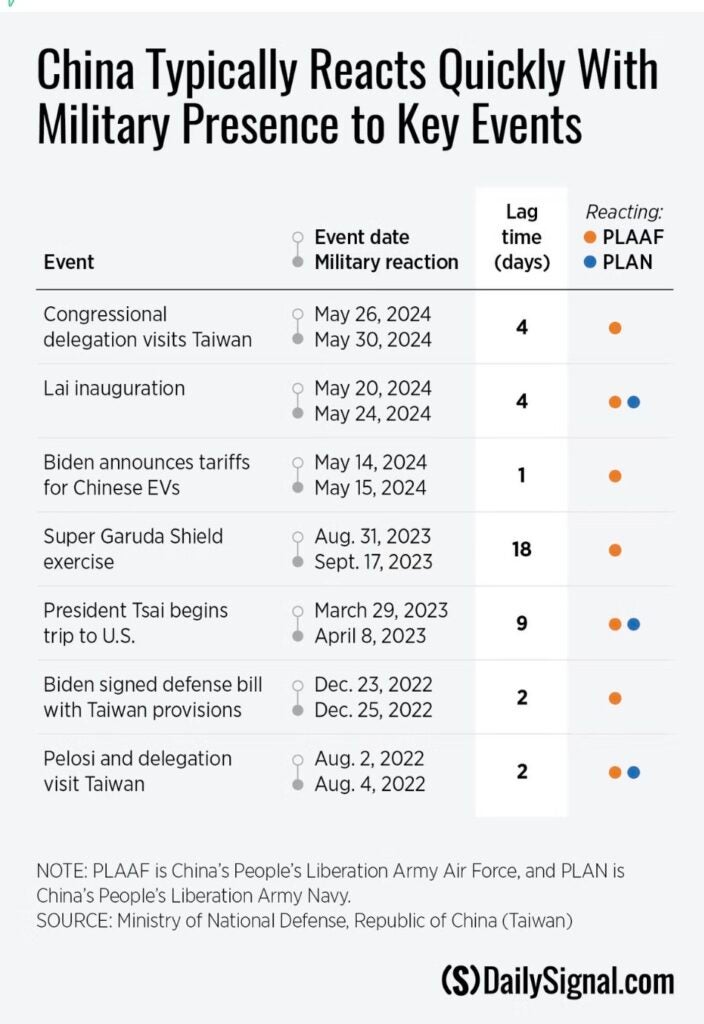
If this arms sale was the trigger for Justice Mission 2025, it took longer than expected when recent provocation cycles Beijing has responded within four days of an offense.
Beijing’s provocations also undermine a diplomatic opening being offered by Taiwan opposition party’s (the KMT) leader, who is seeking a goodwill trip to Beijing—an effort intended to bolster her party as the more responsible in stabilizing cross-straits relations.
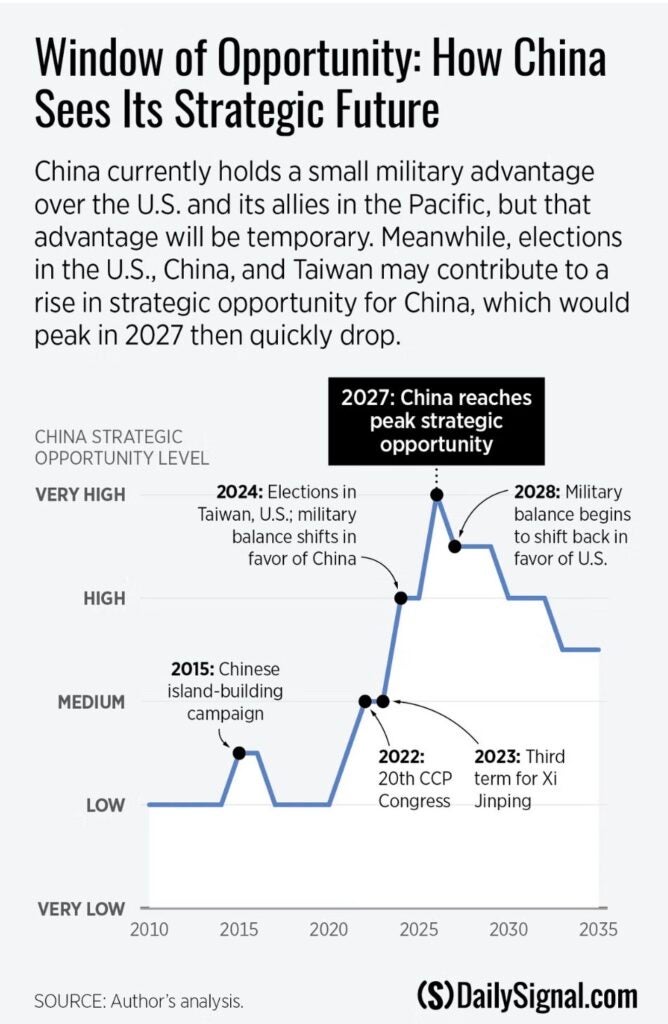
This now seems unlikely, especially with Secretary General Xi Jinping’s direction that his military be ready to fight a war over the fate of Taiwan by 2027.
So, what is known so far about Justice Mission 2025?
For one, this is the sixth massive military demonstration focused on encircling Taiwan since August 2022.
Justice Mission 2025 involves all Chinese military branches of the Eastern Theater responsible for executing any war against Taiwan—including rocket, naval, air force, and coast guard.
If past is prologue, Chinese military operations will last for several days before returning to average levels of military activity. During this time, expect new weapon systems to be demonstrated in live-fire exercises, such as the YJ-20 anti-ship ballistic missile fired from a Chinese destroyer on Dec. 28 with a range in excess of 1,000 miles.
Chinese military forces may also attempt to board and inspect vessels transiting the Taiwan Strait—a threat first leveled in April 2023 and since acted on against Taiwan’s shipping around its island of Kinmen.
Another troubling incident refuted by Taiwan is Chinese state media is drone video taken during Justice Mission 2025 of downtown Taipei.
If true, this drone very likely violated territorial airspace—a red line not crossed in over 67 years.
This would signal Beijing is much more willing to take risks, and closer to shedding blood than any time since the second Taiwan crisis of 1958.
Over 1,000 people were killed, several ships were sunk from both sides, and 31 Communist Chinese jets were shot down.
Should the current “exercises” by the Chinese military spiral into open hostilities, it is less clear how a large-scale war would be averted.
Unlike the third Taiwan crisis of 1996, the military balance is more in favor of Beijing than ever before.
The United States sent two carrier strike groups toward Taiwan as Beijing flexed its naval and rocket forces in an abortive effort to scuttle the election of Taiwanese President Lee Teng-hui—who Beijing viewed as pro Taiwan independence.
Today, the U.S. Navy has two carrier strike groups and an amphibious ready group nearby, as well as significant amounts of land-based aircraft stationed in Japan and Korea
While impressive, China has built up a capability to target U.S. forces within 1000 miles of the mainland under a withering fire of land-based, sea-launched and air-launched missiles.
Beijing has a fleet of 400 modern naval warships to America’s 290 and a rocket force that numbers in the thousands.
Should war come between China and a U.S.-led coalition to deny China from seizing Taiwan, it would exceed in intensity anything seen in Ukraine or the Middle East in recent years.
While such a war would be disastrous for everyone, Beijing for decades has been preparing for while America and its allies are only now coming to terms.
Deterring war today requires capacity and unexpected actions to knock Beijing off its timelines.
It is never too late to bolster U.S. and allied defenses to deter and, if necessary, prevail in what would be a long and very uncertain war.
War on this scale would not only determine the fate of Taiwan, but also America. For this reason, greater efforts to rebuild our defense industry, build warships, increase stockpiles of key munitions, and further integrate war planning with key allies in measurable ways is urgently needed in the coming months.
Justice Mission 2025 is a reminder China is preparing for war as America’s enemies undermine U.S. vital national interests and dismantle the entire international system that has benefited the American people for more than eight decades.
Platitudes will not deter aggressive dictators. Actions are all that matters. The question for 2026 is, will America be able to keep Asian tensions from boiling over?

