











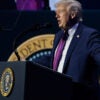
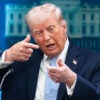





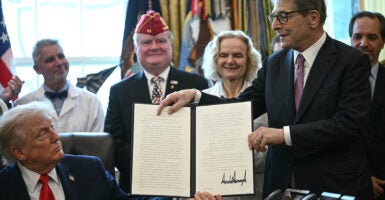
President Donald Trump signed an executive order on Thursday classifying marijuana as a less dangerous substance, despite concerns from GOP lawmakers that the move will “send the wrong message to America’s children.”
Trump signed an order changing the classification of marijuana from a Schedule I drug, which includes the most dangerous substances, such as heroin, LSD, and ecstasy, to a Schedule II drug, which the Drug Enforcement Administration describes as having “a moderate to low potential for physical and psychological dependence.”
“This reclassification order will make it far easier to conduct marijuana related medical research, allowing us to study benefits, potential dangers and future treatments,” Trump said. “It’s going to have a tremendously positive impact.”
The order also asks Congress to reconsider its classification of hemp-derived CBD to help seniors access CBD products.
“Some people are literally dying in there, dying with tremendous pain and this, in many cases, literally stops it,” he said, “and they have their senses about them, as opposed to painkillers, which don’t allow that don’t allow them to die with dignity.”
Rep. Pete Sessions, R-Texas, and House Freedom Caucus Chairman Andy Harris, R-Md., led 24 other members in writing a letter to Trump urging him to oppose the rescheduling of marijuana. Led by Sen. Ted Budd of North Carolina, 22 Republican senators did the same.
When The Daily Signal asked Trump how he’d respond to Republicans saying the order will normalize drug usage for youth, he said he’d “let one of the doctors respond to it, because they can do it a lot better than me.”
“But I can only tell you that when you see polls, 82% of the people want this,” he told The Daily Signal. “When I have friends that are really, really sick and they’ve gone through … I guess you could say … unfortunately, I don’t want to become too involved in it, because I don’t want it happening. But these are people that really know what’s going to, very smart people.”
“This is one of the most successful people in the country and a very brilliant guy,” he continued, pointing to cancer victim and philanthropist Howard Kessler. “And when they go through this horrible ordeal of cancer or other things, and they realize that this is something that makes them feel better without all of the side effects of some of the drugs, where you’re just totally knocked out and out of it. But I’d like to have one of the doctors maybe respond, because you people do it better than anybody.”
Nora Volkow, director of the National Institute on Drug Abuse under the Department of Health and Human Services, took over to respond.
“We have had cannabis scheduled for how long? And it hasn’t protected neither the adolescents nor the adults,” she said. “We have 20 million people in the United States with cannabis use disorder.”
“This is not legalizing it,” she continued. “It’s making easier to do research so that we can use it when it is indicated and optimal.”
This is an opportunity to do more research on cannabis to see “if it’s as good as many people say,” she said.
The House members told Trump, “Reclassifying marijuana as a Schedule III drug will send the wrong message to America’s children, enable drug cartels, and make our roads more dangerous.”
The senators said rescheduling marijuana endangers “America’s workplace and America’s roads,” and gives “a massive tax break to marijuana companies.”
Trump repeatedly said he doesn’t condone recreational drug usage, and that he will not use medical marijuana.
“I don’t want it,” he said. “I’m not going to be taking it, but a lot of people do want it, a lot of people need it.”
Heritage Foundation scholar Paul Larkin said the order increases the likelihood that more people will use marijuana.
“The real beneficiaries of today’s rescheduling decision are not Americans or patients suffering from pain, but the Chinese transnational criminal organizations, which control 75% of the illegal marijuana industry,” he said. “This means America’s enemy, the Chinese Communist Party, benefits as well.”
“An unsafe drug like cannabis cannot be placed in any category but Schedule I,” Larkin continued. “It’s up to policymakers to classify this harmful drug correctly.”

